 Add to Chrome
 Add to Firefox
 Add to Edge
Phoneme-based speech recognition driven by large language models and sampling marginalization
Dec 20, 2025
Recently, the Large Language Model-based Phoneme-to-Grapheme (LLM-P2G) method has shown excellent performance in speech recognition tasks and has become a feasible direction to replace the traditional WFST decoding method. This framework takes into account both recognition accuracy and system scalability through two-stage modeling of phoneme prediction and text generation. However, the existing LLM-P2G adopts the Top-K Marginalized (TKM) training strategy, and its candidate phoneme sequences rely on beam search generation, which has problems such as insufficient path diversity, low training efficiency, and high resource overhead. To this end, this paper proposes a sampling marginalized training strategy (Sampling-K Marginalized, SKM), which replaces beam search with random sampling to generate candidate paths, improving marginalized modeling and training efficiency. Experiments were conducted on Polish and German datasets, and the results showed that SKM further improved the model learning convergence speed and recognition performance while maintaining the complexity of the model. Comparative experiments with a speech recognition method that uses a projector combined with a large language model (SpeechLLM) also show that the SKM-driven LLM-P2G has more advantages in recognition accuracy and structural simplicity. The study verified the practical value and application potential of this method in cross-language speech recognition systems.

LLM-based phoneme-to-grapheme for phoneme-based speech recognition
Jun 05, 2025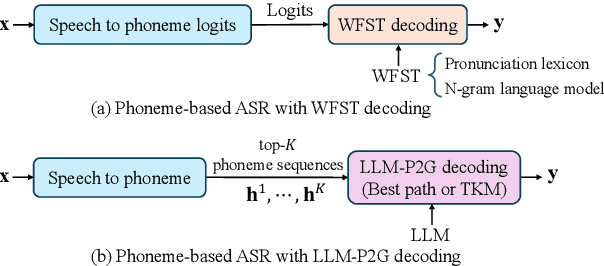
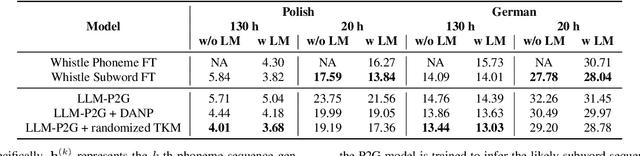
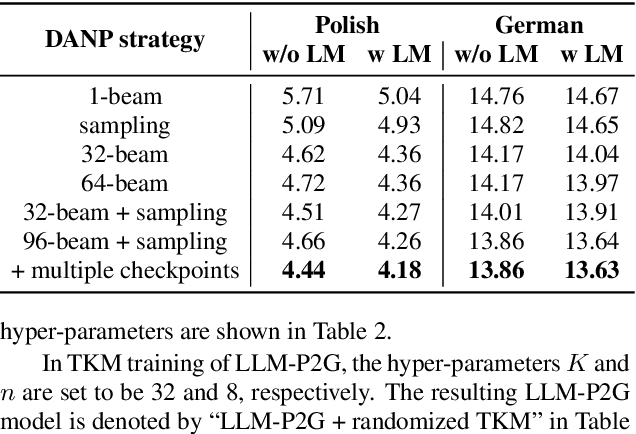
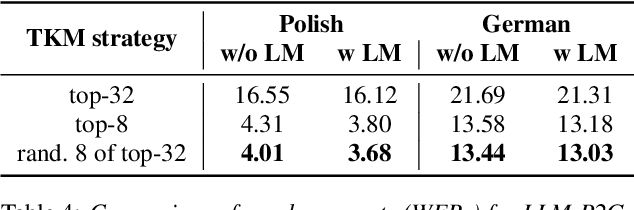
In automatic speech recognition (ASR), phoneme-based multilingual pre-training and crosslingual fine-tuning is attractive for its high data efficiency and competitive results compared to subword-based models. However, Weighted Finite State Transducer (WFST) based decoding is limited by its complex pipeline and inability to leverage large language models (LLMs). Therefore, we propose LLM-based phoneme-to-grapheme (LLM-P2G) decoding for phoneme-based ASR, consisting of speech-to-phoneme (S2P) and phoneme-to-grapheme (P2G). A challenge is that there seems to have information loss in cascading S2P and P2G. To address this challenge, we propose two training strategies: data augmentation with noisy phonemes (DANP), and randomized top-$K$ marginalized (TKM) training and decoding. Our experimental results show that LLM-P2G outperforms WFST-based systems in crosslingual ASR for Polish and German, by relative WER reductions of 3.6% and 6.9% respectively.
Whistle: Data-Efficient Multilingual and Crosslingual Speech Recognition via Weakly Phonetic Supervision
Jun 04, 2024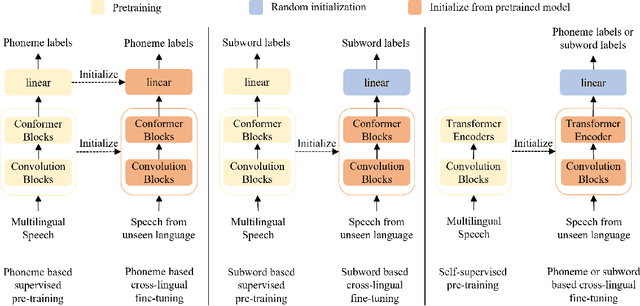
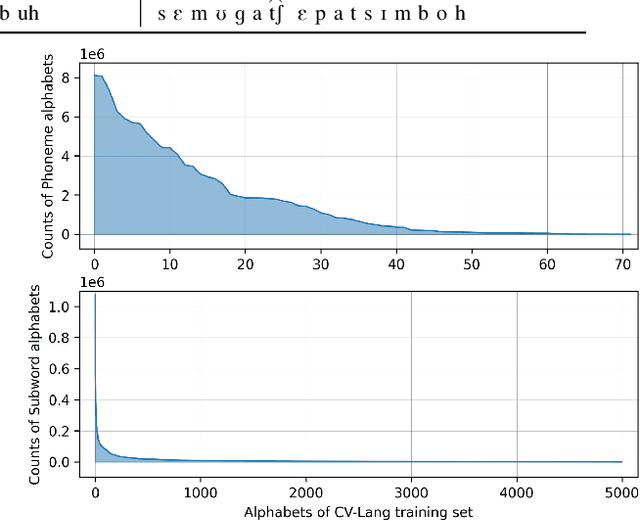
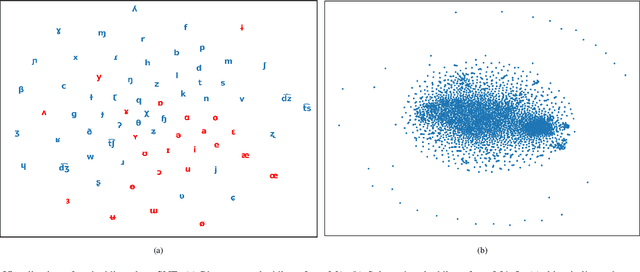
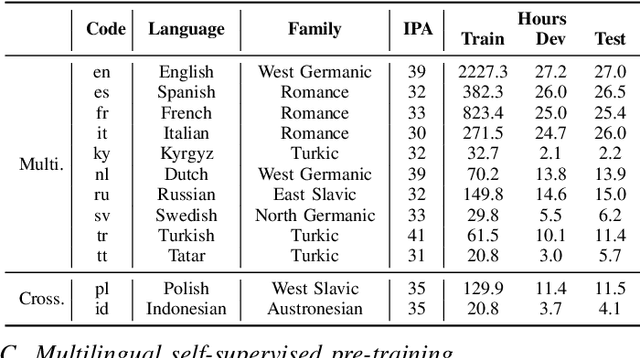
There exist three approaches for multilingual and crosslingual automatic speech recognition (MCL-ASR) - supervised pre-training with phonetic or graphemic transcription, and self-supervised pre-training. We find that pre-training with phonetic supervision has been underappreciated so far for MCL-ASR, while conceptually it is more advantageous for information sharing between different languages. This paper explores the approach of pre-training with weakly phonetic supervision towards data-efficient MCL-ASR, which is called Whistle. We relax the requirement of gold-standard human-validated phonetic transcripts, and obtain International Phonetic Alphabet (IPA) based transcription by leveraging the LanguageNet grapheme-to-phoneme (G2P) models. We construct a common experimental setup based on the CommonVoice dataset, called CV-Lang10, with 10 seen languages and 2 unseen languages. A set of experiments are conducted on CV-Lang10 to compare, as fair as possible, the three approaches under the common setup for MCL-ASR. Experiments demonstrate the advantages of phoneme-based models (Whistle) for MCL-ASR, in terms of speech recognition for seen languages, crosslingual performance for unseen languages with different amounts of few-shot data, overcoming catastrophic forgetting, and training efficiency.It is found that when training data is more limited, phoneme supervision can achieve better results compared to subword supervision and self-supervision, thereby providing higher data-efficiency. To support reproducibility and promote future research along this direction, we will release the code, models and data for the whole pipeline of Whistle at https://github.com/thu-spmi/CAT upon publication.