 Add to Chrome
 Add to Firefox
 Add to Edge
$α$-fair heterogeneous agent reinforcement learning
Jun 11, 2026
Cooperation in multi-agent systems is typically optimized through utilitarian objectives that maximize overall efficiency but fail to account for reward distribution, often resulting in inequitable "leader-follower" dynamics. While fairness-based approaches encourage pro-social behaviors where every agent benefits from cooperation, many current algorithms - including those utilizing reward shaping - break the stationarity of Markov Games or lack rigorous theoretical guarantees. This creates a critical gap between fair objective methods and theoretically safe learning frameworks. We propose a novel framework that bridges $α$-fairness with Heterogeneous-Agent Trust Region Learning (HATRL), ensuring monotonic improvement and convergence toward Nash Equilibria. Our approach leverages a fair advantage function that dynamically weights agent utilities based on their expected returns, allowing the global objective to transition from purely utilitarian efficiency to $α$-fairness welfare based on the parameter $α$. We introduce two practical algorithms, $α$-fair HATRPO and $α$-fair HAPPO, and demonstrate through experiments in sequential social dilemmas like CleanUp and CommonHarvest that they perform better than HATRL's algorithms from a utilitarian point of view while achieving socially higher outcomes.

Altruism and Fair Objective in Mixed-Motive Markov games
Feb 09, 2026Cooperation is fundamental for society's viability, as it enables the emergence of structure within heterogeneous groups that seek collective well-being. However, individuals are inclined to defect in order to benefit from the group's cooperation without contributing the associated costs, thus leading to unfair situations. In game theory, social dilemmas entail this dichotomy between individual interest and collective outcome. The most dominant approach to multi-agent cooperation is the utilitarian welfare which can produce efficient highly inequitable outcomes. This paper proposes a novel framework to foster fairer cooperation by replacing the standard utilitarian objective with Proportional Fairness. We introduce a fair altruistic utility for each agent, defined on the individual log-payoff space and derive the analytical conditions required to ensure cooperation in classic social dilemmas. We then extend this framework to sequential settings by defining a Fair Markov Game and deriving novel fair Actor-Critic algorithms to learn fair policies. Finally, we evaluate our method in various social dilemma environments.
Comparing a composite model versus chained models to locate a nearest visual object
Jun 02, 2023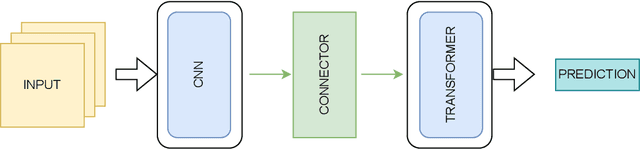

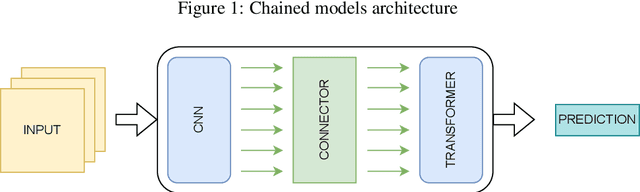
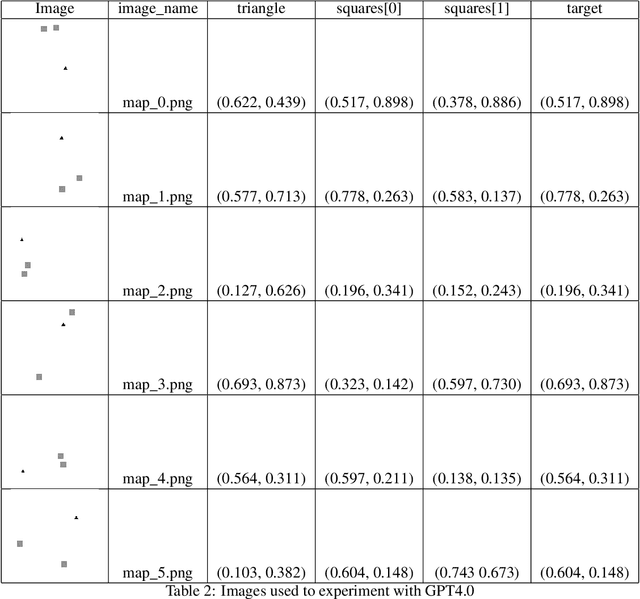
Extracting information from geographic images and text is crucial for autonomous vehicles to determine in advance the best cell stations to connect to along their future path. Multiple artificial neural network models can address this challenge; however, there is no definitive guidance on the selection of an appropriate model for such use cases. Therefore, we experimented two architectures to solve such a task: a first architecture with chained models where each model in the chain addresses a sub-task of the task; and a second architecture with a single model that addresses the whole task. Our results showed that these two architectures achieved the same level performance with a root mean square error (RMSE) of 0.055 and 0.056; The findings further revealed that when the task can be decomposed into sub-tasks, the chain architecture exhibits a twelve-fold increase in training speed compared to the composite model. Nevertheless, the composite model significantly alleviates the burden of data labeling.
Tackling Asymmetric and Circular Sequential Social Dilemmas with Reinforcement Learning and Graph-based Tit-for-Tat
Jun 26, 2022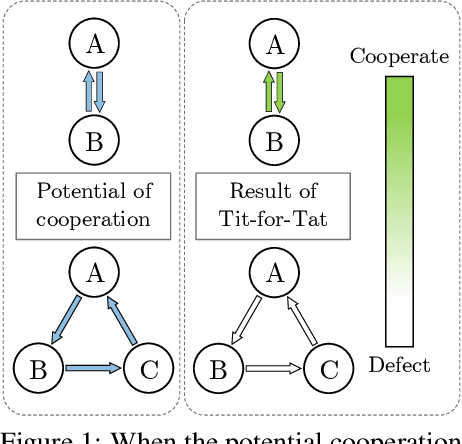
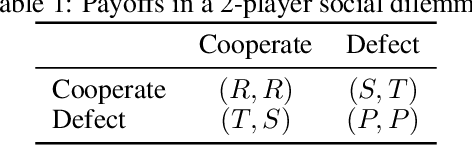
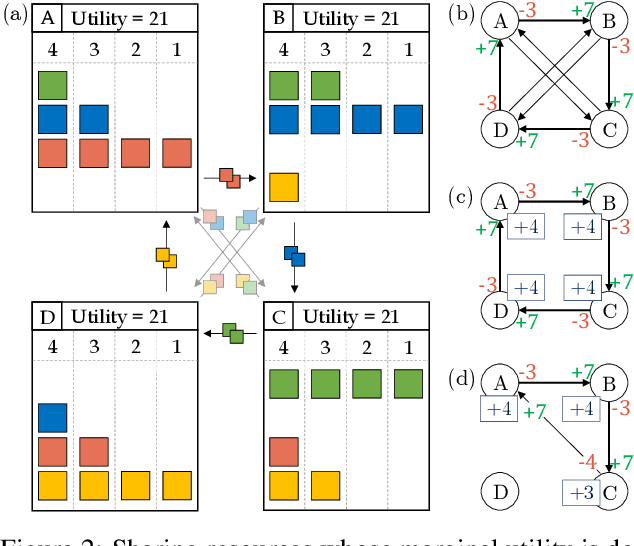
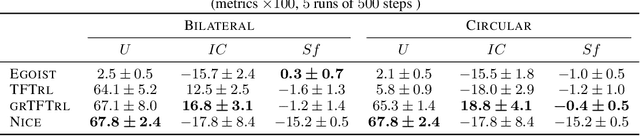
In many societal and industrial interactions, participants generally prefer their pure self-interest at the expense of the global welfare. Known as social dilemmas, this category of non-cooperative games offers situations where multiple actors should all cooperate to achieve the best outcome but greed and fear lead to a worst self-interested issue. Recently, the emergence of Deep Reinforcement Learning (RL) has generated revived interest in social dilemmas with the introduction of Sequential Social Dilemma (SSD). Cooperative agents mixing RL policies and Tit-for-tat (TFT) strategies have successfully addressed some non-optimal Nash equilibrium issues. However, this kind of paradigm requires symmetrical and direct cooperation between actors, conditions that are not met when mutual cooperation become asymmetric and is possible only with at least a third actor in a circular way. To tackle this issue, this paper extends SSD with Circular Sequential Social Dilemma (CSSD), a new kind of Markov games that better generalizes the diversity of cooperation between agents. Secondly, to address such circular and asymmetric cooperation, we propose a candidate solution based on RL policies and a graph-based TFT. We conducted some experiments on a simple multi-player grid world which offers adaptable cooperation structures. Our work confirmed that our graph-based approach is beneficial to address circular situations by encouraging self-interested agents to reach mutual cooperation.
Context-Aware Adaptive Framework for e-Health Monitoring
May 10, 2016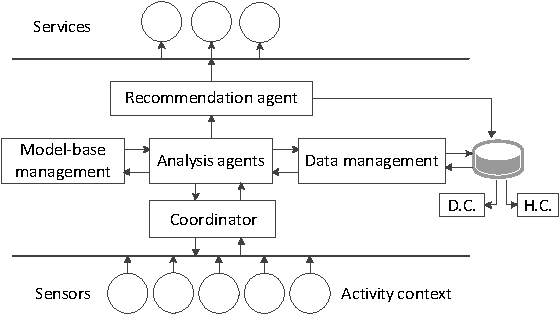
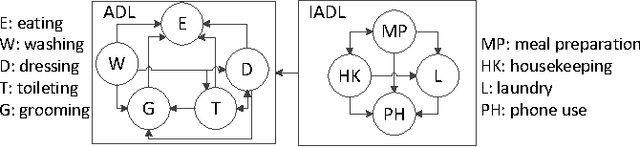
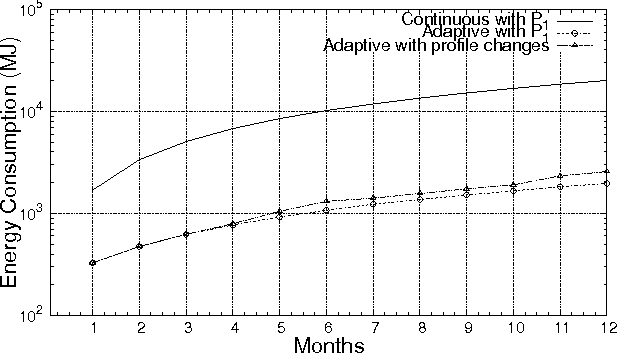
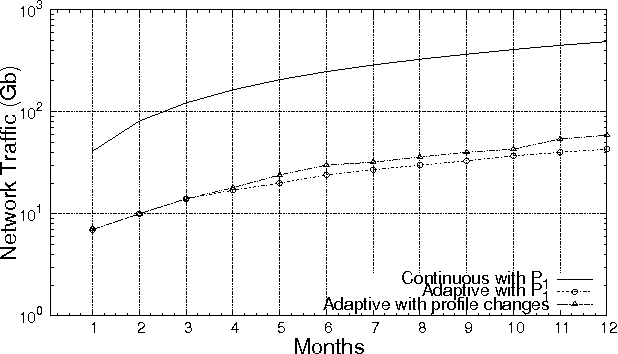
For improving e-health services, we propose a context-aware framework to monitor the activities of daily living of dependent persons. We define a strategy for generating long-term realistic scenarios and a framework containing an adaptive monitoring algorithm based on three approaches for optimizing resource usage. The used approaches provide a deep knowledge about the person's context by considering: the person's profile, the activities and the relationships between activities. We evaluate the performances of our framework and show its adaptability and significant reduction in network, energy and processing usage over a traditional monitoring implementation.
* 8 pages, Proceedings of the 11th IEEE Global Communications Conference (merged with the IEEE DSDIS2015), Sydney, Australi,11-13 December, 2015
A Markovian-based Approach for Daily Living Activities Recognition
Mar 10, 2016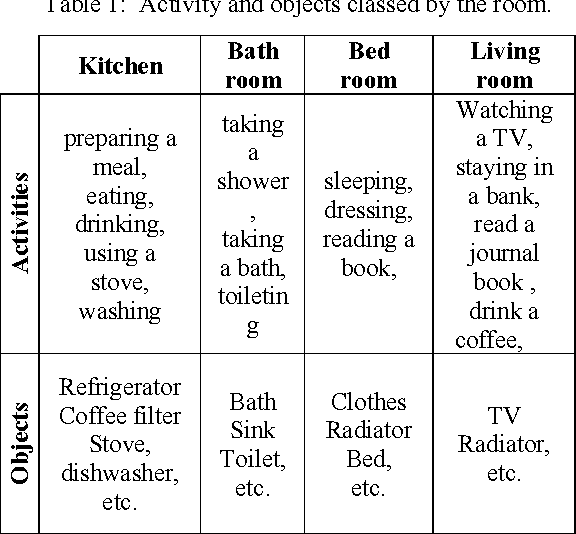
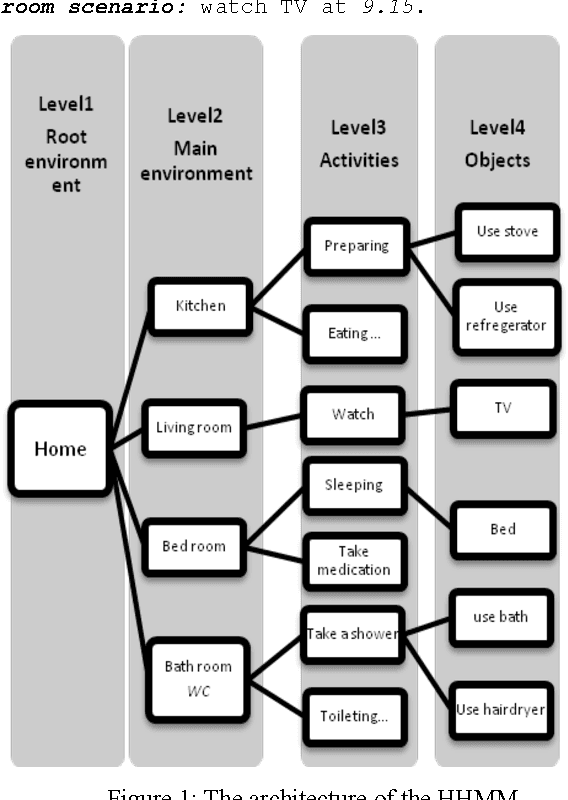
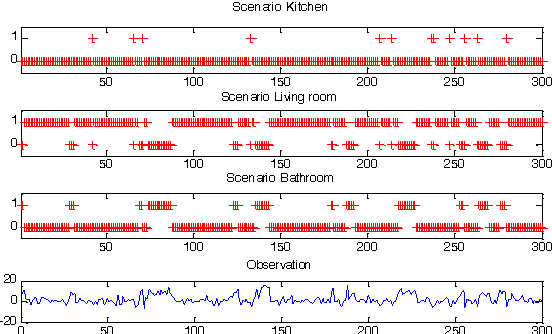
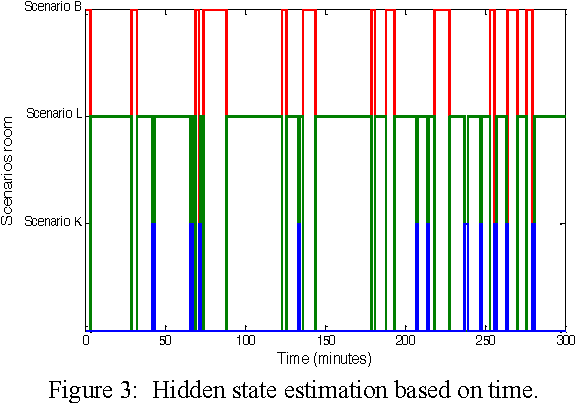
Recognizing the activities of daily living plays an important role in healthcare. It is necessary to use an adapted model to simulate the human behavior in a domestic space to monitor the patient harmonically and to intervene in the necessary time. In this paper, we tackle this problem using the hierarchical hidden Markov model for representing and recognizing complex indoor activities. We propose a new grammar, called "Home By Room Activities Language", to facilitate the complexity of human scenarios and consider the abnormal activities.