 Add to Chrome
 Add to Firefox
 Add to Edge
AI Outperforms Humans in Personalized Image Aesthetics Assessment via LLM-Based Interviews and Semantic Feature Extraction
May 14, 2026
Accurately predicting individual aesthetic evaluation for images is a fundamental challenge for AI. Various deep learning (DL)-based models have been proposed for this task, training on image evaluation data to extract objective low-level features. However, aesthetic preferences are inherently subjective and individual-dependent. Accurate prediction thus requires the extraction of high-level semantic features of images and the active collection of preference information from the target individual. To address this issue, we focus on the utility of Large Language Models (LLMs) pretrained on vast amounts of textual data, and develop an integrated DL-LLM system. The system actively elicits aesthetic preferences through LLM-based semi-structured interviews and predicts aesthetic evaluation by leveraging both low-level and high-level features. In our experiments, we compare the proposed system against conventional systems, human predictors, and the target individual's own re-evaluations after a certain time interval. Our results show that the proposed system outperforms all of them, with particularly strong performance on highly-rated images. Moreover, the prediction error of the proposed system is smaller than within-person variability, while human predictors show the largest error, likely due to the influence of their own aesthetic values. These results suggest that AI may be better positioned than others or one's future self to capture individual aesthetic preferences at a given point. This opens a new question of whether AI could serve as a deeper interpreter of human aesthetic sensibility than humans themselves.

Assessing the Aesthetic Evaluation Capabilities of GPT-4 with Vision: Insights from Group and Individual Assessments
Mar 06, 2024Recently, it has been recognized that large language models demonstrate high performance on various intellectual tasks. However, few studies have investigated alignment with humans in behaviors that involve sensibility, such as aesthetic evaluation. This study investigates the performance of GPT-4 with Vision, a state-of-the-art language model that can handle image input, on the task of aesthetic evaluation of images. We employ two tasks, prediction of the average evaluation values of a group and an individual's evaluation values. We investigate the performance of GPT-4 with Vision by exploring prompts and analyzing prediction behaviors. Experimental results reveal GPT-4 with Vision's superior performance in predicting aesthetic evaluations and the nature of different responses to beauty and ugliness. Finally, we discuss developing an AI system for aesthetic evaluation based on scientific knowledge of the human perception of beauty, employing agent technologies that integrate traditional deep learning models with large language models.
Shaping the Epochal Individuality and Generality: The Temporal Dynamics of Uncertainty and Prediction Error in Musical Improvisation
Oct 04, 2023
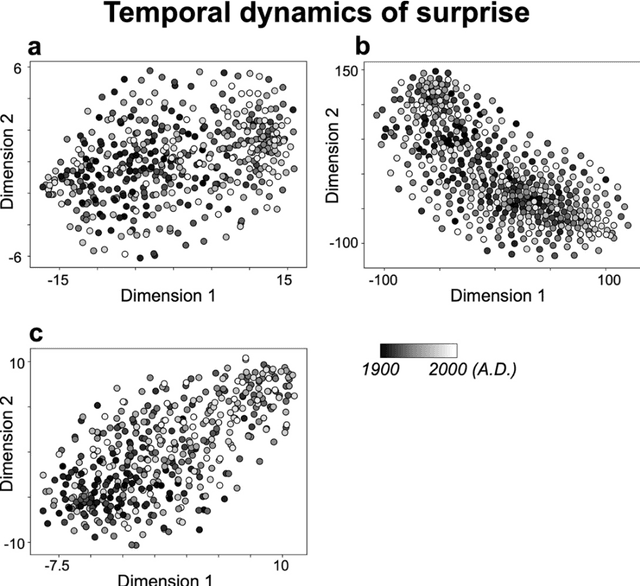
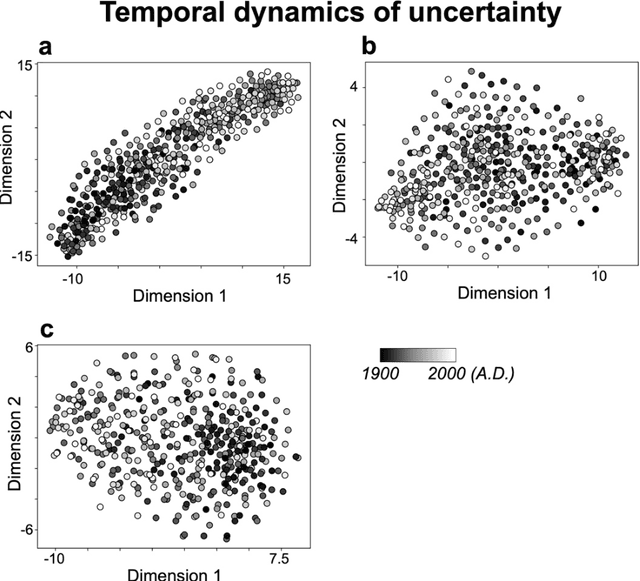
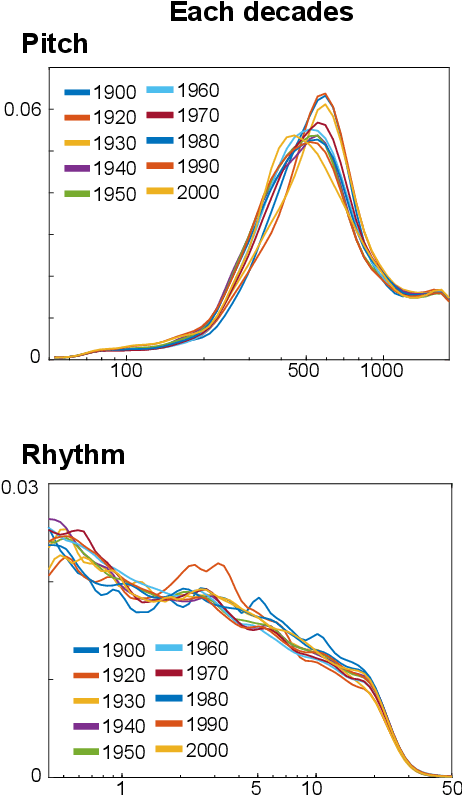
Musical improvisation, much like spontaneous speech, reveals intricate facets of the improviser's state of mind and emotional character. However, the specific musical components that reveal such individuality remain largely unexplored. Within the framework of brain's statistical learning and predictive processing, this study examined the temporal dynamics of uncertainty and surprise (prediction error) in a piece of musical improvisation. This study employed the HBSL model to analyze a corpus of 456 Jazz improvisations, spanning 1905 to 2009, from 78 distinct Jazz musicians. The results indicated distinctive temporal patterns of surprise and uncertainty, especially in pitch and pitch-rhythm sequences, revealing era-specific features from the early 20th to the 21st centuries. Conversely, rhythm sequences exhibited a consistent degree of uncertainty across eras. Further, the acoustic properties remain unchanged across different periods. These findings highlight the importance of how temporal dynamics of surprise and uncertainty in improvisational music change over periods, profoundly influencing the distinctive methodologies artists adopt for improvisation in each era. Further, it is suggested that the development of improvisational music can be attributed to the brain's adaptive statistical learning mechanisms, which constantly refine internal models to mirror the cultural and emotional nuances of their respective epochs. This study unravels the evolutionary trajectory of improvisational music and highlights the nuanced shifts artists employ to resonate with the cultural and emotional landscapes of their times.