 Add to Chrome
 Add to Firefox
 Add to Edge
Distilling Aggregate Mobility Statistics into a Language Model Policy for Post-Event Crowd Simulation
Aug 20, 2026
Pedestrian simulators need a behaviour rule for every agent, but privacy usually limits the data for setting one to aggregate statistics, namely zone-level device counts and origin-to-destination (OD) flows, with no individual trajectories. Such aggregates under-determine individual behaviour, because many different sets of decisions reproduce the same counts. We fine-tune a language model crowd agent so that the simulated population matches the observed destination composition, the fraction of the departing crowd heading to each point of interest. We read this target from the OD flow and reweight the model's own destination distribution onto it by iterative proportional fitting. Because fine-tuning inflates the dominant destination class, we fit the low-rank adapter to trajectories resampled to a corrected training composition that reaches the target after this inflation. On mobile network counts from two baseball games the fine-tuned agent runs without inference-time correction, cutting the destination-share error by 25%, while the grid correlation remains similar across policies.

MobText-SISA: Efficient Machine Unlearning for Mobility Logs with Spatio-Temporal and Natural-Language Data
Aug 27, 2025Modern mobility platforms have stored vast streams of GPS trajectories, temporal metadata, free-form textual notes, and other unstructured data. Privacy statutes such as the GDPR require that any individual's contribution be unlearned on demand, yet retraining deep models from scratch for every request is untenable. We introduce MobText-SISA, a scalable machine-unlearning framework that extends Sharded, Isolated, Sliced, and Aggregated (SISA) training to heterogeneous spatio-temporal data. MobText-SISA first embeds each trip's numerical and linguistic features into a shared latent space, then employs similarity-aware clustering to distribute samples across shards so that future deletions touch only a single constituent model while preserving inter-shard diversity. Each shard is trained incrementally; at inference time, constituent predictions are aggregated to yield the output. Deletion requests trigger retraining solely of the affected shard from its last valid checkpoint, guaranteeing exact unlearning. Experiments on a ten-month real-world mobility log demonstrate that MobText-SISA (i) sustains baseline predictive accuracy, and (ii) consistently outperforms random sharding in both error and convergence speed. These results establish MobText-SISA as a practical foundation for privacy-compliant analytics on multimodal mobility data at urban scale.
Privacy-preserving Pedestrian Tracking using Distributed 3D LiDARs
Mar 22, 2023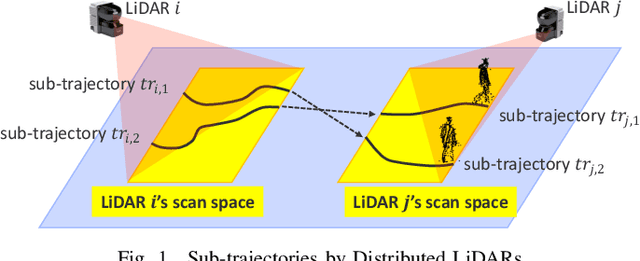
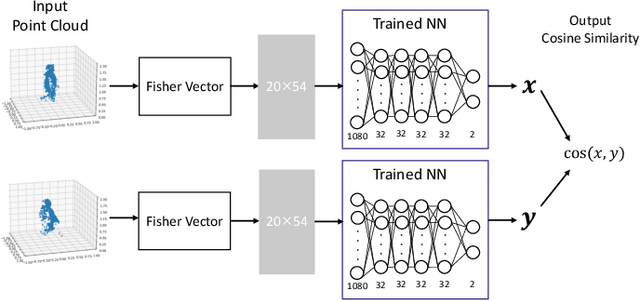
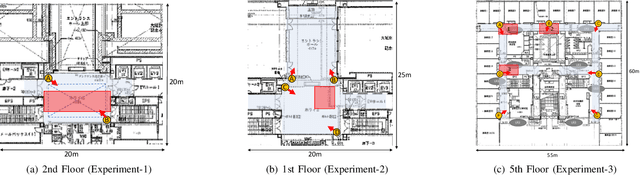
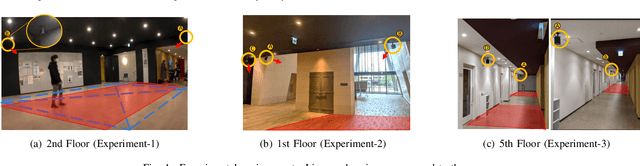
The growing demand for intelligent environments unleashes an extraordinary cycle of privacy-aware applications that makes individuals' life more comfortable and safe. Examples of these applications include pedestrian tracking systems in large areas. Although the ubiquity of camera-based systems, they are not a preferable solution due to the vulnerability of leaking the privacy of pedestrians. In this paper, we introduce a novel privacy-preserving system for pedestrian tracking in smart environments using multiple distributed LiDARs of non-overlapping views. The system is designed to leverage LiDAR devices to track pedestrians in partially covered areas due to practical constraints, e.g., occlusion or cost. Therefore, the system uses the point cloud captured by different LiDARs to extract discriminative features that are used to train a metric learning model for pedestrian matching purposes. To boost the system's robustness, we leverage a probabilistic approach to model and adapt the dynamic mobility patterns of individuals and thus connect their sub-trajectories. We deployed the system in a large-scale testbed with 70 colorless LiDARs and conducted three different experiments. The evaluation result at the entrance hall confirms the system's ability to accurately track the pedestrians with a 0.98 F-measure even with zero-covered areas. This result highlights the promise of the proposed system as the next generation of privacy-preserving tracking means in smart environments.