 Add to Chrome
 Add to Firefox
 Add to Edge
Less is More: Quality-Aware Training Data Selection for Scientific Summarization
Jun 23, 2026
Scientific long-document summarization datasets commonly treat author-written abstracts as gold reference summaries, although their quality and alignment with the source article vary. At the same time, publicly available scientific summarization datasets remain limited in scale and structure for modern long-context models. In this work, we address both challenges by a) constructing and releasing one of the largest biomedical and life science datasets for long-document summarization, containing 1.88 million PMC articles, and b) analyzing the reference quality of author-written abstracts with source-grounded and model-based metrics. We show that author-written abstracts vary in their alignment with the full article and that these quality signals can guide training-data selection. Training on selected high-quality subsets outperforms random sampling at matched training sizes and can match or exceed larger random subsets on factuality-oriented metrics. Our findings suggest that reference quality is an important factor in scientific summarization and that quality-aware data selection can improve training efficiency.

From Lengthy to Lucid: A Systematic Literature Review on NLP Techniques for Taming Long Sentences
Dec 08, 2023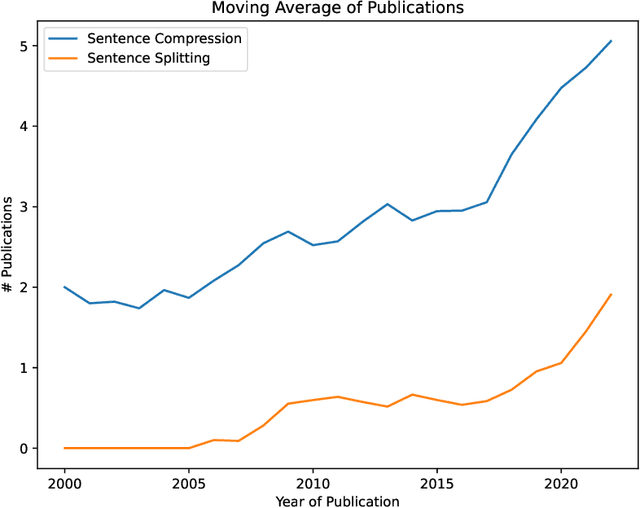
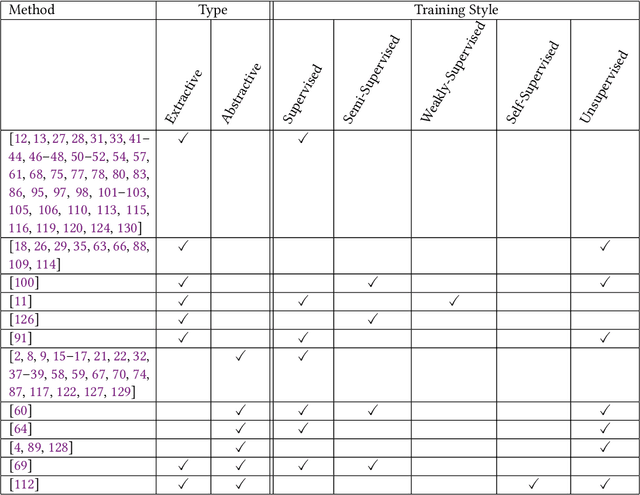
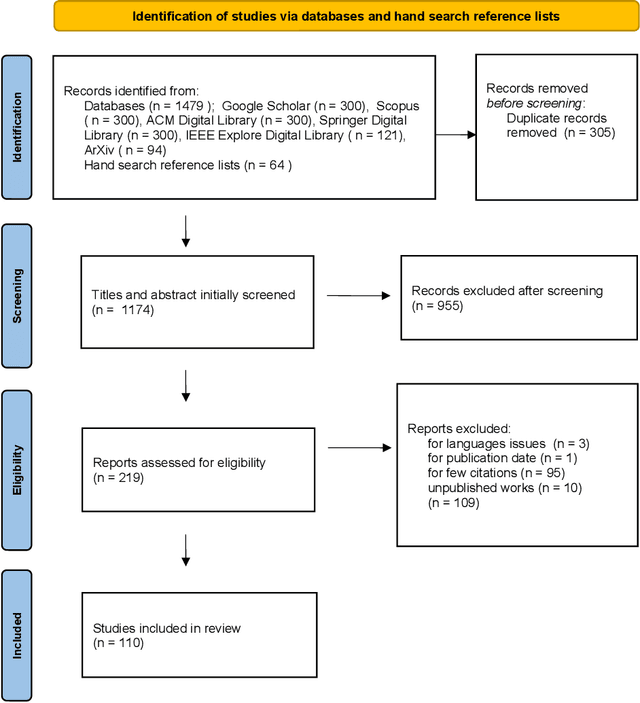
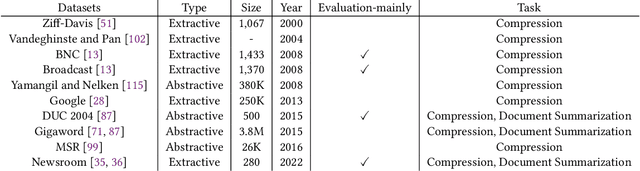
Long sentences have been a persistent issue in written communication for many years since they make it challenging for readers to grasp the main points or follow the initial intention of the writer. This survey, conducted using the PRISMA guidelines, systematically reviews two main strategies for addressing the issue of long sentences: a) sentence compression and b) sentence splitting. An increased trend of interest in this area has been observed since 2005, with significant growth after 2017. Current research is dominated by supervised approaches for both sentence compression and splitting. Yet, there is a considerable gap in weakly and self-supervised techniques, suggesting an opportunity for further research, especially in domains with limited data. In this survey, we categorize and group the most representative methods into a comprehensive taxonomy. We also conduct a comparative evaluation analysis of these methods on common sentence compression and splitting datasets. Finally, we discuss the challenges and limitations of current methods, providing valuable insights for future research directions. This survey is meant to serve as a comprehensive resource for addressing the complexities of long sentences. We aim to enable researchers to make further advancements in the field until long sentences are no longer a barrier to effective communication.
Topic-Aware Evaluation and Transformer Methods for Topic-Controllable Summarization
Jun 13, 2022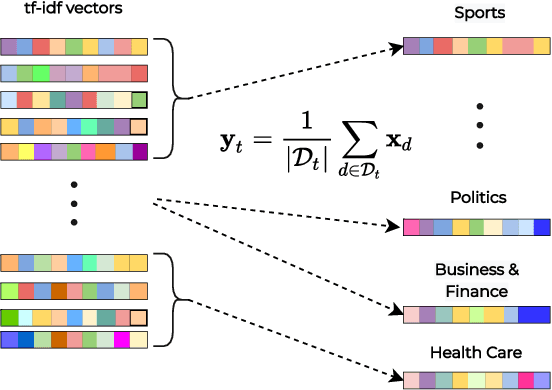
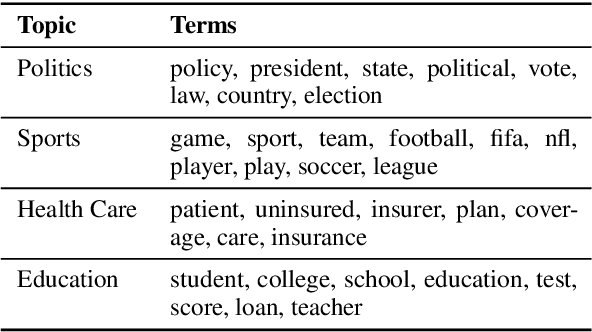
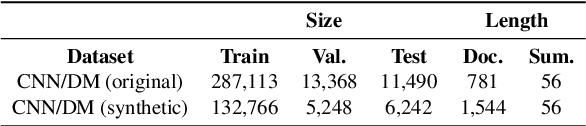
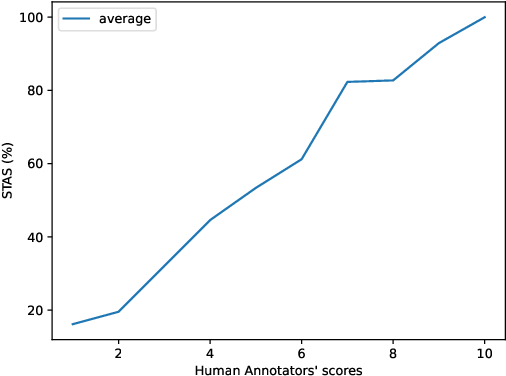
Topic-controllable summarization is an emerging research area with a wide range of potential applications. However, existing approaches suffer from significant limitations. First, there is currently no established evaluation metric for this task. Furthermore, existing methods built upon recurrent architectures, which can significantly limit their performance compared to more recent Transformer-based architectures, while they also require modifications to the model's architecture for controlling the topic. In this work, we propose a new topic-oriented evaluation measure to automatically evaluate the generated summaries based on the topic affinity between the generated summary and the desired topic. We also conducted a user study that validates the reliability of this measure. Finally, we propose simple, yet powerful methods for topic-controllable summarization either incorporating topic embeddings into the model's architecture or employing control tokens to guide the summary generation. Experimental results show that control tokens can achieve better performance compared to more complicated embedding-based approaches while being at the same time significantly faster.