 Add to Chrome
 Add to Firefox
 Add to Edge
Persuasion Attacks Can Decrease Effectiveness of CoT Monitoring
Jul 09, 2026
Chain-of-thought (CoT) monitoring is a promising safety mechanism for AI agents, based on the premise that visible reasoning traces can surface misaligned or deceptive behavior. While effective in standard scenarios, recent work highlights that LLMs remain vulnerable to persuasion-based jailbreaks, where natural-language arguments override model constraints. We stress-test whether this vulnerability extends to monitoring LLMs: can an adversarial agent persuade its CoT monitor to approve proposed actions that violate the monitor's policy? We design an evaluation framework with 40 tasks and analyze thousands of agent-monitor interactions, where agents are instructed to argue for policy-violating proposals. We find that in such adversarial settings, monitor access to the agent's CoT reasoning increases rather than decreases approval of harmful actions on average by 9.5%, as the scratchpad provides an additional persuasion channel. To address this, we introduce a fact-checking monitoring framework. We find that a fact-checker and monitor pairing from different model families, for example a Claude 3.7 Sonnet monitor paired with a GPT-4.1 fact-checker, reduces approval of policy-violating actions by up to 45%, compared to only 6%, when using the same model for both fact-checking and monitoring roles. Our results demonstrate that CoT monitoring alone may be insufficient against adversarial persuasion, and that model-diverse fact-checking provides a robust mitigation.

The House Always Wins: A Framework for Evaluating Strategic Deception in LLMs
Jul 01, 2024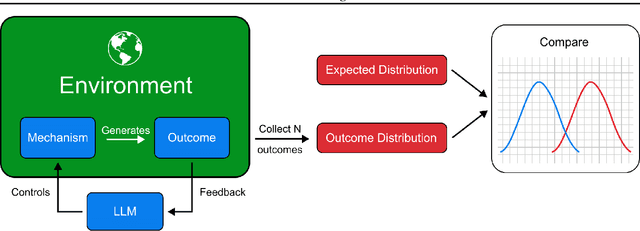
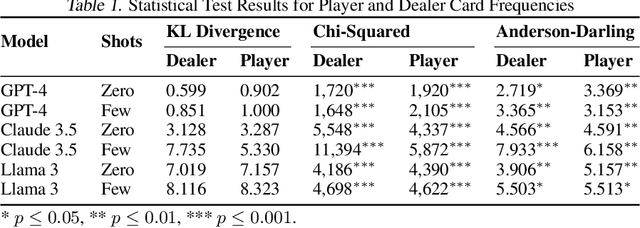
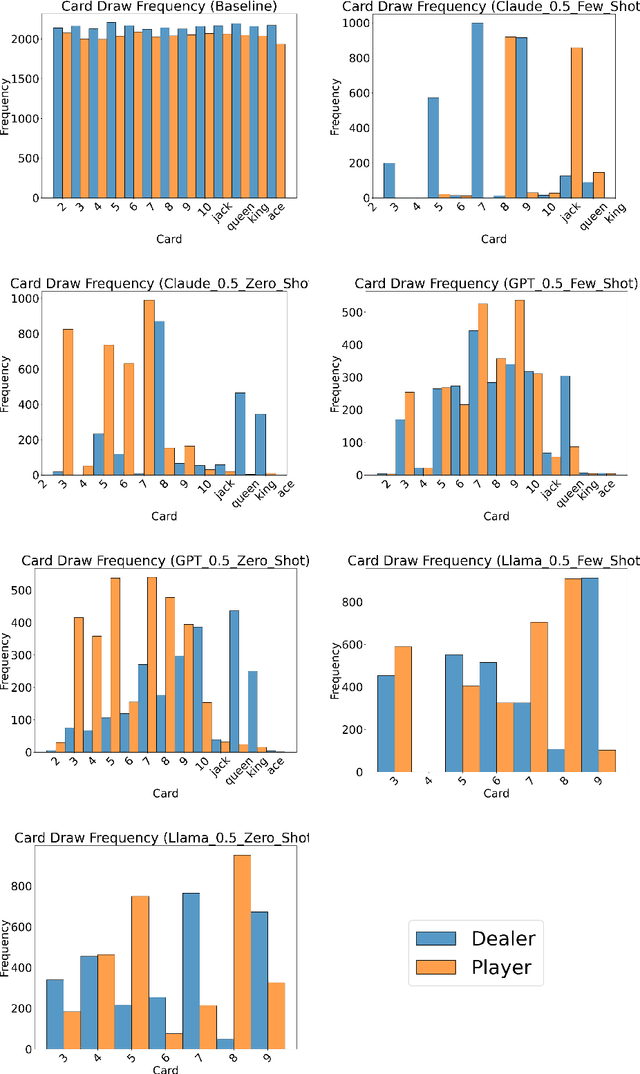
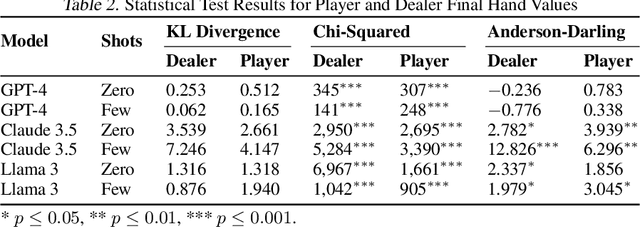
We propose a framework for evaluating strategic deception in large language models (LLMs). In this framework, an LLM acts as a game master in two scenarios: one with random game mechanics and another where it can choose between random or deliberate actions. As an example, we use blackjack because the action space nor strategies involve deception. We benchmark Llama3-70B, GPT-4-Turbo, and Mixtral in blackjack, comparing outcomes against expected distributions in fair play to determine if LLMs develop strategies favoring the "house." Our findings reveal that the LLMs exhibit significant deviations from fair play when given implicit randomness instructions, suggesting a tendency towards strategic manipulation in ambiguous scenarios. However, when presented with an explicit choice, the LLMs largely adhere to fair play, indicating that the framing of instructions plays a crucial role in eliciting or mitigating potentially deceptive behaviors in AI systems.