 Add to Chrome
 Add to Firefox
 Add to Edge
Scene Grounding In the Wild
Mar 27, 2026
Reconstructing accurate 3D models of large-scale real-world scenes from unstructured, in-the-wild imagery remains a core challenge in computer vision, especially when the input views have little or no overlap. In such cases, existing reconstruction pipelines often produce multiple disconnected partial reconstructions or erroneously merge non-overlapping regions into overlapping geometry. In this work, we propose a framework that grounds each partial reconstruction to a complete reference model of the scene, enabling globally consistent alignment even in the absence of visual overlap. We obtain reference models from dense, geospatially accurate pseudo-synthetic renderings derived from Google Earth Studio. These renderings provide full scene coverage but differ substantially in appearance from real-world photographs. Our key insight is that, despite this significant domain gap, both domains share the same underlying scene semantics. We represent the reference model using 3D Gaussian Splatting, augmenting each Gaussian with semantic features, and formulate alignment as an inverse feature-based optimization scheme that estimates a global 6DoF pose and scale while keeping the reference model fixed. Furthermore, we introduce the WikiEarth dataset, which registers existing partial 3D reconstructions with pseudo-synthetic reference models. We demonstrate that our approach consistently improves global alignment when initialized with various classical and learning-based pipelines, while mitigating failure modes of state-of-the-art end-to-end models. All code and data will be released.

4-LEGS: 4D Language Embedded Gaussian Splatting
Oct 15, 2024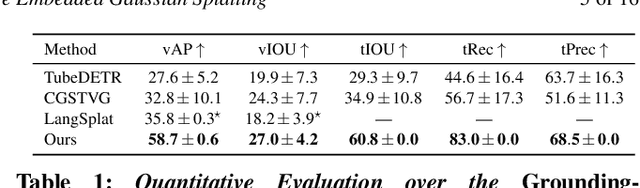
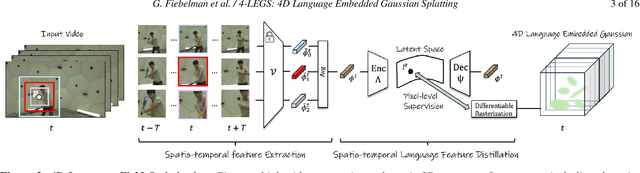
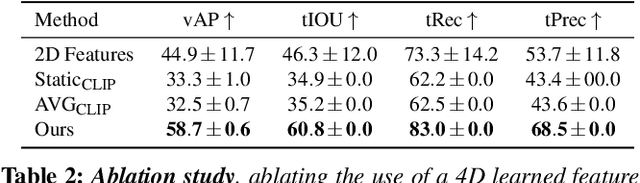
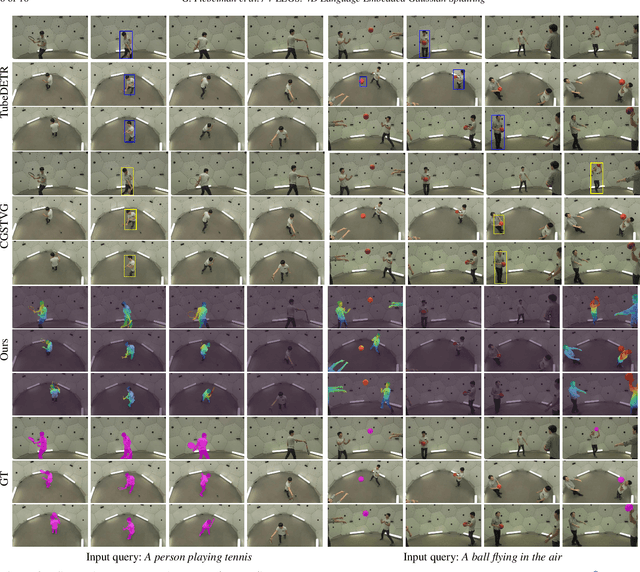
The emergence of neural representations has revolutionized our means for digitally viewing a wide range of 3D scenes, enabling the synthesis of photorealistic images rendered from novel views. Recently, several techniques have been proposed for connecting these low-level representations with the high-level semantics understanding embodied within the scene. These methods elevate the rich semantic understanding from 2D imagery to 3D representations, distilling high-dimensional spatial features onto 3D space. In our work, we are interested in connecting language with a dynamic modeling of the world. We show how to lift spatio-temporal features to a 4D representation based on 3D Gaussian Splatting. This enables an interactive interface where the user can spatiotemporally localize events in the video from text prompts. We demonstrate our system on public 3D video datasets of people and animals performing various actions.