 Add to Chrome
 Add to Firefox
 Add to Edge
Wiener Representation Filtering for VLM Hallucination Suppression
Aug 08, 2026
Vision-language models (VLMs) excel at open-ended captioning and visual QA but often describe objects, attributes, or relations absent from the image, a phenomenon known as object hallucination. We propose a {training-free, post-hoc representation editing technique} that operates in the representation space of the language backbone. The method performs a lightweight, one-time offline calibration on a modest paired dataset to estimate the required covariance structures, using only forward passes and empirical second-order statistics with no gradient updates or fine-tuning, after which the correction is absorbed directly into the model's existing weights. By modeling hidden states as a superposition of truthful and hallucination-associated components, we derive a Wiener-type estimator whose optimal gains are given in closed form from the covariances of paired truthful and hallucinated representations. An eigendecomposition yields mode-wise attenuation that respects a stability criterion, i.e., the filter responds continuously to estimation noise. The correction is applied once to the feed-forward output projections of selected deeper layers, at inference time, the model runs unchanged and at the same speed. Experiments on LLaVA-1.5, MiniGPT-4, Gemma3, and mPLUG-Owl2 demonstrate consistent reductions in object hallucination on CHAIR, POPE, and MME while maintaining caption fluency and overall response quality. We further demonstrate the generality of our approach on the TempCompass video understanding benchmark and on discrete diffusion language models for grounded dialogue, showing that representation filtering reduces hallucinations even in temporal video reasoning and multi-step, sequence-wide denoising settings.

Mean-Field Parallel Decoding for Discrete Diffusion Language Models
Jun 14, 2026Discrete diffusion language models enable parallel token generation, offering a pathway to low-latency decoding. However, selecting tokens independently by marginal confidence limits effective parallelism: tokens that appear reliable in isolation can form incompatible configurations when several positions are updated at once. We introduce a training-free decoding framework that coordinates these parallel updates. At each forward pass, the method assigns a commit score to each masked position and refines these scores using pairwise interactions derived from the model's predictive distributions. A variational relaxation yields a simple fixed-point update that suppresses conflicting simultaneous commitments within a single forward pass. This mechanism allows the decoder to commit more tokens in parallel while maintaining competitive generation quality. The method is lightweight, requires no auxiliary model or retraining, and drops into existing diffusion decoding pipelines without modification. Experiments on reasoning and code-generation benchmarks show consistent improvements in the quality-latency trade-off.
Suppressing VLM Hallucinations with Spectral Representation Filtering
Nov 15, 2025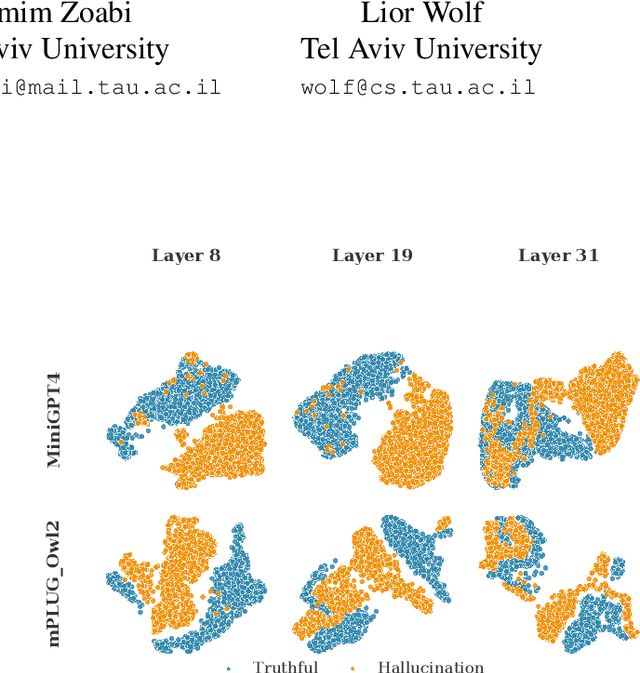
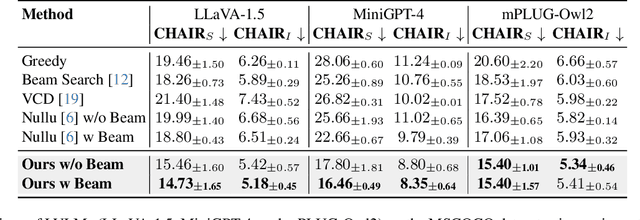

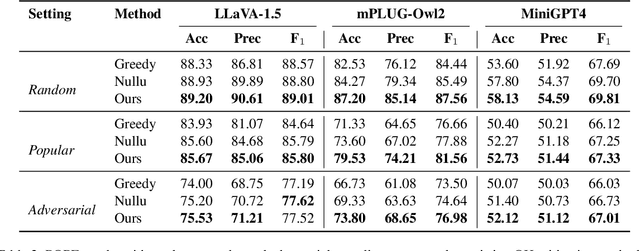
Vision-language models (VLMs) frequently produce hallucinations in the form of descriptions of objects, attributes, or relations that do not exist in the image due to over-reliance on language priors and imprecise cross-modal grounding. We introduce Spectral Representation Filtering (SRF), a lightweight, training-free method to suppress such hallucinations by analyzing and correcting the covariance structure of the model's representations. SRF identifies low-rank hallucination modes through eigendecomposition of the covariance of the differences between features collected for truthful and hallucinatory captions, revealing structured biases in the feature space. A soft spectral filter then attenuates these modes in the feed-forward projection weights of deeper vLLM layers, equalizing feature variance while preserving semantic fidelity. Unlike decoding or retraining-based approaches, SRF operates entirely post-hoc, incurs zero inference overhead, and requires no architectural modifications. Across three families of VLMs (LLaVA-1.5, MiniGPT-4, and mPLUG-Owl2), SRF consistently reduces hallucination rates on MSCOCO, POPE-VQA, and other visual tasks benchmarks, achieving state-of-the-art faithfulness without degrading caption quality.