 Add to Chrome
 Add to Firefox
 Add to Edge
Evolution Strategies for Deep RL pretraining
Mar 31, 2026
Although Deep Reinforcement Learning has proven highly effective for complex decision-making problems, it demands significant computational resources and careful parameter adjustment in order to develop successful strategies. Evolution strategies offer a more straightforward, derivative-free approach that is less computationally costly and simpler to deploy. However, ES generally do not match the performance levels achieved by DRL, which calls into question their suitability for more demanding scenarios. This study examines the performance of ES and DRL across tasks of varying difficulty, including Flappy Bird, Breakout and Mujoco environments, as well as whether ES could be used for initial training to enhance DRL algorithms. The results indicate that ES do not consistently train faster than DRL. When used as a preliminary training step, they only provide benefits in less complex environments (Flappy Bird) and show minimal or no improvement in training efficiency or stability across different parameter settings when applied to more sophisticated tasks (Breakout and MuJoCo Walker).

TiMoE: Time-Aware Mixture of Language Experts
Aug 12, 2025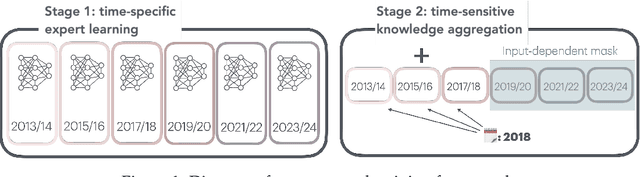
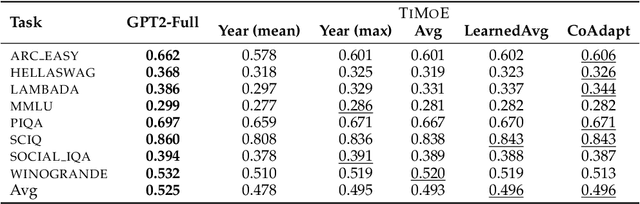
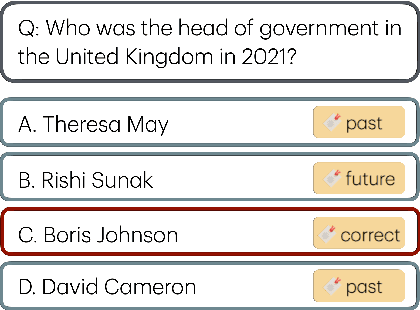
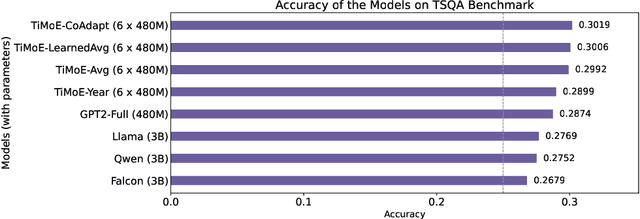
Large language models (LLMs) are typically trained on fixed snapshots of the web, which means that their knowledge becomes stale and their predictions risk temporal leakage: relying on information that lies in the future relative to a query. We tackle this problem by pre-training from scratch a set of GPT-style experts on disjoint two-year slices of a 2013-2024 corpus and combining them through TiMoE, a Time-aware Mixture of Language Experts. At inference time, TiMoE masks all experts whose training window ends after the query timestamp and merges the remaining log-probabilities in a shared space, guaranteeing strict causal validity while retaining the breadth of multi-period knowledge. We also release TSQA, a 10k-question benchmark whose alternatives are explicitly labelled as past, future or irrelevant, allowing fine-grained measurement of temporal hallucinations. Experiments on eight standard NLP tasks plus TSQA show that a co-adapted TiMoE variant matches or exceeds the best single-period expert and cuts future-knowledge errors by up to 15%. Our results demonstrate that modular, time-segmented pre-training paired with causal routing is a simple yet effective path toward LLMs that stay chronologically grounded without sacrificing general performance much. We open source our code at TiMoE (Github): https://github.com/epfml/TiMoE