 Add to Chrome
 Add to Firefox
 Add to Edge
Interleaved Speech Language Models Latently Work In Text
Jun 21, 2026
Speech language models (SLMs) have been extensively studied, with the common paradigm incorporating text data and pre-trained text LMs. A leading approach is speech-text interleaving in which models are trained over sequences containing both speech and text tokens, aiming to boost even speech-only capabilities. Yet the way these two modalities interact in the model latent space remains unclear. In this work, we analyze interleaved speech-text LMs from different model families and sizes through the scope of the logit lens to provide such insight. We reveal that these models go through an implicit transcription phase in which the text token of the spoken word becomes decodable in intermediate layers, despite not being trained for speech recognition. The transcription of the word appears as one of the top candidate words for as much as 77\% of the data. Following this stage, the models proceed to predict the next word in the text space before transforming back to the speech domain. We finally analyze the role of interleaving data, and initializing from text LMs in eliciting this behavior, as well as seeing how this correlates with spoken knowledge abilities. Our analysis sheds light on the internal mechanisms underlying the relationship between speech and text modalities and could shape SLM optimization.

GmSLM : Generative Marmoset Spoken Language Modeling
Sep 11, 2025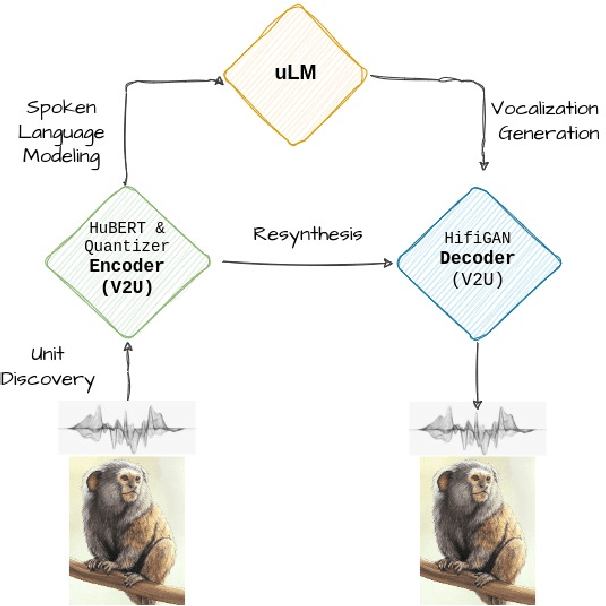
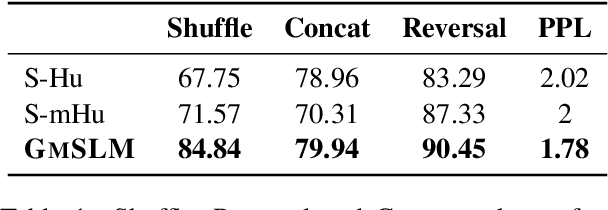
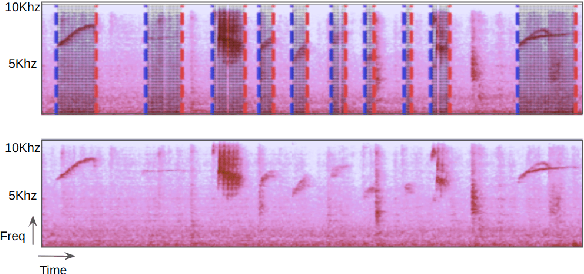
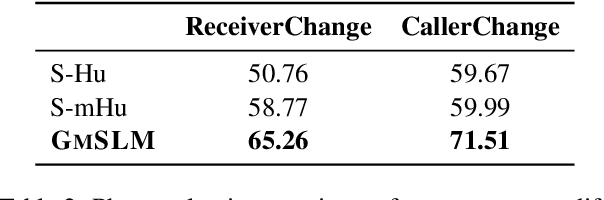
Marmoset monkeys exhibit complex vocal communication, challenging the view that nonhuman primates vocal communication is entirely innate, and show similar features of human speech, such as vocal labeling of others and turn-taking. Studying their vocal communication offers a unique opportunity to link it with brain activity-especially given the difficulty of accessing the human brain in speech and language research. Since Marmosets communicate primarily through vocalizations, applying standard LLM approaches is not straightforward. We introduce Generative Marmoset Spoken Language Modeling (GmSLM), an optimized spoken language model pipeline for Marmoset vocal communication. We designed a novel zero-shot evaluation metrics using unsupervised in-the-wild data, alongside weakly labeled conversational data, to assess GmSLM and demonstrate its advantage over a basic human-speech-based baseline. GmSLM generated vocalizations closely matched real resynthesized samples acoustically and performed well on downstream tasks. Despite being fully unsupervised, GmSLM effectively distinguish real from artificial conversations and may support further investigations of the neural basis of vocal communication and provides a practical framework linking vocalization and brain activity. We believe GmSLM stands to benefit future work in neuroscience, bioacoustics, and evolutionary biology. Samples are provided under: pages.cs.huji.ac.il/adiyoss-lab/GmSLM.