 Add to Chrome
 Add to Firefox
 Add to Edge
A Neurosymbolic Framework for Interpretable Skeleton-Based Seizure Detection via Concept-Driven Logical Reasoning
Jun 19, 2026
Video-based seizure detection is essential for the management of epilepsy patients, offering a non-invasive complement to electroencephalography. While several deep learning approaches have been developed for video-based seizure detection, none are inherently interpretable, limiting their adoption and translation into clinical practice. We present, to our knowledge, the first exploration of a neurosymbolic framework for video-based seizure detection that directly addresses this gap. Our approach (1) extracts patient-centric skeleton sequences from epilepsy monitoring units via a prompt-guided foundation model, (2) predicts binary spatio-temporal concept activations grounded in clinical motor semiology guidelines, and (3) composes them via differentiable logic into interpretable Boolean rules with auditable contributions. Furthermore, to mitigate false positives arising from the traditional binary formulation (seizure vs.\ non-seizure), we sub-classify non-seizure segments into clinically relevant normal activities, providing the model with fine-grained discriminative supervision. Evaluated on two public seizure video benchmarks, our framework achieves 89.78% sensitivity with 0.06 false detections per hour on SAHZU and 85.27%,0.09 on IEEE, while producing complete three-level interpretability: every prediction decomposes into which motor primitives were detected, how they were logically composed, and how much each rule contributed to the clinical decision. We publicly release all annotations, extracted pose sequences, our data pipeline and code, https://github.com/Mr-TalhaIlyas/CDSD/.

CWD30: A Comprehensive and Holistic Dataset for Crop Weed Recognition in Precision Agriculture
May 17, 2023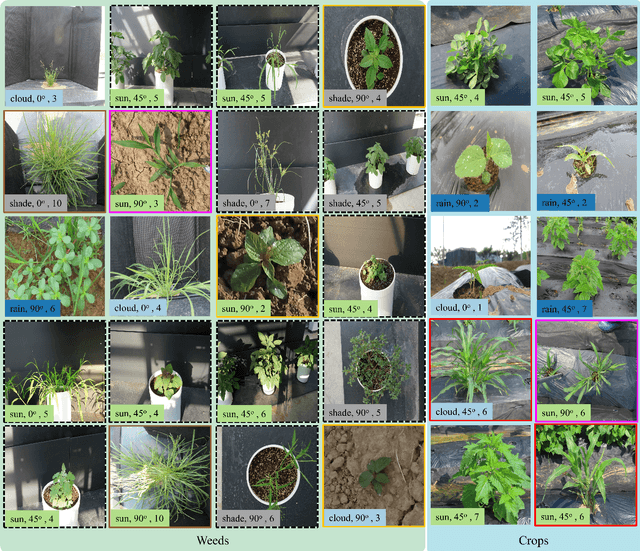
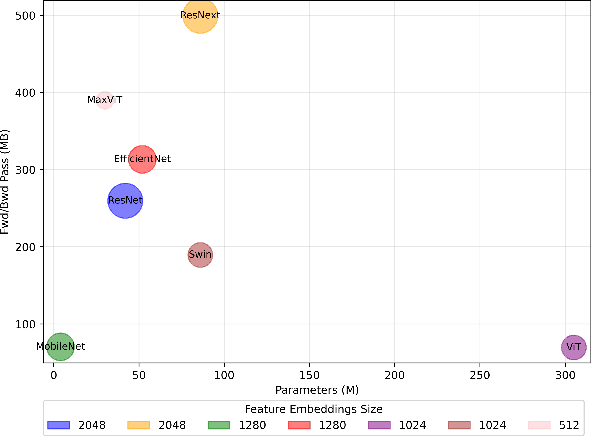
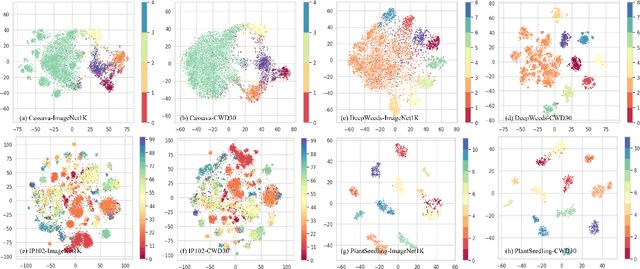
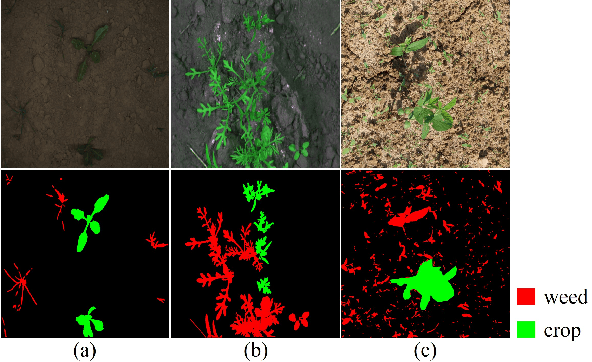
The growing demand for precision agriculture necessitates efficient and accurate crop-weed recognition and classification systems. Current datasets often lack the sample size, diversity, and hierarchical structure needed to develop robust deep learning models for discriminating crops and weeds in agricultural fields. Moreover, the similar external structure and phenomics of crops and weeds complicate recognition tasks. To address these issues, we present the CWD30 dataset, a large-scale, diverse, holistic, and hierarchical dataset tailored for crop-weed recognition tasks in precision agriculture. CWD30 comprises over 219,770 high-resolution images of 20 weed species and 10 crop species, encompassing various growth stages, multiple viewing angles, and environmental conditions. The images were collected from diverse agricultural fields across different geographic locations and seasons, ensuring a representative dataset. The dataset's hierarchical taxonomy enables fine-grained classification and facilitates the development of more accurate, robust, and generalizable deep learning models. We conduct extensive baseline experiments to validate the efficacy of the CWD30 dataset. Our experiments reveal that the dataset poses significant challenges due to intra-class variations, inter-class similarities, and data imbalance. Additionally, we demonstrate that minor training modifications like using CWD30 pretrained backbones can significantly enhance model performance and reduce convergence time, saving training resources on several downstream tasks. These challenges provide valuable insights and opportunities for future research in crop-weed recognition. We believe that the CWD30 dataset will serve as a benchmark for evaluating crop-weed recognition algorithms, promoting advancements in precision agriculture, and fostering collaboration among researchers in the field.