 Add to Chrome
 Add to Firefox
 Add to Edge
Tactile Data Recording System for Clothing with Motion-Controlled Robotic Sliding
Nov 08, 2025
The tactile sensation of clothing is critical to wearer comfort. To reveal physical properties that make clothing comfortable, systematic collection of tactile data during sliding motion is required. We propose a robotic arm-based system for collecting tactile data from intact garments. The system performs stroking measurements with a simulated fingertip while precisely controlling speed and direction, enabling creation of motion-labeled, multimodal tactile databases. Machine learning evaluation showed that including motion-related parameters improved identification accuracy for audio and acceleration data, demonstrating the efficacy of motion-related labels for characterizing clothing tactile sensation. This system provides a scalable, non-destructive method for capturing tactile data of clothing, contributing to future studies on fabric perception and reproduction.

Pinching Visuo-haptic Display: Investigating Cross-Modal Effects of Visual Textures on Electrostatic Cloth Tactile Sensations
Nov 08, 2025
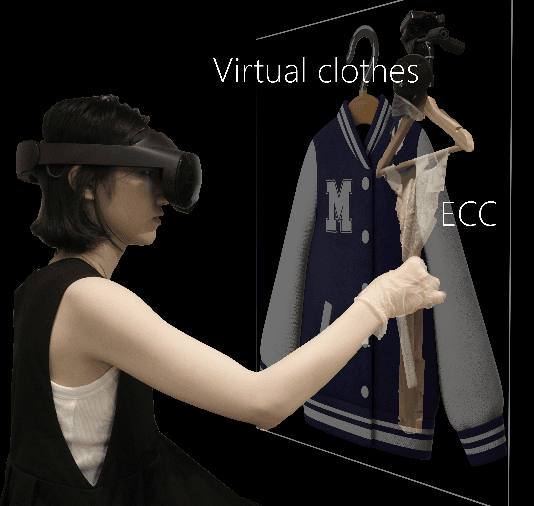
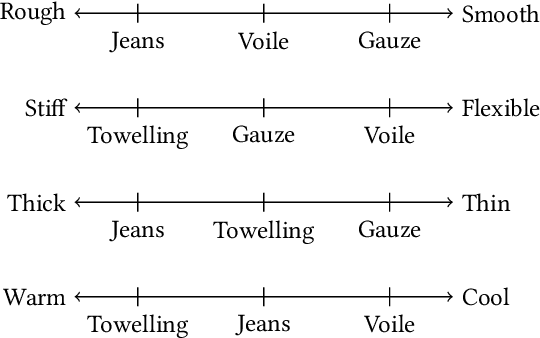
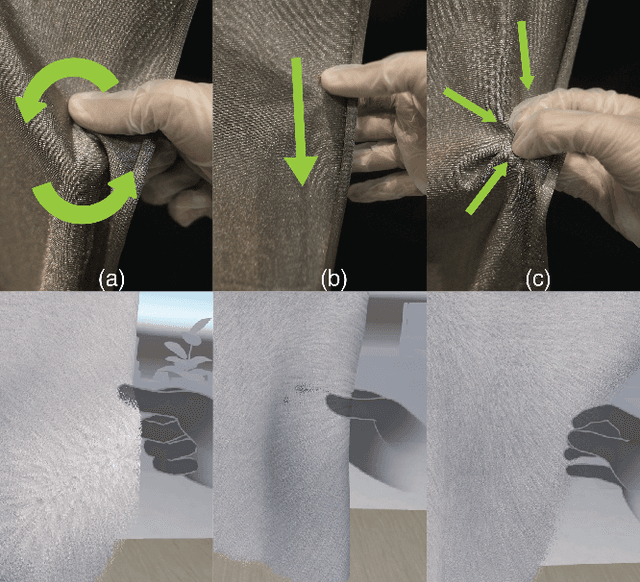
This paper investigates how visual texture presentation influences tactile perception when interacting with electrostatic cloth displays. We propose a visuo-haptic system that allows users to pinch and rub virtual fabrics while feeling realistic frictional sensations modulated by electrostatic actuation. Through a user study, we examined the cross-modal effects between visual roughness and perceived tactile friction. The results demonstrate that visually rough textures amplify the perceived frictional force, even under identical electrostatic stimuli. These findings contribute to the understanding of multimodal texture perception and provide design insights for haptic feedback in virtual material interfaces.
Telextiles: End-to-end Remote Transmission of Fabric Tactile Sensation
May 06, 2024The tactile sensation of textiles is critical in determining the comfort of clothing. For remote use, such as online shopping, users cannot physically touch the textile of clothes, making it difficult to evaluate its tactile sensation. Tactile sensing and actuation devices are required to transmit the tactile sensation of textiles. The sensing device needs to recognize different garments, even with hand-held sensors. In addition, the existing actuation device can only present a limited number of known patterns and cannot transmit unknown tactile sensations of textiles. To address these issues, we propose Telextiles, an interface that can remotely transmit tactile sensations of textiles by creating a latent space that reflects the proximity of textiles through contrastive self-supervised learning. We confirm that textiles with similar tactile features are located close to each other in the latent space through a two-dimensional plot. We then compress the latent features for known textile samples into the 1D distance and apply the 16 textile samples to the rollers in the order of the distance. The roller is rotated to select the textile with the closest feature if an unknown textile is detected.
* 10 pages, 8 figures, Proceedings of the 36th Annual ACM Symposium on User Interface Software and Technology