 Add to Chrome
 Add to Firefox
 Add to Edge
Symbol-Aware Reasoning with Masked Discrete Diffusion for Handwritten Mathematical Expression Recognition
Feb 03, 2026
Handwritten Mathematical Expression Recognition (HMER) requires reasoning over diverse symbols and 2D structural layouts, yet autoregressive models struggle with exposure bias and syntactic inconsistency. We present a discrete diffusion framework that reformulates HMER as iterative symbolic refinement instead of sequential generation. Through multi-step remasking, the proposal progressively refines both symbols and structural relations, removing causal dependencies and improving structural consistency. A symbol-aware tokenization and Random-Masking Mutual Learning further enhance syntactic alignment and robustness to handwriting diversity. On the MathWriting benchmark, the proposal achieves 5.56\% CER and 60.42\% EM, outperforming strong Transformer and commercial baselines. Consistent gains on CROHME 2014--2023 demonstrate that discrete diffusion provides a new paradigm for structure-aware visual recognition beyond generative modeling.

Hierarchical Modeling Approach to Fast and Accurate Table Recognition
Dec 24, 2025The extraction and use of diverse knowledge from numerous documents is a pressing challenge in intelligent information retrieval. Documents contain elements that require different recognition methods. Table recognition typically consists of three subtasks, namely table structure, cell position and cell content recognition. Recent models have achieved excellent recognition with a combination of multi-task learning, local attention, and mutual learning. However, their effectiveness has not been fully explained, and they require a long period of time for inference. This paper presents a novel multi-task model that utilizes non-causal attention to capture the entire table structure, and a parallel inference algorithm for faster cell content inference. The superiority is demonstrated both visually and statistically on two large public datasets.
Multi-Cell Decoder and Mutual Learning for Table Structure and Character Recognition
Apr 20, 2024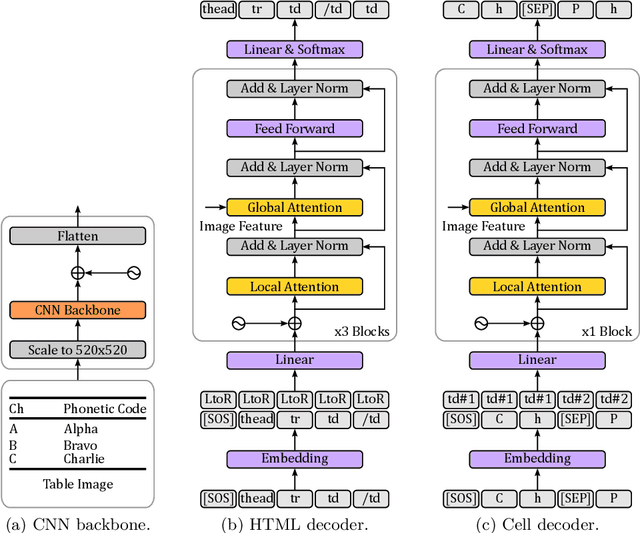
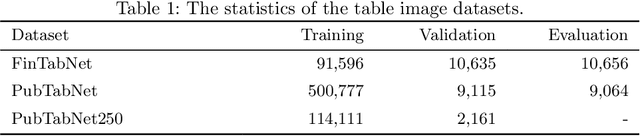
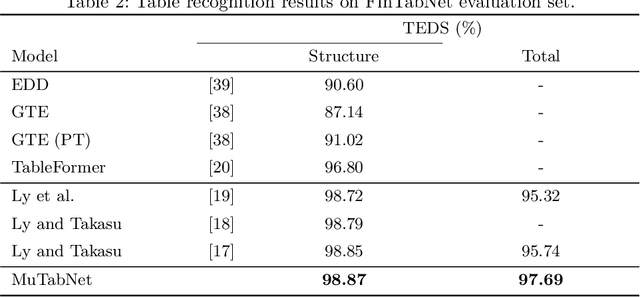
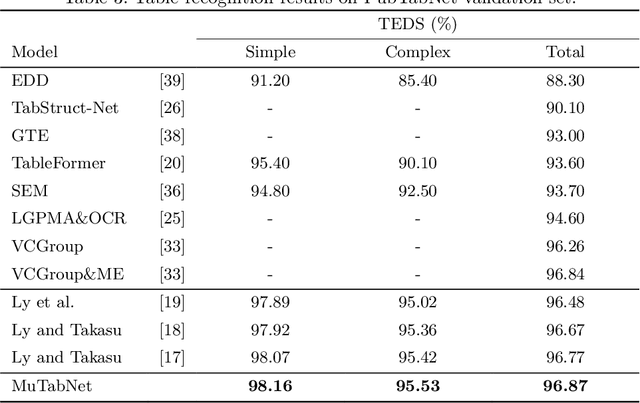
Extracting table contents from documents such as scientific papers and financial reports and converting them into a format that can be processed by large language models is an important task in knowledge information processing. End-to-end approaches, which recognize not only table structure but also cell contents, achieved performance comparable to state-of-the-art models using external character recognition systems, and have potential for further improvements. In addition, these models can now recognize long tables with hundreds of cells by introducing local attention. However, the models recognize table structure in one direction from the header to the footer, and cell content recognition is performed independently for each cell, so there is no opportunity to retrieve useful information from the neighbor cells. In this paper, we propose a multi-cell content decoder and bidirectional mutual learning mechanism to improve the end-to-end approach. The effectiveness is demonstrated on two large datasets, and the experimental results show comparable performance to state-of-the-art models, even for long tables with large numbers of cells.