 Add to Chrome
 Add to Firefox
 Add to Edge
Left-Right Symmetry Breaking in CLIP-style Vision-Language Models Trained on Synthetic Spatial-Relation Data
Jan 19, 2026
Spatial understanding remains a key challenge in vision-language models. Yet it is still unclear whether such understanding is truly acquired, and if so, through what mechanisms. We present a controllable 1D image-text testbed to probe how left-right relational understanding emerges in Transformer-based vision and text encoders trained with a CLIP-style contrastive objective. We train lightweight Transformer-based vision and text encoders end-to-end on paired descriptions of one- and two-object scenes and evaluate generalization to unseen object pairs while systematically varying label and layout diversity. We find that contrastive training learns left-right relations and that label diversity, more than layout diversity, is the primary driver of generalization in this setting. To gain the mechanistic understanding, we perform an attention decomposition and show that interactions between positional and token embeddings induce a horizontal attention gradient that breaks left-right symmetry in the encoders; ablating this contribution substantially reduces left-right discrimination. Our results provide a mechanistic insight of when and how CLIP-style models acquire relational competence.

Offline Reinforcement Learning for End-to-End Autonomous Driving
Dec 21, 2025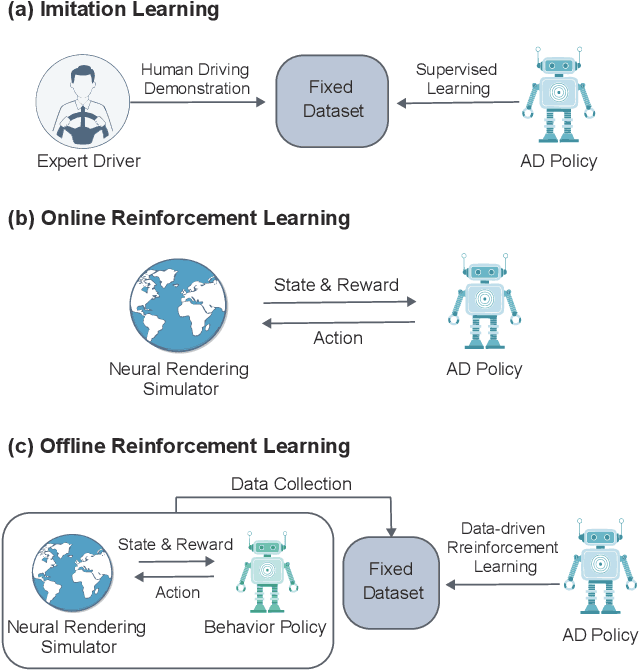
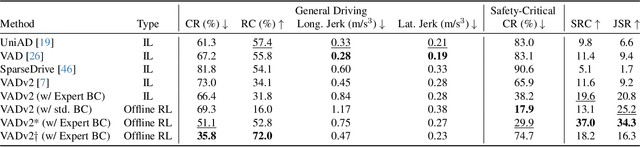
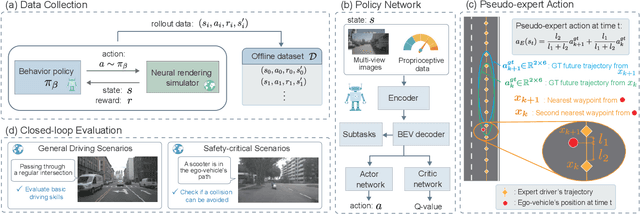
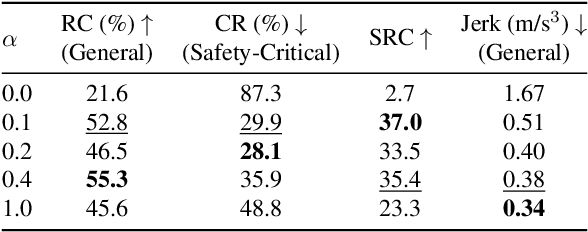
End-to-end (E2E) autonomous driving models that take only camera images as input and directly predict a future trajectory are appealing for their computational efficiency and potential for improved generalization via unified optimization; however, persistent failure modes remain due to reliance on imitation learning (IL). While online reinforcement learning (RL) could mitigate IL-induced issues, the computational burden of neural rendering-based simulation and large E2E networks renders iterative reward and hyperparameter tuning costly. We introduce a camera-only E2E offline RL framework that performs no additional exploration and trains solely on a fixed simulator dataset. Offline RL offers strong data efficiency and rapid experimental iteration, yet is susceptible to instability from overestimation on out-of-distribution (OOD) actions. To address this, we construct pseudo ground-truth trajectories from expert driving logs and use them as a behavior regularization signal, suppressing imitation of unsafe or suboptimal behavior while stabilizing value learning. Training and closed-loop evaluation are conducted in a neural rendering environment learned from the public nuScenes dataset. Empirically, the proposed method achieves substantial improvements in collision rate and route completion compared with IL baselines. Our code will be available at [URL].