 Add to Chrome
 Add to Firefox
 Add to Edge
Dark Quest II: A Wide-Coverage Neural Network Emulator of the Nonlinear Matter Power Spectrum Across Extended Cosmologies
May 27, 2026
\textsc{DarkEmulator2} is a neural network emulator of the nonlinear matter power spectrum in a nine-dimensional $w_0 w_a νo \mathrm{CDM}$ parameter space, developed as the emulator component of the \textsc{Dark Quest II} (DQ2) program. It is trained on simulations generated with the \textsc{Ginkaku} code, whose numerical implementation, accuracy tests, and post-processing pipeline are described in the companion paper. The design follows a unified strategy: in addition to the cosmological parameter vector, we supplement the neural network's inputs with three families of physically motivated auxiliary quantities -- the linear matter power spectrum, descriptors of the simulation resolution, and a low-dimensional summary of the initial Gaussian random field -- that are expected to improve generalization across the parameter space. Training a single network jointly across three simulation resolution tiers allows the emulator to exploit a small number of high-resolution simulations while retaining broad coverage from lower-resolution simulations. For a $L_{\mathrm{box}}=1\,\hiGpc$ box with $N=3000^{3}$ particles, the emulator reproduces the simulated matter power spectrum to subpercent accuracy up to the particle Nyquist scale, $k_{\mathrm{Ny}}\simeq 10\,\hMpci$. The emulator remains accurate over the calibrated wavenumber range, while its highest-$k$ predictions depend on the simulation resolution and shot noise. We validate the emulator on independent test suites and, through a cross-comparison with several public emulators and widely used fitting formulas, characterize the inter-model consistency and the parameter-dependent trends in their residuals.

Decoding Cosmological Information in Weak-Lensing Mass Maps with Generative Adversarial Networks
Nov 28, 2019
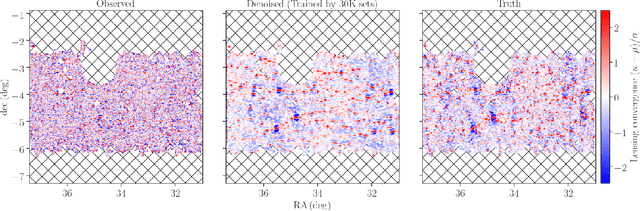
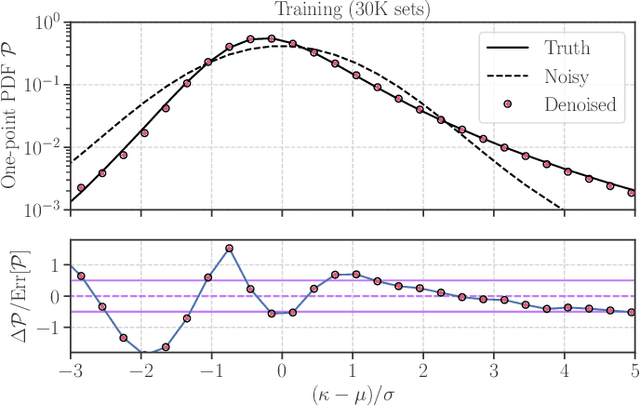
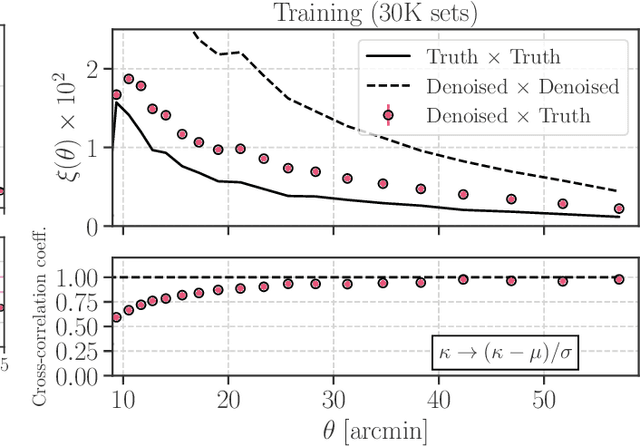
Galaxy imaging surveys enable us to map the cosmic matter density field through weak gravitational lensing analysis. The density reconstruction is compromised by a variety of noise originating from observational conditions, galaxy number density fluctuations, and intrinsic galaxy properties. We propose a deep-learning approach based on generative adversarial networks (GANs) to reduce the noise in the weak lensing map under realistic conditions. We perform image-to-image translation using conditional GANs in order to produce noiseless lensing maps using the first-year data of the Subaru Hyper Suprime-Cam (HSC) survey. We train the conditional GANs by using 30000 sets of mock HSC catalogs that directly incorporate observational effects. We show that an ensemble learning method with GANs can reproduce the one-point probability distribution function (PDF) of the lensing convergence map within a $0.5-1\sigma$ level. We use the reconstructed PDFs to estimate a cosmological parameter $S_{8} = \sigma_{8}\sqrt{\Omega_{\rm m0}/0.3}$, where $\Omega_{\rm m0}$ and $\sigma_{8}$ represent the mean and the scatter in the cosmic matter density. The reconstructed PDFs place tighter constraint, with the statistical uncertainty in $S_8$ reduced by a factor of $2$ compared to the noisy PDF. This is equivalent to increasing the survey area by $4$ without denoising by GANs. Finally, we apply our denoising method to the first-year HSC data, to place $2\sigma$-level cosmological constraints of $S_{8} < 0.777 \, ({\rm stat}) + 0.105 \, ({\rm sys})$ and $S_{8} < 0.633 \, ({\rm stat}) + 0.114 \, ({\rm sys})$ for the noisy and denoised data, respectively.