 Add to Chrome
 Add to Firefox
 Add to Edge
Learning from Reliable Latent Prompts for Visual Recognition with Missing Modalities
Jun 29, 2026
Large-scale multimodal models (LMMs) have achieved superior performance in visual recognition by synergizing information across diverse, massive-scale paired modalities. In real-world scenarios, however, missing-modality inputs are ubiquitous, causing models optimized for modality-complete data to exhibit precipitous performance degradation. Existing research has introduced prompt learning to mitigate this issue, typically by generating dynamic prompts from instance-level features, regardless of whether the input modalities are complete or partially absent. However, such input-conditioned strategies are hindered by the escalating unreliability of instance-level features; as higher missing rates increase the proportion of incomplete modalities, the resulting instability in prompt learning limits the model's performance. To address this limitation, we hypothesize that learnable latent prompts themselves encapsulate stable, modality-intrinsic priors that are decoupled from corrupted inputs. Consequently, we propose a novel paradigm: Learning from Reliable Latent Prompts. Unlike prior methods, we model input-agnostic learnable prompts as stable latent anchors that enable robust guidance and effective cross-modal knowledge compensation, even under extreme missing rates (e.g., 90%). Empirical results across three benchmark datasets demonstrate that our "learn-from-latent-prompts" approach achieves state-of-the-art performance across a wide range of missing-modality scenarios. Extensive experiments further confirm the effectiveness of this paradigm in providing a robust solution to the missing-modality problem.

CADM: Cluster-customized Adaptive Distance Metric for Categorical Data Clustering
Nov 08, 2025An appropriate distance metric is crucial for categorical data clustering, as the distance between categorical data cannot be directly calculated. However, the distances between attribute values usually vary in different clusters induced by their different distributions, which has not been taken into account, thus leading to unreasonable distance measurement. Therefore, we propose a cluster-customized distance metric for categorical data clustering, which can competitively update distances based on different distributions of attributes in each cluster. In addition, we extend the proposed distance metric to the mixed data that contains both numerical and categorical attributes. Experiments demonstrate the efficacy of the proposed method, i.e., achieving an average ranking of around first in fourteen datasets. The source code is available at https://anonymous.4open.science/r/CADM-47D8
TYrPPG: Uncomplicated and Enhanced Learning Capability rPPG for Remote Heart Rate Estimation
Nov 08, 2025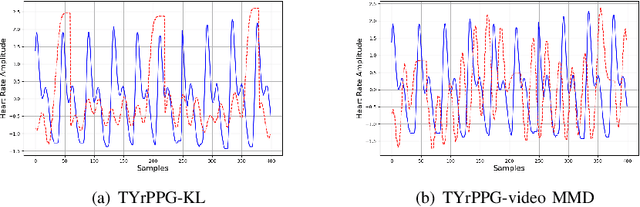
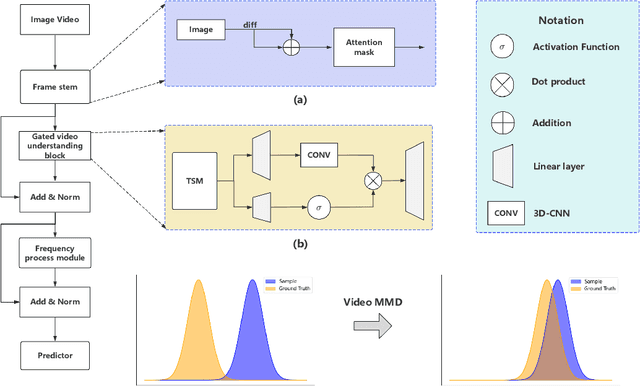
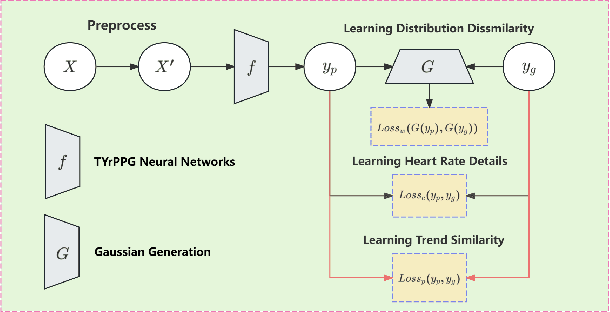
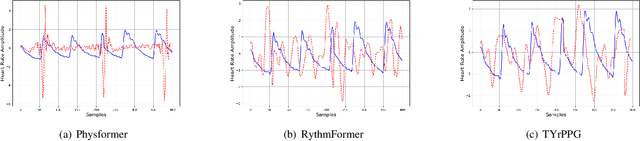
Remote photoplethysmography (rPPG) can remotely extract physiological signals from RGB video, which has many advantages in detecting heart rate, such as low cost and no invasion to patients. The existing rPPG model is usually based on the transformer module, which has low computation efficiency. Recently, the Mamba model has garnered increasing attention due to its efficient performance in natural language processing tasks, demonstrating potential as a substitute for transformer-based algorithms. However, the Mambaout model and its variants prove that the SSM module, which is the core component of the Mamba model, is unnecessary for the vision task. Therefore, we hope to prove the feasibility of using the Mambaout-based module to remotely learn the heart rate. Specifically, we propose a novel rPPG algorithm called uncomplicated and enhanced learning capability rPPG (TYrPPG). This paper introduces an innovative gated video understanding block (GVB) designed for efficient analysis of RGB videos. Based on the Mambaout structure, this block integrates 2D-CNN and 3D-CNN to enhance video understanding for analysis. In addition, we propose a comprehensive supervised loss function (CSL) to improve the model's learning capability, along with its weakly supervised variants. The experiments show that our TYrPPG can achieve state-of-the-art performance in commonly used datasets, indicating its prospects and superiority in remote heart rate estimation. The source code is available at https://github.com/Taixi-CHEN/TYrPPG.