 Add to Chrome
 Add to Firefox
 Add to Edge
FSKD: Monocular Forest Structure Inference via LiDAR-to-RGBI Knowledge Distillation
Apr 02, 2026
Very High Resolution (VHR) forest structure data at individual-tree scale is essential for carbon, biodiversity, and ecosystem monitoring. Still, airborne LiDAR remains costly and infrequent despite being the reference for forest structure metrics like Canopy Height Model (CHM), Plant Area Index (PAI), and Foliage Height Diversity (FHD). We propose FSKD: a LiDAR-to-RGB-Infrared (RGBI) knowledge distillation (KD) framework in which a multi-modal teacher fuses RGBI imagery with LiDAR-derived planar metrics and vertical profiles via cross-attention, and an RGBI-only SegFormer student learns to reproduce these outputs. Trained on 384 $km^2$ of forests in Saxony, Germany (20 cm ground sampling distance (GSD)) and evaluated on eight geographically distinct test tiles, the student achieves state-of-the-art (SOTA) zero-shot CHM performance (MedAE 4.17 m, $R^2$=0.51, IoU 0.87), outperforming HRCHM/DAC baselines by 29--46% in MAE (5.81 m vs. 8.14--10.84 m) with stronger correlation coefficients (0.713 vs. 0.166--0.652). Ablations show that multi-modal fusion improves performance by 10--26% over RGBI-only training, and that asymmetric distillation with appropriate model capacity is critical. The method jointly predicts CHM, PAI, and FHD, a multi-metric capability not provided by current monocular CHM estimators, although PAI/FHD transfer remains region-dependent and benefits from local calibration. The framework also remains effective under temporal mismatch (winter LiDAR, summer RGBI), removing strict co-acquisition constraints and enabling scalable 20 cm operational monitoring for workflows such as Digital Twin Germany and national Digital Orthophoto programs.

TiledAttention: a CUDA Tile SDPA Kernel for PyTorch
Mar 02, 2026TiledAttention is a scaled dot-product attention (SDPA) forward operator for SDPA research on NVIDIA GPUs. Implemented in cuTile Python (TileIR) and exposed as a PyTorch-callable function, it is easier to modify than low-level CUDA templates while retaining realistic behavior via online softmax and tiled $K,V$ streaming. The approach is both performant and directly editable at the schedule level from Python (tile shapes, staging, shared-memory layout), enabling rapid, reproducible kernel research without template-heavy CUDA/CUTLASS rewrites. We benchmark TiledAttention on an NVIDIA DGX GB10 node with a reproducible harness and compare against PyTorch SDPA (auto-dispatch) and explicit unfused baselines across sequence length, head dimension, and precision (FP16/BF16). While production fused baselines remain stronger overall, TiledAttention delivers large speedups over standard eager attention paths and is available for direct use within PyTorch workflows, providing a practical balance between performance and customizability.
Three Stage Narrative Analysis; Plot-Sentiment Breakdown, Structure Learning and Concept Detection
Nov 14, 2025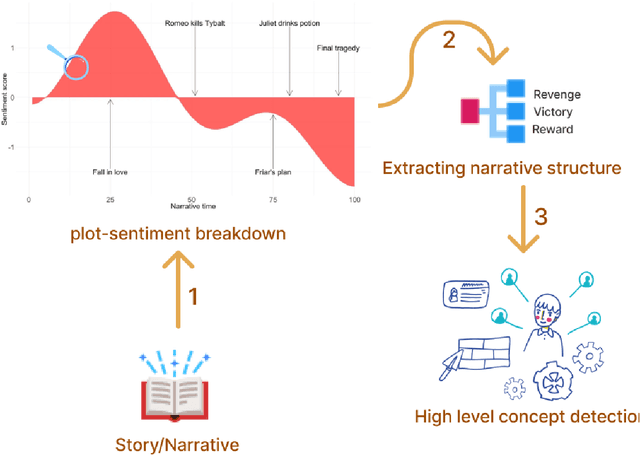
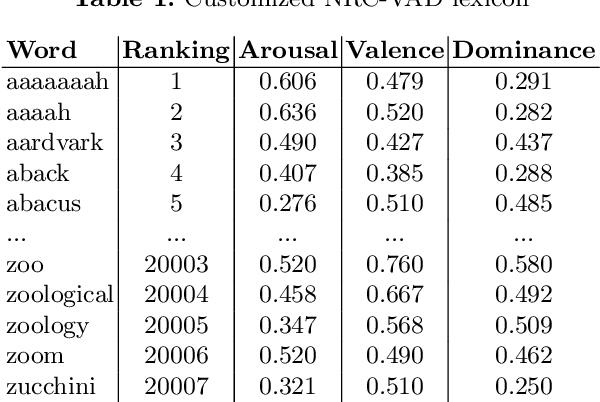
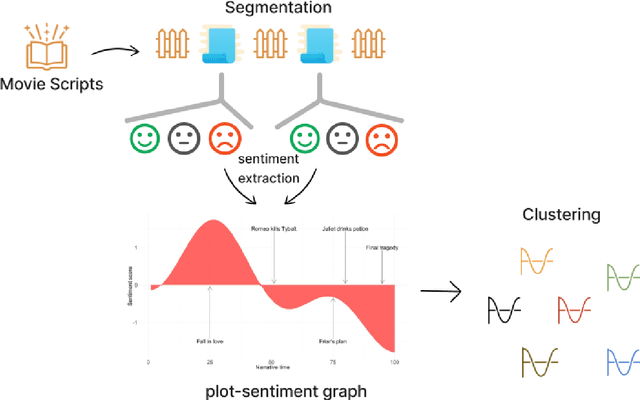
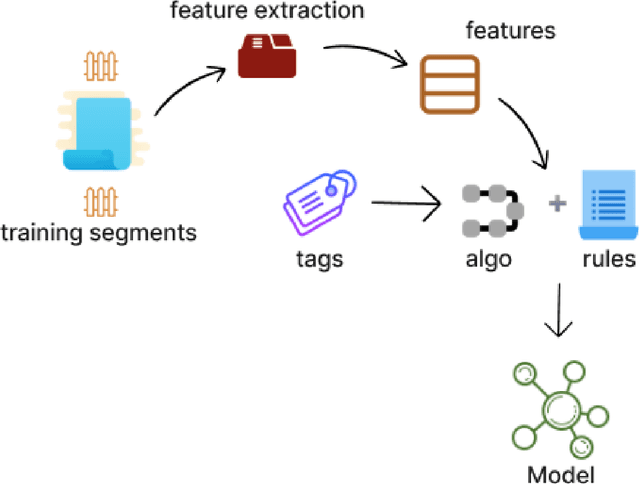
Story understanding and analysis have long been challenging areas within Natural Language Understanding. Automated narrative analysis requires deep computational semantic representations along with syntactic processing. Moreover, the large volume of narrative data demands automated semantic analysis and computational learning rather than manual analytical approaches. In this paper, we propose a framework that analyzes the sentiment arcs of movie scripts and performs extended analysis related to the context of the characters involved. The framework enables the extraction of high-level and low-level concepts conveyed through the narrative. Using dictionary-based sentiment analysis, our approach applies a custom lexicon built with the LabMTsimple storylab module. The custom lexicon is based on the Valence, Arousal, and Dominance scores from the NRC-VAD dataset. Furthermore, the framework advances the analysis by clustering similar sentiment plots using Wards hierarchical clustering technique. Experimental evaluation on a movie dataset shows that the resulting analysis is helpful to consumers and readers when selecting a narrative or story.