 Add to Chrome
 Add to Firefox
 Add to Edge
Frame Theoretical Derivation of Three Factor Learning Rule for Oja's Subspace Rule
Apr 03, 2026
We show that the error-gated Hebbian rule for PCA (EGHR-PCA), a three-factor learning rule equivalent to Oja's subspace rule under Gaussian inputs, can be systematically derived from Oja's subspace rule using frame theory. The global third factor in EGHR-PCA arises exactly as a frame coefficient when the learning rule is expanded with respect to a natural frame on the space of symmetric matrices. This provides a principled, non-heuristic derivation of a biologically plausible learning rule from its mathematically canonical counterpart.

Unsupervised Learning in Echo State Networks for Input Reconstruction
Jan 20, 2025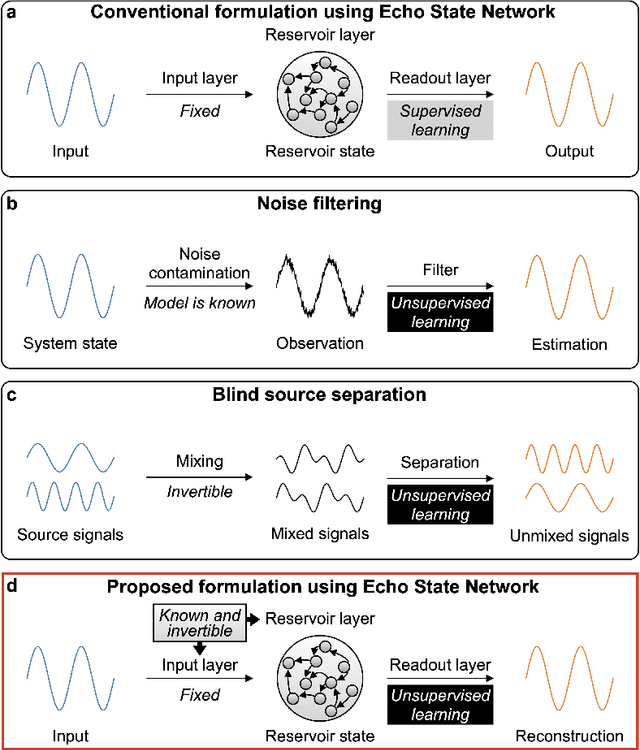
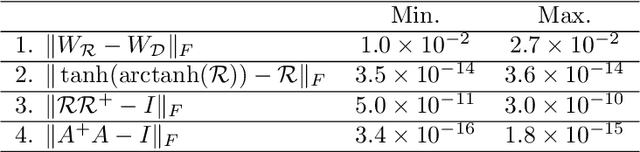
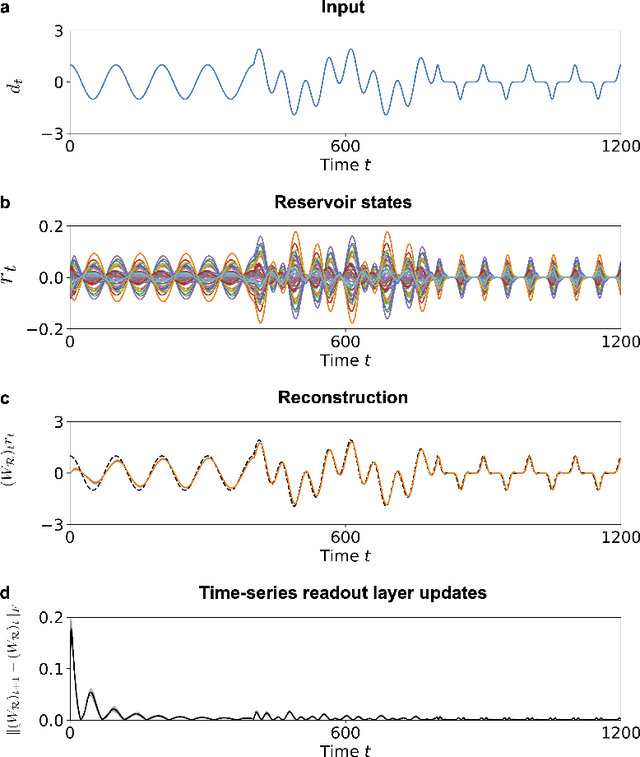
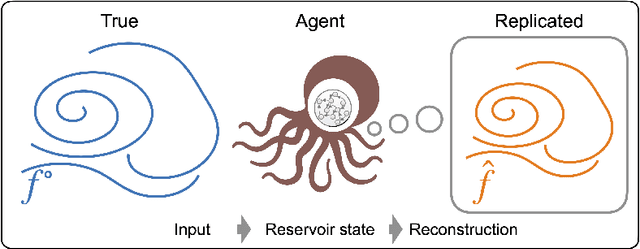
Conventional echo state networks (ESNs) require supervised learning to train the readout layer, using the desired outputs as training data. In this study, we focus on input reconstruction (IR), which refers to training the readout layer to reproduce the input time series in its output. We reformulate the learning algorithm of the ESN readout layer to perform IR using unsupervised learning (UL). By conducting theoretical analysis and numerical experiments, we demonstrate that IR in ESNs can be effectively implemented under realistic conditions without explicitly using the desired outputs as training data; in this way, UL is enabled. Furthermore, we demonstrate that applications relying on IR, such as dynamical system replication and noise filtering, can be reformulated within the UL framework. Our findings establish a theoretically sound and universally applicable IR formulation, along with its related tasks in ESNs. This work paves the way for novel predictions and highlights unresolved theoretical challenges in ESNs, particularly in the context of time-series processing methods and computational models of the brain.