 Add to Chrome
 Add to Firefox
 Add to Edge
Memory Uncertainty Relation and Harmonic Memory in Random Recurrent Networks
May 23, 2026
We present an inequality that bounds the short-term memory capability of dynamical systems from below. It can be interpreted as an uncertainty relation between a measure of short-term memory and that of the size of state fluctuations induced by input signals. The lower bound can be achieved by a readout weight and thus represents a suboptimal memory called harmonic memory. We examine analytically and numerically the inequality in a number of reservoir systems subject to input noise. We illustrate cases in which equality is achieved exactly, equality holds asymptotically, and the inequality is strict. We also study the effect of a state-space regularization to elucidate the inequality in terms of the fluctuation structure of the state-space. We find that a certain strength of input noise induces extra memory under the regularization, and we refer to this phenomenon as noise-induced memory. We observe that the memory uncertainty relation does not hold in general for the regularized memory and harmonic memory. This fact is explained in terms of the mechanism of noise-induced memory.
* 14 pages, 10 figures

Optimal short-term memory before the edge of chaos in driven random recurrent networks
Dec 24, 2019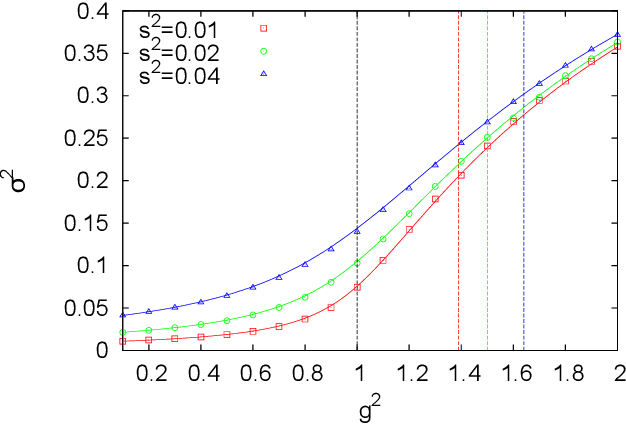
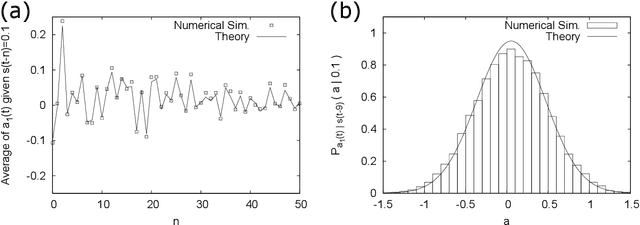
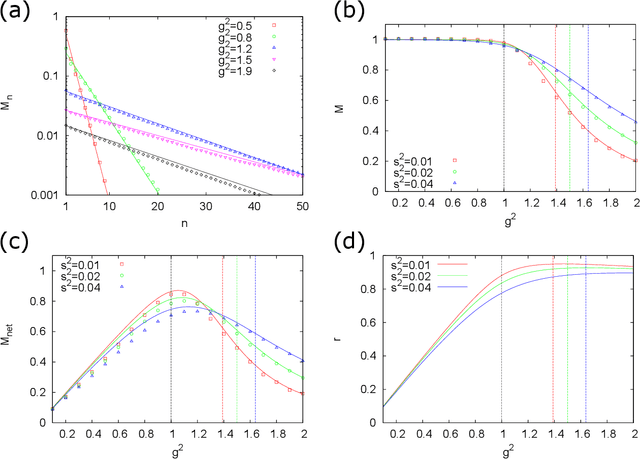
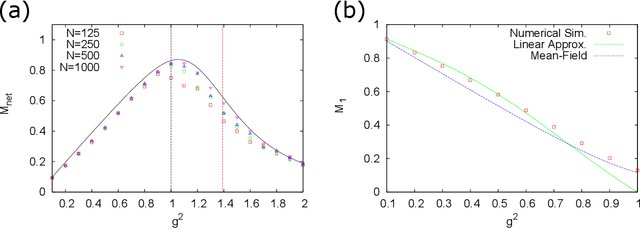
The ability of discrete-time nonlinear recurrent neural networks to store time-varying small input signals is investigated by mean-field theory. The combination of a small input strength and mean-field assumptions makes it possible to derive an approximate expression for the conditional probability density of the state of a neuron given a past input signal. From this conditional probability density, we can analytically calculate short-term memory measures, such as memory capacity, mutual information, and Fisher information, and determine the relationships among these measures, which have not been clarified to date to the best of our knowledge. We show that the network contribution of these short-term memory measures peaks before the edge of chaos, where the dynamics of input-driven networks is stable but corresponding systems without input signals are unstable.