 Add to Chrome
 Add to Firefox
 Add to Edge
The Weight Gram Matrix Captures Sequential Feature Linearization in Deep Networks
May 07, 2026
Understanding how deep neural networks learn representations remains a central challenge in machine learning theory. In this work, we propose a feature-centric framework for analyzing neural network training by relating weight updates to feature evolution. We introduce a simple identity, the Feature Learning Equation, which identifies the weight Gram matrix as the key object capturing feature dynamics. This enables us to interpret gradient descent as implicitly inducing a hypothetical evolution of features, whose covariance structure - termed the Virtual Covariance - characterizes how representations evolve during training. Building on this perspective, we introduce Target Linearity, a measure quantifying the linear alignment between features and targets. By analyzing the training and layer-wise dynamics, we show that deep networks learn to sequentially transform representations toward target-linear structure. This linearization perspective provides a unified interpretation of several empirical phenomena, including Neural Collapse and linear interpolation in generative models.

ABC3: Active Bayesian Causal Inference with Cohn Criteria in Randomized Experiments
Dec 15, 2024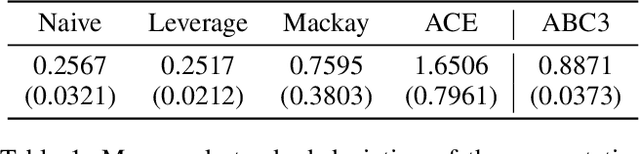
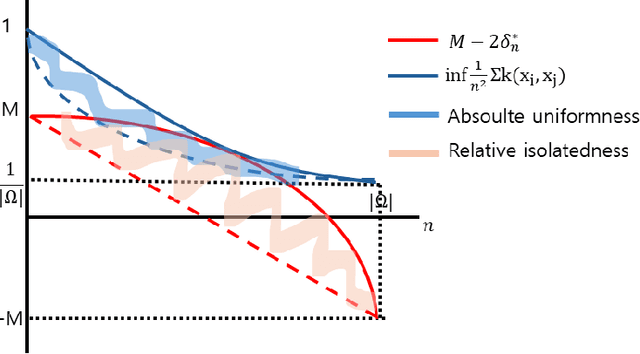
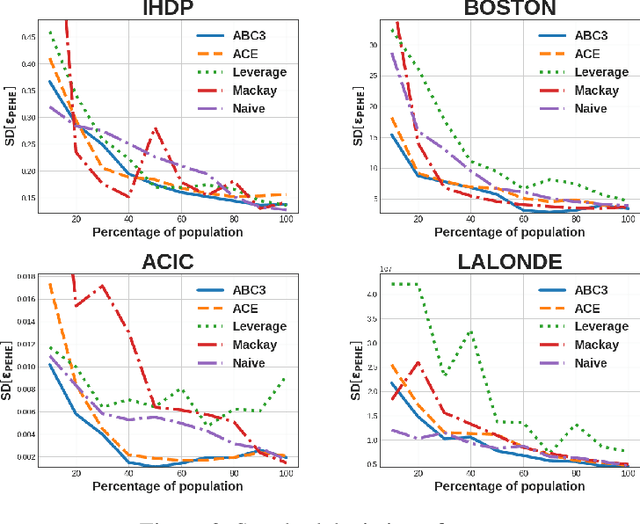
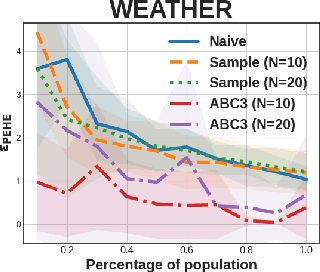
In causal inference, randomized experiment is a de facto method to overcome various theoretical issues in observational study. However, the experimental design requires expensive costs, so an efficient experimental design is necessary. We propose ABC3, a Bayesian active learning policy for causal inference. We show a policy minimizing an estimation error on conditional average treatment effect is equivalent to minimizing an integrated posterior variance, similar to Cohn criteria \citep{cohn1994active}. We theoretically prove ABC3 also minimizes an imbalance between the treatment and control groups and the type 1 error probability. Imbalance-minimizing characteristic is especially notable as several works have emphasized the importance of achieving balance. Through extensive experiments on real-world data sets, ABC3 achieves the highest efficiency, while empirically showing the theoretical results hold.
Pre-trained Language Models Return Distinguishable Probability Distributions to Unfaithfully Hallucinated Texts
Sep 25, 2024In this work, we show the pre-trained language models return distinguishable generation probability and uncertainty distribution to unfaithfully hallucinated texts, regardless of their size and structure. By examining 24 models on 6 data sets, we find out that 88-98% of cases return statistically significantly distinguishable generation probability and uncertainty distributions. Using this general phenomenon, we showcase a hallucination-reducing training algorithm. Our algorithm outperforms other baselines by achieving higher faithfulness metrics while maintaining sound general text quality measures.