 Add to Chrome
 Add to Firefox
 Add to Edge
Dense-Sparse Dynamic Time Warping for Customizing Piano Concerto Accompaniments
Jul 20, 2026
In this study, we explore how pianists can customize Music Minus One (MMO) concerto accompaniments to match their playing style. Bypassing the need for a symbolic score, often not available digitally, we use three types of audio data: solo piano recordings, MMO orchestra-only recordings, and mixed recordings of both piano and orchestra (e.g., from YouTube). The mixed recording serves as an intermediary reference to align the solo and orchestra parts, with only the orchestral part being adjusted through time-scale modification to synchronize with the user's playing. The main challenge with estimating these alignments is the spectral mismatch between recordings containing different musical parts. Motivated by this application scenario, we introduce Dense-Sparse DTW, a variant of Dynamic Time Warping (DTW) that is designed to improve robustness of alignments to spectral mismatch by focusing on aligning a selected subset of audio frames containing prominent timing cues. We collect and annotate data from four piano concerto movements and establish a framework for generating and evaluating customized accompaniment recordings. On this benchmark, we show that Dense-Sparse DTW has better or comparable performance than more complex approaches based on source separation and spectral subtraction techniques.
* Published at ICASSP 2025

Segmental DTW: A Parallelizable Alternative to Dynamic Time Warping
Jul 16, 2026In this work we explore parallelizable alternatives to DTW for globally aligning two feature sequences. One of the main practical limitations of DTW is its quadratic computation and memory cost. Previous works have sought to reduce the computational cost in various ways, such as imposing bands in the cost matrix or using a multiresolution approach. In this work, we utilize the fact that computation is an abundant resource and focus instead on exploring alternatives that approximate the inherently sequential DTW algorithm with one that is parallelizable. We describe two variations of an algorithm called Segmental DTW, in which the global cost matrix is broken into smaller sub-matrices, subsequence DTW is performed on each sub-matrix, and the results are used to solve a segment-level dynamic programming problem that specifies a globally optimal alignment path. We evaluate the proposed alignment algorithms on an audio-audio alignment task using the Chopin Mazurka dataset, and we show that they closely match the performance of regular DTW. We further demonstrate that almost all of the computations in Segmental DTW are parallelizable, and that one of the variants is unilaterally better than the other for both empirical and theoretical reasons.
* Published at ICASSP 2021
Estimating the Reliability of Dynamic Time Warping Alignments Using Circumstantial Evidence
Jul 16, 2026Recent works have explored ways to handle uncertainty in dynamic time warping (DTW) alignment paths through the use of differentiable variants of DTW like Soft-DTW. In this paper, we approach the issue of uncertainty in DTW alignment paths in a different way. Given a DTW alignment path, we propose a metric that indicates how reliable a local segment of the alignment path is. The intuition for our metric is based on the idea of circumstantial evidence. If DTW has found a very prominent path, then if we re-run the alignment with relaxed boundary conditions, it will still pick the same path. If, on the other hand, DTW has found a "weak" path, then re-running the alignment with relaxed boundary conditions will likely yield a different path. Accordingly, our reliability metric is computed by picking a local section of the DTW alignment path, re-estimating the alignment with FlexDTW (which allows flexibility in the boundary conditions), and then measuring how well the DTW and FlexDTW paths agree. We assess the proposed reliability metric on DTW alignment paths containing both matching and non-matching regions across a range of scenarios on an audio-audio alignment task. We find that the reliability metric correctly identifies reliable regions of the alignment path with an aggregate AUROC of 0.97. This approach provides an unsupervised method for estimating the reliability of a DTW alignment path.
A Study of Parallelizable Alternatives to Dynamic Time Warping for Aligning Long Sequences
Jul 16, 2026This article investigates several parallelizable alternatives to DTW for estimating the alignment between two long sequences. Whereas most previous work has focused on reducing the total computation and/or memory costs of DTW, our focus is instead on reducing wall clock time by utilizing common hardware like GPUs that are optimized for parallel processing. We propose and study four different parallelizable alignment algorithms: the first three algorithms compute approximations of DTW by breaking the pairwise cost matrix into rectangular regions and processing the regions in parallel, and the fourth algorithm computes an exact DTW alignment by processing the cost matrix along diagonals rather than rows or columns. We characterize the performance of our proposed alignment algorithms on an audio-audio alignment task, and we develop GPU-based implementations for the two best-performing algorithms, which we call weakly-ordered Segmental DTW (WSDTW) and Parallelized Diagonal DTW (ParDTW). Our experiments indicate that ParDTW is the most practical and useful of the four algorithms: it computes an exact DTW alignment and reduces runtime by 1.5 to 2 orders of magnitude on long sequences compared to current alternatives. We present a comprehensive evaluation and study of the alignment accuracy, runtime, and practical limitations of the proposed alignment algorithms.
* Published in IEEE/ACM Transactions on Audio, Speech, and Language Processing
PBSCSR: The Piano Bootleg Score Composer Style Recognition Dataset
Feb 07, 2024
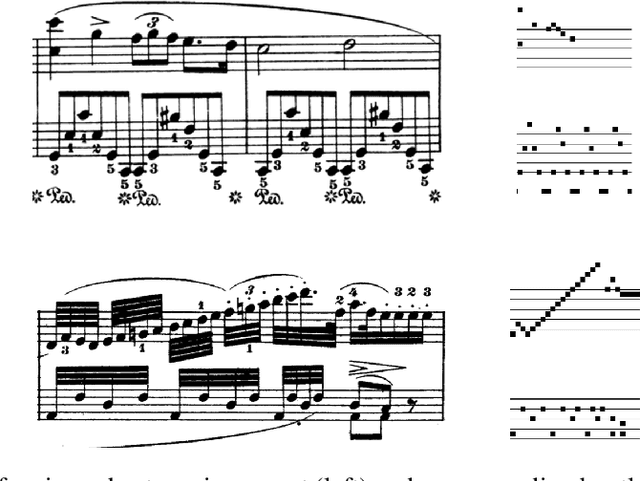
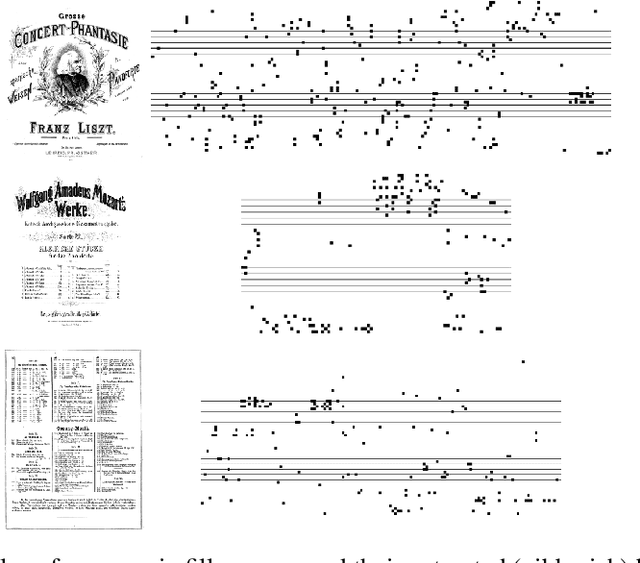

This article motivates, describes, and presents the PBSCSR dataset for studying composer style recognition of piano sheet music. Our overarching goal was to create a dataset for studying composer style recognition that is "as accessible as MNIST and as challenging as ImageNet". To achieve this goal, we use a previously proposed feature representation of sheet music called a bootleg score, which encodes the position of noteheads relative to the staff lines. Using this representation, we sample fixed-length bootleg score fragments from piano sheet music images on IMSLP. The dataset itself contains 40,000 62x64 bootleg score images for a 9-way classification task, 100,000 62x64 bootleg score images for a 100-way classification task, and 29,310 unlabeled variable-length bootleg score images for pretraining. The labeled data is presented in a form that mirrors MNIST images, in order to make it extremely easy to visualize, manipulate, and train models in an efficient manner. Additionally, we include relevant metadata to allow access to the underlying raw sheet music images and other related data on IMSLP. We describe several research tasks that could be studied with the dataset, including variations of composer style recognition in a few-shot or zero-shot setting. For tasks that have previously proposed models, we release code and baseline results for future works to compare against. We also discuss open research questions that the PBSCSR data is especially well suited to facilitate research on and areas of fruitful exploration in future work.
Composer Style Classification of Piano Sheet Music Images Using Language Model Pretraining
Jul 29, 2020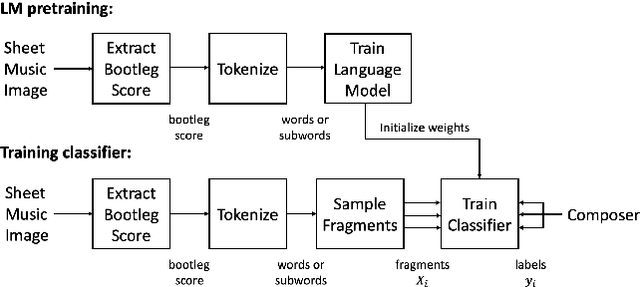
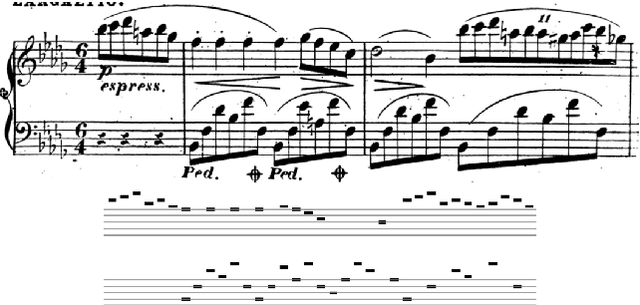
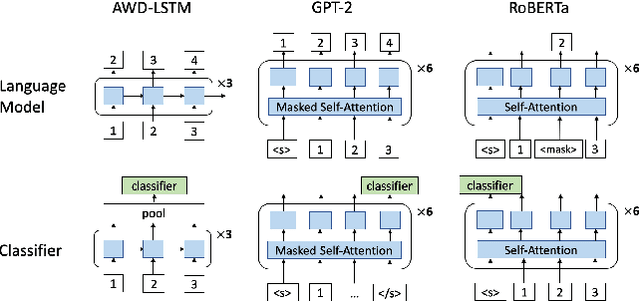
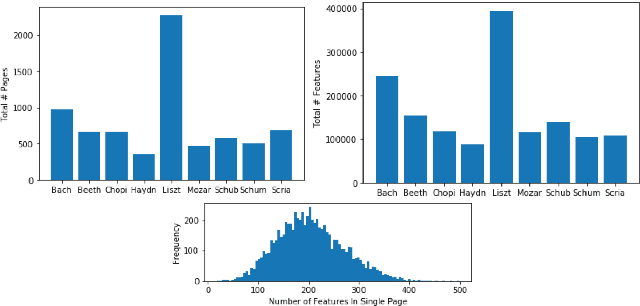
This paper studies composer style classification of piano sheet music images. Previous approaches to the composer classification task have been limited by a scarcity of data. We address this issue in two ways: (1) we recast the problem to be based on raw sheet music images rather than a symbolic music format, and (2) we propose an approach that can be trained on unlabeled data. Our approach first converts the sheet music image into a sequence of musical "words" based on the bootleg feature representation, and then feeds the sequence into a text classifier. We show that it is possible to significantly improve classifier performance by first training a language model on a set of unlabeled data, initializing the classifier with the pretrained language model weights, and then finetuning the classifier on a small amount of labeled data. We train AWD-LSTM, GPT-2, and RoBERTa language models on all piano sheet music images in IMSLP. We find that transformer-based architectures outperform CNN and LSTM models, and pretraining boosts classification accuracy for the GPT-2 model from 46\% to 70\% on a 9-way classification task. The trained model can also be used as a feature extractor that projects piano sheet music into a feature space that characterizes compositional style.
Camera-Based Piano Sheet Music Identification
Jul 29, 2020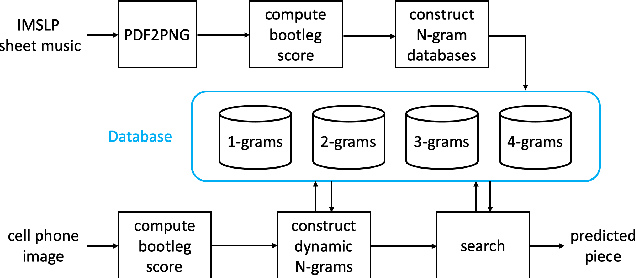
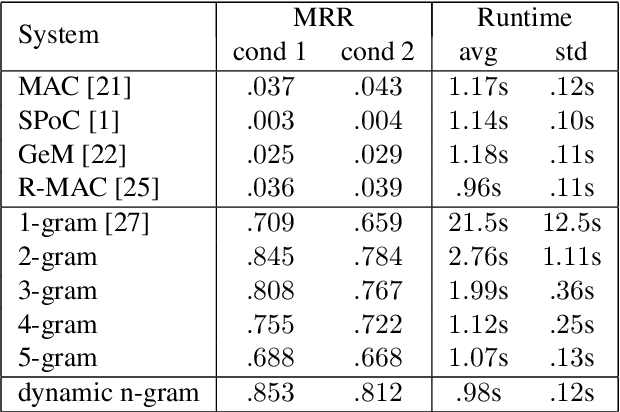
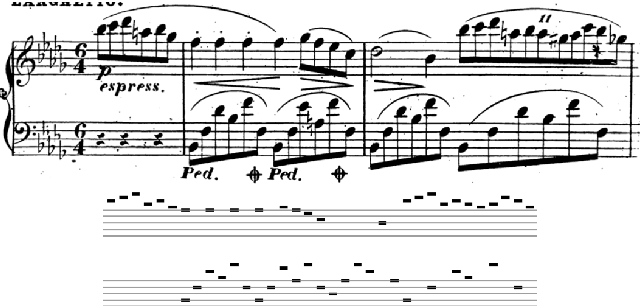
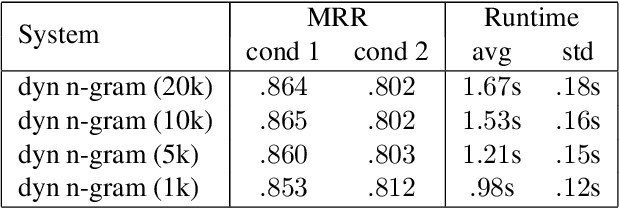
This paper presents a method for large-scale retrieval of piano sheet music images. Our work differs from previous studies on sheet music retrieval in two ways. First, we investigate the problem at a much larger scale than previous studies, using all solo piano sheet music images in the entire IMSLP dataset as a searchable database. Second, we use cell phone images of sheet music as our input queries, which lends itself to a practical, user-facing application. We show that a previously proposed fingerprinting method for sheet music retrieval is far too slow for a real-time application, and we diagnose its shortcomings. We propose a novel hashing scheme called dynamic n-gram fingerprinting that significantly reduces runtime while simultaneously boosting retrieval accuracy. In experiments on IMSLP data, our proposed method achieves a mean reciprocal rank of 0.85 and an average runtime of 0.98 seconds per query.