 Add to Chrome
 Add to Firefox
 Add to Edge
On the Foundations of Trustworthy Artificial Intelligence
Mar 26, 2026
We prove that platform-deterministic inference is necessary and sufficient for trustworthy AI. We formalize this as the Determinism Thesis and introduce trust entropy to quantify the cost of non-determinism, proving that verification failure probability equals 1 - 2^{-H_T} exactly. We prove a Determinism-Verification Collapse: verification under determinism requires O(1) hash comparison; without it, the verifier faces an intractable membership problem. IEEE 754 floating-point arithmetic fundamentally violates the determinism requirement. We resolve this by constructing a pure integer inference engine that achieves bitwise identical output across ARM and x86. In 82 cross-architecture tests on models up to 6.7B parameters, we observe zero hash mismatches. Four geographically distributed nodes produce identical outputs, verified by 356 on-chain attestation transactions. Every major trust property of AI systems (fairness, robustness, privacy, safety, alignment) presupposes platform determinism. Our system, 99,000 lines of Rust deployed across three continents, establishes that AI trust is a question of arithmetic.

Reactor Mk.1 performances: MMLU, HumanEval and BBH test results
Jun 15, 2024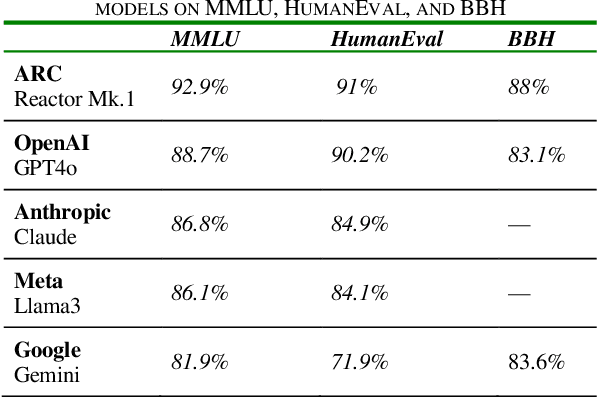
The paper presents the performance results of Reactor Mk.1, ARCs flagship large language model, through a benchmarking process analysis. The model utilizes the Lychee AI engine and possesses less than 100 billion parameters, resulting in a combination of efficiency and potency. The Reactor Mk.1 outperformed models such as GPT-4o, Claude Opus, and Llama 3, with achieved scores of 92% on the MMLU dataset, 91% on HumanEval dataset, and 88% on BBH dataset. It excels in both managing difficult jobs and reasoning, establishing as a prominent AI solution in the present cutting-edge AI technology.