 Add to Chrome
 Add to Firefox
 Add to Edge
Next-Generation License Plate Detection and Recognition System using YOLOv8
Dec 18, 2025
In the evolving landscape of traffic management and vehicle surveillance, efficient license plate detection and recognition are indispensable. Historically, many methodologies have tackled this challenge, but consistent real-time accuracy, especially in diverse environments, remains elusive. This study examines the performance of YOLOv8 variants on License Plate Recognition (LPR) and Character Recognition tasks, crucial for advancing Intelligent Transportation Systems. Two distinct datasets were employed for training and evaluation, yielding notable findings. The YOLOv8 Nano variant demonstrated a precision of 0.964 and mAP50 of 0.918 on the LPR task, while the YOLOv8 Small variant exhibited a precision of 0.92 and mAP50 of 0.91 on the Character Recognition task. A custom method for character sequencing was introduced, effectively sequencing the detected characters based on their x-axis positions. An optimized pipeline, utilizing YOLOv8 Nano for LPR and YOLOv8 Small for Character Recognition, is proposed. This configuration not only maintains computational efficiency but also ensures high accuracy, establishing a robust foundation for future real-world deployments on edge devices within Intelligent Transportation Systems. This effort marks a significant stride towards the development of smarter and more efficient urban infrastructures.
* 6 pages, 5 figures. Accepted and published in the 2023 IEEE 20th International Conference on Smart Communities: Improving Quality of Life using AI, Robotics and IoT (HONET)

Quantum Long Short-Term Memory vs Classical LSTM in Time Series Forecasting: A Comparative Study in Solar Power Forecasting
Oct 25, 2023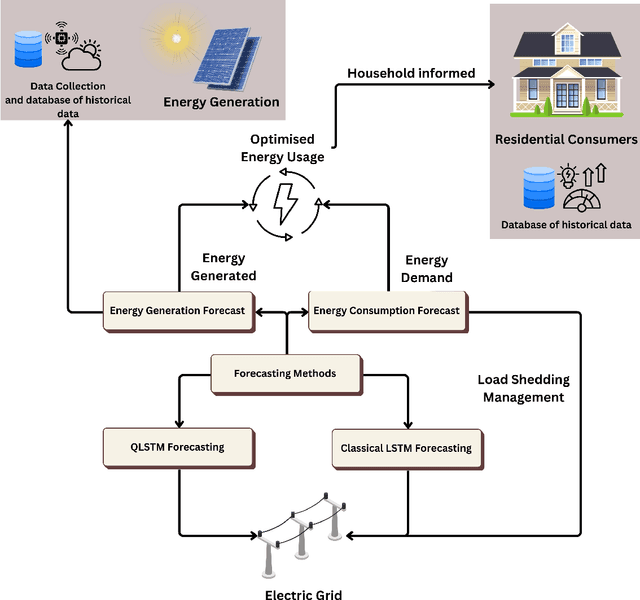
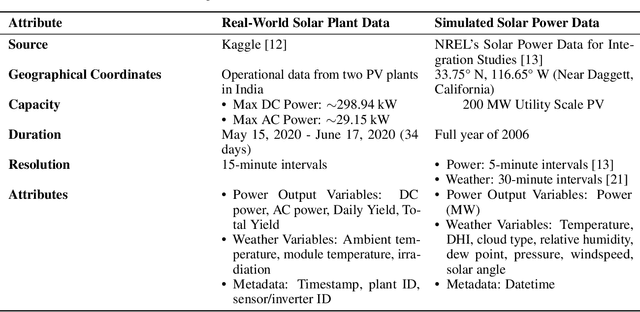
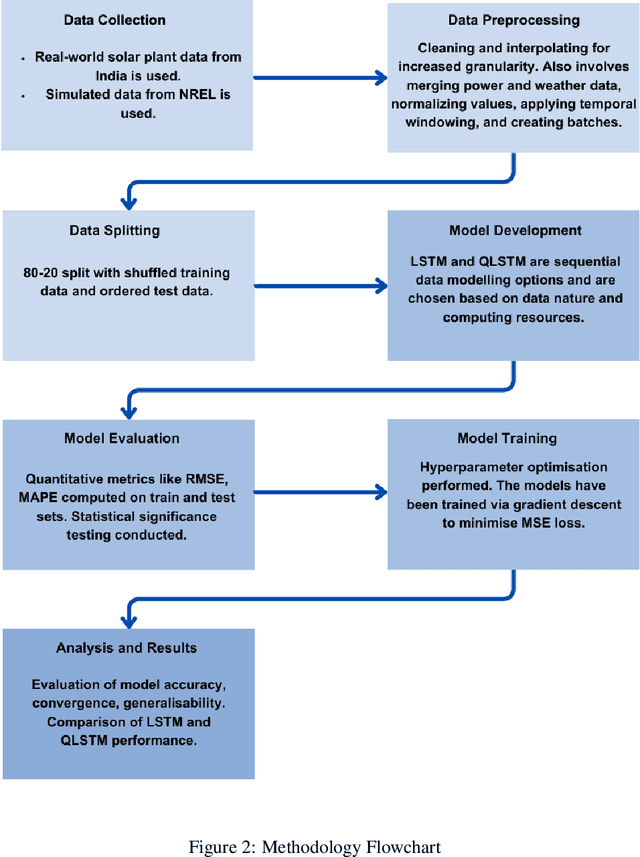
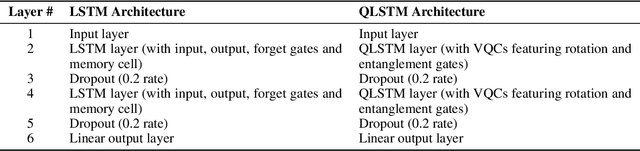
Accurately forecasting solar power generation is crucial in the global progression towards sustainable energy systems. In this study, we conduct a meticulous comparison between Quantum Long Short-Term Memory (QLSTM) and classical Long Short-Term Memory (LSTM) models for solar power production forecasting. Our controlled experiments reveal promising advantages of QLSTMs, including accelerated training convergence and substantially reduced test loss within the initial epoch compared to classical LSTMs. These empirical findings demonstrate QLSTM's potential to swiftly assimilate complex time series relationships, enabled by quantum phenomena like superposition. However, realizing QLSTM's full capabilities necessitates further research into model validation across diverse conditions, systematic hyperparameter optimization, hardware noise resilience, and applications to correlated renewable forecasting problems. With continued progress, quantum machine learning can offer a paradigm shift in renewable energy time series prediction. This pioneering work provides initial evidence substantiating quantum advantages over classical LSTM, while acknowledging present limitations. Through rigorous benchmarking grounded in real-world data, our study elucidates a promising trajectory for quantum learning in renewable forecasting. Additional research and development can further actualize this potential to achieve unprecedented accuracy and reliability in predicting solar power generation worldwide.