 Add to Chrome
 Add to Firefox
 Add to Edge
Time-Critical Multimodal Medical Transportation: Organs, Patients, and Medical Supplies
Feb 02, 2026
Timely transportation of organs, patients, and medical supplies is critical to modern healthcare, particularly in emergencies and transplant scenarios where even short delays can severely impact outcomes. Traditional ground-based vehicles such as ambulances are often hindered by traffic congestion; while air vehicles such as helicopters are faster but costly. Emerging air vehicles -- Unmanned Aerial Vehicles and electric vertical take-off and landing aircraft -- have lower operating costs, but remain limited by range and susceptibility to weather conditions. A multimodal transportation system that integrates both air and ground vehicles can leverage the strengths of each to enhance overall transportation efficiency. This study introduces a constructive greedy heuristic algorithm for multimodal vehicle dispatching for medical transportation. Four different fleet configurations were tested: (i) ambulances only, (ii) ambulances with Unmanned Aerial Vehicles, (iii) ambulances with electric vertical take-off and landing aircraft, and (iv) a fully integrated fleet of ambulances, Unmanned Aerial Vehicles, and electric vertical take-off and landing aircraft. The algorithm incorporates payload consolidation across compatible routes, accounts for traffic congestion in ground operations and weather conditions in aerial operations, while enabling rapid vehicle dispatching compared to computationally intensive optimization models. Using a common set of conditions, we evaluate all four fleet types to identify the most effective configurations for fulfilling medical transportation needs while minimizing operating costs, recharging/fuel costs, and total transportation time.

Deep Learning Based Multi-Level Classification for Aviation Safety
Feb 01, 2026Bird strikes pose a significant threat to aviation safety, often resulting in loss of life, severe aircraft damage, and substantial financial costs. Existing bird strike prevention strategies primarily rely on avian radar systems that detect and track birds in real time. A major limitation of these systems is their inability to identify bird species, an essential factor, as different species exhibit distinct flight behaviors, and altitudinal preference. To address this challenge, we propose an image-based bird classification framework using Convolutional Neural Networks (CNNs), designed to work with camera systems for autonomous visual detection. The CNN is designed to identify bird species and provide critical input to species-specific predictive models for accurate flight path prediction. In addition to species identification, we implemented dedicated CNN classifiers to estimate flock formation type and flock size. These characteristics provide valuable supplementary information for aviation safety. Specifically, flock type and size offer insights into collective flight behavior, and trajectory dispersion . Flock size directly relates to the potential impact severity, as the overall damage risk increases with the combined kinetic energy of multiple birds.
Bird Movement Prediction Using Long Short-Term Memory Networks to Prevent Bird Strikes with Low Altitude Aircraft
Dec 17, 2023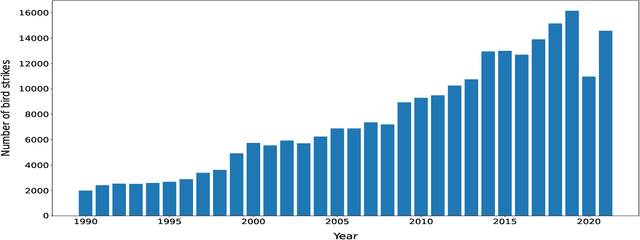
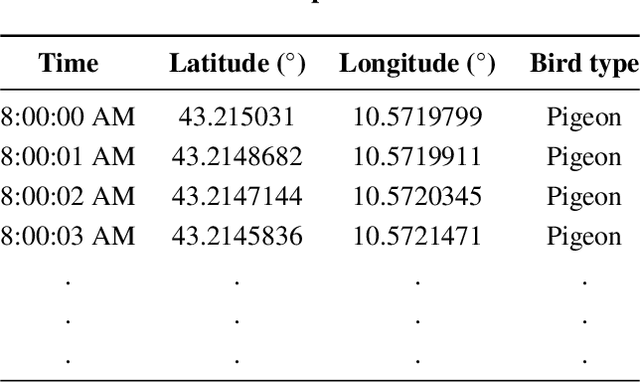
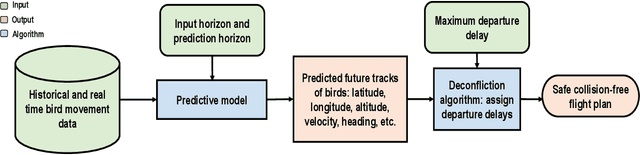
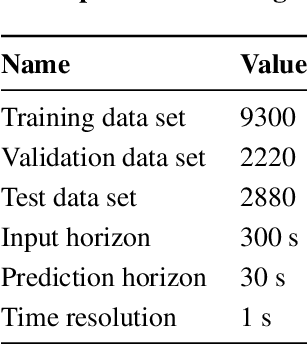
The number of collisions between aircraft and birds in the airspace has been increasing at an alarming rate over the past decade due to increasing bird population, air traffic and usage of quieter aircraft. Bird strikes with aircraft are anticipated to increase dramatically when emerging Advanced Air Mobility aircraft start operating in the low altitude airspace where probability of bird strikes is the highest. Not only do such bird strikes can result in human and bird fatalities, but they also cost the aviation industry millions of dollars in damages to aircraft annually. To better understand the causes and effects of bird strikes, research to date has mainly focused on analyzing factors which increase the probability of bird strikes, identifying high risk birds in different locations, predicting the future number of bird strike incidents, and estimating cost of bird strike damages. However, research on bird movement prediction for use in flight planning algorithms to minimize the probability of bird strikes is very limited. To address this gap in research, we implement four different types of Long Short-Term Memory (LSTM) models to predict bird movement latitudes and longitudes. A publicly available data set on the movement of pigeons is utilized to train the models and evaluate their performances. Using the bird flight track predictions, aircraft departures from Cleveland Hopkins airport are simulated to be delayed by varying amounts to avoid potential bird strikes with aircraft during takeoff. Results demonstrate that the LSTM models can predict bird movement with high accuracy, achieving a Mean Absolute Error of less than 100 meters, outperforming linear and nonlinear regression models. Our findings indicate that incorporating bird movement prediction into flight planning can be highly beneficial.
Deep-Dispatch: A Deep Reinforcement Learning-Based Vehicle Dispatch Algorithm for Advanced Air Mobility
Dec 17, 2023Near future air taxi operations with electric vertical take-off and landing (eVTOL) aircraft will be constrained by the need for frequent recharging of eVTOLs, limited takeoff and landing pads in vertiports, and subject to time-varying demand and electricity prices, making the eVTOL dispatch problem unique and particularly challenging to solve. Previously, we have developed optimization models to address this problem. Such optimization models however suffer from prohibitively high computational run times when the scale of the problem increases, making them less practical for real world implementation. To overcome this issue, we have developed two deep reinforcement learning-based eVTOL dispatch algorithms, namely single-agent and multi-agent deep Q-learning eVTOL dispatch algorithms, where the objective is to maximize operating profit. An eVTOL-based passenger transportation simulation environment was built to assess the performance of our algorithms across $36$ numerical cases with varying number of eVTOLs, vertiports, and demand. The results indicate that the multi-agent eVTOL dispatch algorithm can closely approximate the optimal dispatch policy with significantly less computational expenses compared to the benchmark optimization model. The multi-agent algorithm was found to outperform the single-agent counterpart with respect to both profits generated and training time.