 Add to Chrome
 Add to Firefox
 Add to Edge
APEX: A Network-Native Time-Series Foundation Model for Forecasting and Anomaly Detection for Wireless Edge Operations
Jun 10, 2026
Generic time-series foundation models transfer poorly to wireless network telemetry whose signals are bursty, zero-inflated, and coupled across protocol layers. We present APEX, a network-native, decoder-only transformer for forecasting enterprise AP telemetry, and evaluate it on DHCP degradation as a representative network task. APEX is pre-trained on 10-channel multivariate telemetry from ~4,500 production wireless networks (~100K AP time series, 34 metrics per AP), and is available as APEX-Large (269M, cloud) and APEX-Edge (10.5M, edge). On a 192-step (4-day) DHCP degradation benchmark, APEX-Large reduces MAE by 18% over the strongest foundation-model baseline (Toto) and 38% over SARIMA, with anomaly-detection F1 = 0.93, while APEX-Edge enables sub-second, privacy-preserving inference on AP-class edge hardware. These results suggest network-native pre-training is a practical foundation for proactive wireless operations.

Evidence-Grounded Ensemble Diagnosis of 802.11 Packet Captures: A Multi-Stage Pipeline with Deterministic Reliability Scoring
Jun 05, 2026Diagnosing 802.11 packet captures requires expert protocol knowledge, is slow, inconsistent across engineers, and unscalable. LLM-based approaches sound plausible but fabricate protocol events absent from captures (especially truncated traces), produce uncalibrated confidence scores, and suffer evaluation bias when golden references are co-produced by the model under test. We introduce PROBE (Protocol Reasoning Over evidence-Based Ensembles), a multi-stage pipeline addressing all three failures. It integrates (i) deterministic PCAP-to-text normalization with frame-level verifiability, (ii) multi-run, multi-candidate ensembles with optional cross-model second opinion and progressive obfuscation, (iii) a verdict-aware evidence framework treating absence of failure evidence as contributing evidence, and (iv) a fully deterministic composite reliability score from evidence validity, run-to-run stability, and cross-model agreement without LLM self-assessment. On 87 enterprise Wi-Fi captures (104 capture-reviewer pairs), single-pass LLM analysis raises weighted evidence F1 from 0.871 (expert baseline) to 0.912 but misses critical frames in 35% of cases. Naive ensemble voting drops below baseline (0.842) as majority voting amplifies conservative verdicts: 50% of confirmed failures are misclassified as 'no issue' or 'insufficient evidence.' Adding evidence-grounded reconciliation achieves 0.957 F1, a 96% auto-accept rate, and a worst-case floor above 0.70. LLM self-reported confidence clusters at 0.95 regardless of difficulty (71% report exactly 0.95), confirming it is uninformative. We also introduce a model-agnostic evaluation framework using per-field assertion matching, eliminating circular bias from model-co-produced golden references.
PLUME: Building a Network-Native Foundation Model for Wireless Traces via Protocol-Aware Tokenization
Mar 13, 2026Foundation models succeed when they learn in the native structure of a modality, whether morphology-respecting tokens in language or pixels in vision. Wireless packet traces deserve the same treatment: meaning emerges from layered headers, typed fields, timing gaps, and cross-packet state machines, not flat strings. We present Plume (Protocol Language Understanding Model for Exchanges), a compact 140M-parameter foundation model for 802.11 traces that learns from structured PDML dissections. A protocol-aware tokenizer splits along the dissector field tree, emits gap tokens for timing, and normalizes identifiers, yielding 6.2x shorter sequences than BPE with higher per token information density. Trained on a curated corpus, Plume achieves 74-97% next-packet token accuracy across five real-world failure categories and AUROC >= 0.99 for zero-shot anomaly detection. On the same prediction task, frontier LLMs (Claude Opus 4.6, GPT-5.4) score comparably despite receiving identical protocol context, yet Plume does so with > 600x fewer parameters, fitting on a single GPU at effectively zero marginal cost vs. cloud API pricing, enabling on-prem, privacy-preserving root cause analysis.
Indoor Air Quality Dataset with Activities of Daily Living in Low to Middle-income Communities
Jul 19, 2024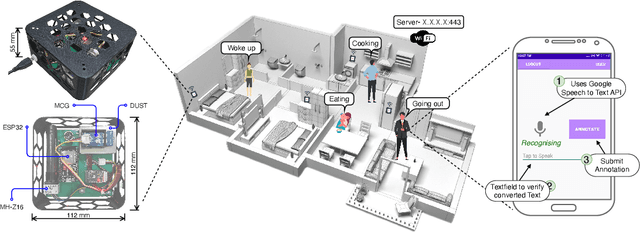
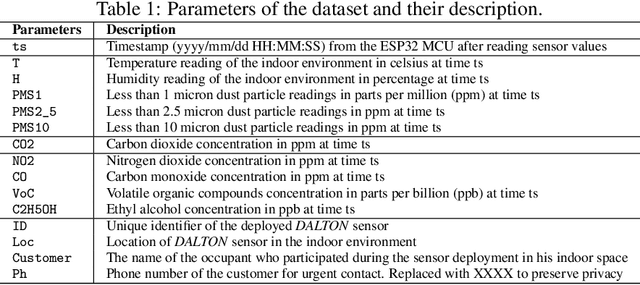
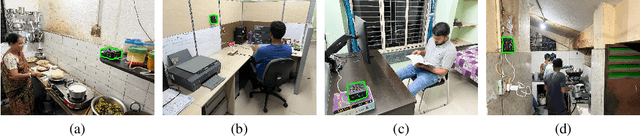
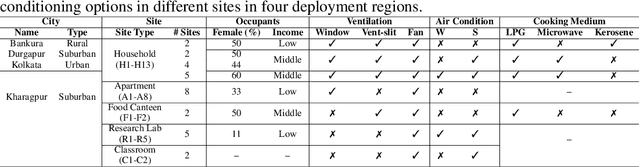
In recent years, indoor air pollution has posed a significant threat to our society, claiming over 3.2 million lives annually. Developing nations, such as India, are most affected since lack of knowledge, inadequate regulation, and outdoor air pollution lead to severe daily exposure to pollutants. However, only a limited number of studies have attempted to understand how indoor air pollution affects developing countries like India. To address this gap, we present spatiotemporal measurements of air quality from 30 indoor sites over six months during summer and winter seasons. The sites are geographically located across four regions of type: rural, suburban, and urban, covering the typical low to middle-income population in India. The dataset contains various types of indoor environments (e.g., studio apartments, classrooms, research laboratories, food canteens, and residential households), and can provide the basis for data-driven learning model research aimed at coping with unique pollution patterns in developing countries. This unique dataset demands advanced data cleaning and imputation techniques for handling missing data due to power failure or network outages during data collection. Furthermore, through a simple speech-to-text application, we provide real-time indoor activity labels annotated by occupants. Therefore, environmentalists and ML enthusiasts can utilize this dataset to understand the complex patterns of the pollutants under different indoor activities, identify recurring sources of pollution, forecast exposure, improve floor plans and room structures of modern indoor designs, develop pollution-aware recommender systems, etc.