 Add to Chrome
 Add to Firefox
 Add to Edge
Reliable and Private Anonymous Routing for Satellite Constellations
Feb 12, 2026
Shared, dynamic network infrastructures, such as dual-use LEO satellite constellations, pose critical threats to metadata privacy, particularly for state actors operating in mixed-trust environments. This work proposes an enhanced anonymity architecture, evolving the Loopix mix-network, to provide robust security and reliability in these volatile topologies. We introduce three primary contributions: (1) A multi-path transport protocol utilizing $(n, k)$ erasure codes, which is demonstrated to counteract the high link volatility and intermittent connectivity that renders standard mix-networks unreliable. (2) The integration of a computationally efficient Private Information Retrieval (PIR) protocol during route discovery. (3) The introduction of adaptive, centrality-based delay strategies that efficiently mitigate the inherent topological bias of LEO networks, providing a superior anonymity-to-latency trade-off. This mechanism provably prevents metadata leakage at the user-provider directory, mitigating profiling and correlation attacks. We validate this architecture via high-fidelity, packet-level simulations of a LEO constellation. Empirical results show our multi-path transport achieves near-zero message loss, establishing a quantifiable trade-off between reliability and bandwidth overhead. Furthermore, microbenchmarks of the PIR protocol quantify its computational and latency overheads, confirming its feasibility for practical deployment. This work provides a validated blueprint for deployable high-anonymity communication systems, demonstrating the viability of securely multiplexing sensitive operations within large-scale commercial network infrastructures.

Physical Layer Security in a Private 5G Network for Industrial and Mobility Application
Oct 09, 2023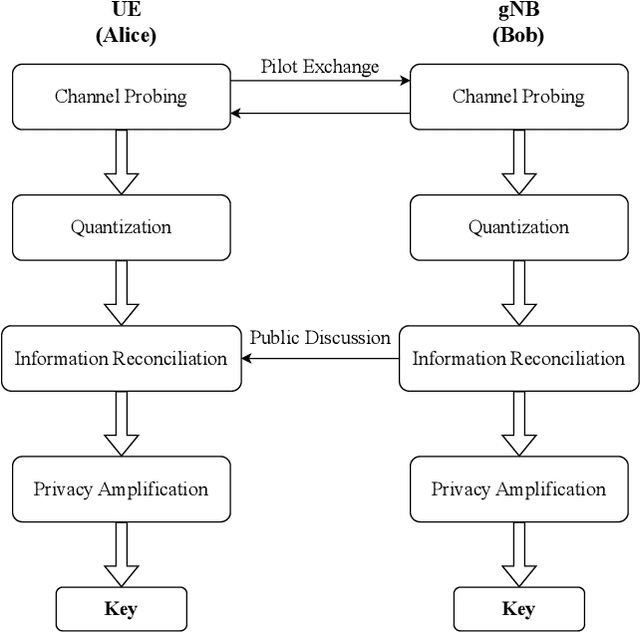
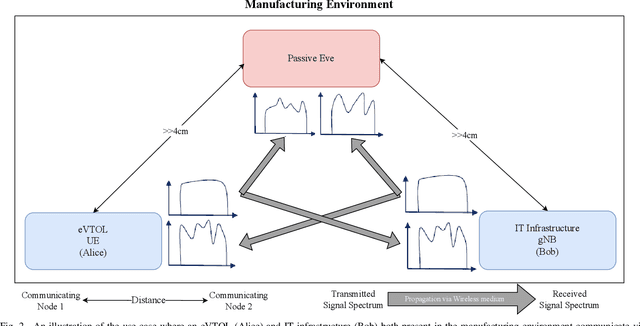
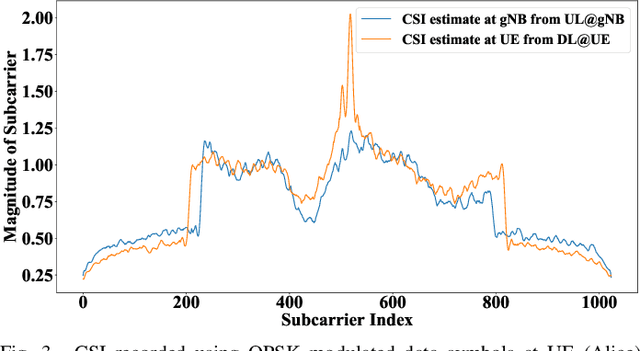
Cellular communication technologies such as 5G are deployed on a large scale around the world. Compared to other communication technologies such as WiFi, Bluetooth, or Ultra Wideband, the 5G communication standard describes support for a large variety of use cases, e.g., Internet of Things, vehicular, industrial, and campus-wide communications. An organization can operate a Private 5G network to provide connectivity to devices in their manufacturing environment. Physical Layer Key Generation (PLKG) is a method to generate a symmetric secret on two nodes despite the presence of a potential passive eavesdropper. To the best of our knowledge, this work is one of the first to implement PLKG in a real Private 5G network. Therefore, it highlights the possibility of integrating PLKG in the communication technology highly relevant for industrial applications. This paper exemplifies the establishment of a long-term symmetric key between an aerial vehicle and IT infrastructure both located in a manufacturing environment and communicating via the radio interface of the Private 5G network.