 Add to Chrome
 Add to Firefox
 Add to Edge
HAPS: Rethinking Image Similarity for Virtual Staining
May 19, 2026
Virtual staining of histopathology images (e.g., H&E-IHC) is an emerging tool in digital pathology, enabling faster and cheaper workflows by synthesizing target stains from routinely acquired slides. Yet, the quality of virtual staining models is still predominantly assessed with generic metrics such as SSIM, PSNR, and LPIPS. Originally developed for natural images, these metrics are inherently misaligned with the domain-specific characteristics of histological data, failing to capture tissue morphology preservation and biomarker expression patterns. Consequently, a robust, domain-specific standard for quantifying similarity across diverse histological modalities remains a critical gap in the field. In this work, we formalize histology image similarity as a standalone problem and systematically evaluate a broad set of full-reference metrics against a dataset of H&E-IHC patch pairs annotated with expert similarity scores. We further analyze metrics sensitivity to controlled geometric distortions (shifts, rotations and non-rigid deformations) that mimic realistic registration errors between serial sections. Guided by these observations, we propose the Histology-Aware Perceptual Similarity (HAPS) metric. HAPS computes distances in the feature space of a frozen encoder pretrained on histopathology data, adding a linear head to aggregate feature-level differences into a final score that aligns with expert assessments. Finally, we demonstrate the practical value of HAPS for quality control of training data. By quantifying the similarity of training pairs in the MIST dataset and filtering low-scoring samples, we create a cleaner training set. Virtual staining models trained on this refined data outperform those trained on the original, unfiltered dataset.

Generation of the NIR spectral Band for Satellite Images with Convolutional Neural Networks
Jun 13, 2021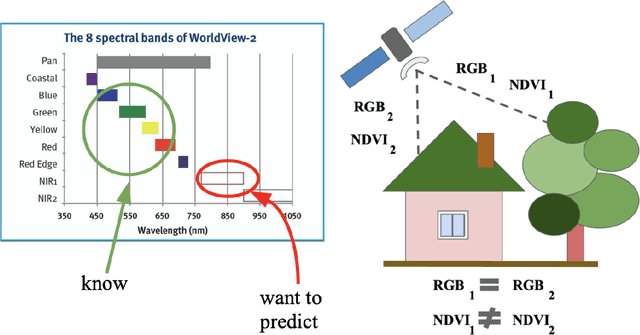
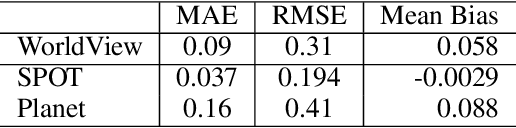
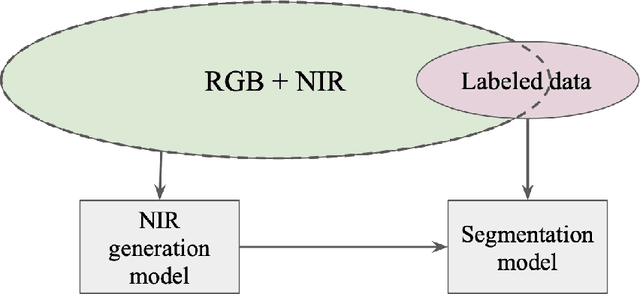
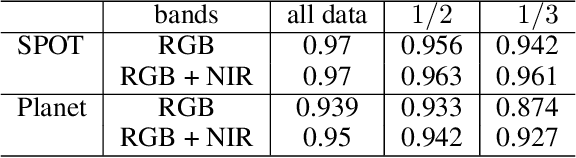
The near-infrared (NIR) spectral range (from 780 to 2500 nm) of the multispectral remote sensing imagery provides vital information for the landcover classification, especially concerning the vegetation assessment. Despite the usefulness of NIR, common RGB is not always accompanied by it. Modern achievements in image processing via deep neural networks allow generating artificial spectral information, such as for the image colorization problem. In this research, we aim to investigate whether this approach can produce not only visually similar images but also an artificial spectral band that can improve the performance of computer vision algorithms for solving remote sensing tasks. We study the generative adversarial network (GAN) approach in the task of the NIR band generation using just RGB channels of high-resolution satellite imagery. We evaluate the impact of a generated channel on the model performance for solving the forest segmentation task. Our results show an increase in model accuracy when using generated NIR comparing to the baseline model that uses only RGB (0.947 and 0.914 F1-score accordingly). Conducted study shows the advantages of generating the extra band and its implementation in applied challenges reducing the required amount of labeled data.
Object-Based Augmentation Improves Quality of Remote SensingSemantic Segmentation
May 12, 2021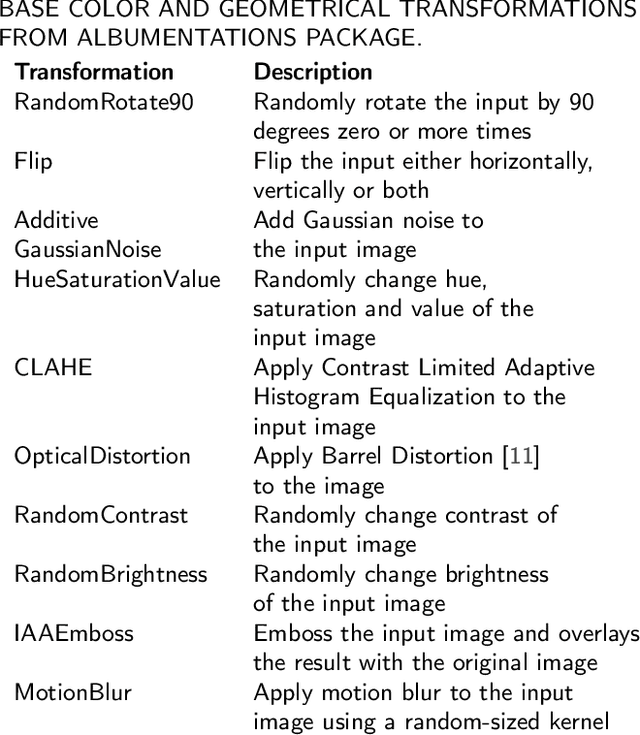
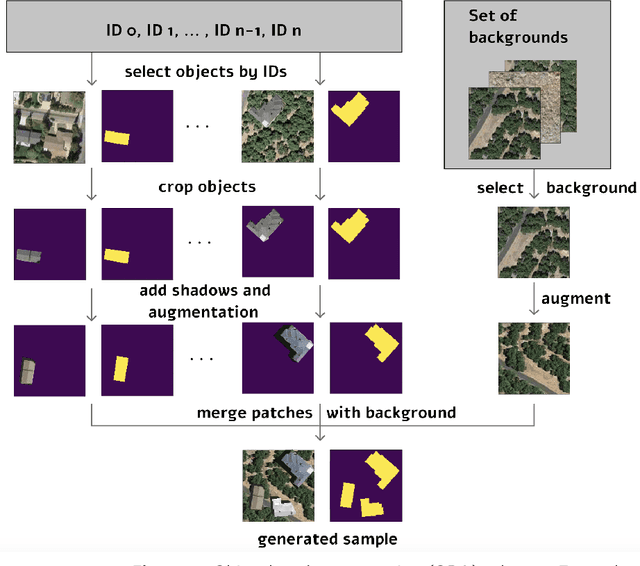
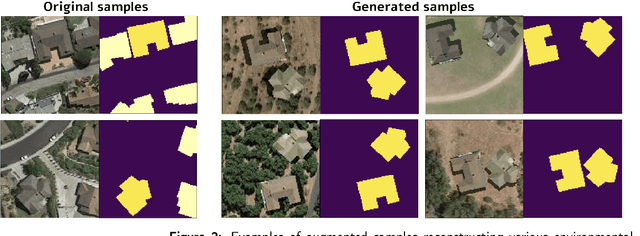

Today deep convolutional neural networks (CNNs) push the limits for most computer vision problems, define trends, and set state-of-the-art results. In remote sensing tasks such as object detection and semantic segmentation, CNNs reach the SotA performance. However, for precise performance, CNNs require much high-quality training data. Rare objects and the variability of environmental conditions strongly affect prediction stability and accuracy. To overcome these data restrictions, it is common to consider various approaches including data augmentation techniques. This study focuses on the development and testing of object-based augmentation. The practical usefulness of the developed augmentation technique is shown in the remote sensing domain, being one of the most demanded ineffective augmentation techniques. We propose a novel pipeline for georeferenced image augmentation that enables a significant increase in the number of training samples. The presented pipeline is called object-based augmentation (OBA) and exploits objects' segmentation masks to produce new realistic training scenes using target objects and various label-free backgrounds. We test the approach on the buildings segmentation dataset with six different CNN architectures and show that the proposed method benefits for all the tested models. We also show that further augmentation strategy optimization can improve the results. The proposed method leads to the meaningful improvement of U-Net model predictions from 0.78 to 0.83 F1-score.