 Add to Chrome
 Add to Firefox
 Add to Edge
Sim2Swim: Zero-Shot Velocity Control for Agile AUV Maneuvering in 3 Minutes
Dec 09, 2025
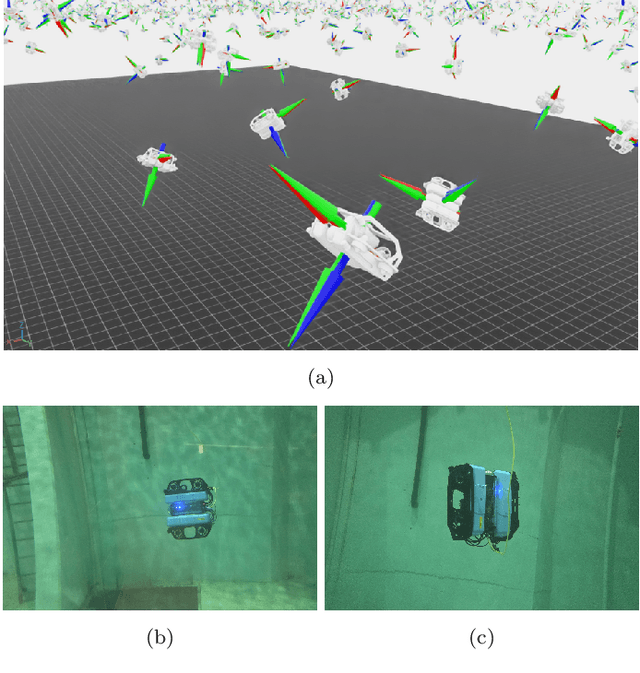
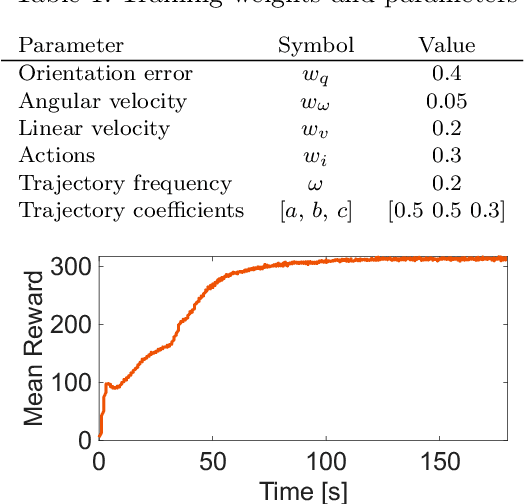
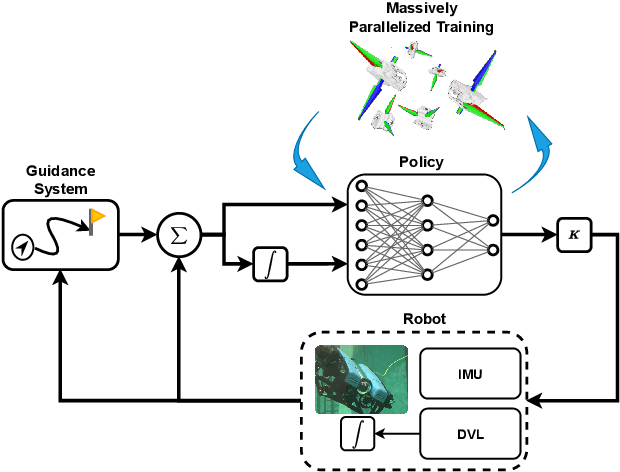
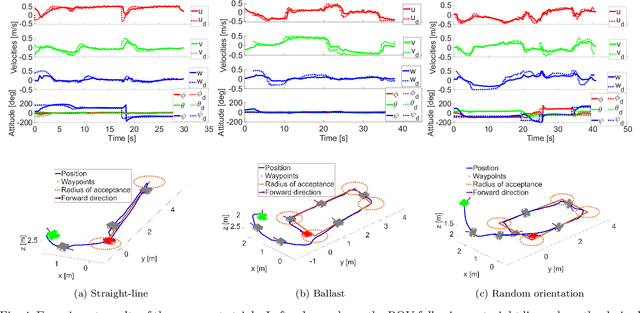
Holonomic autonomous underwater vehicles (AUVs) have the hardware ability for agile maneuvering in both translational and rotational degrees of freedom (DOFs). However, due to challenges inherent to underwater vehicles, such as complex hydrostatics and hydrodynamics, parametric uncertainties, and frequent changes in dynamics due to payload changes, control is challenging. Performance typically relies on carefully tuned controllers targeting unique platform configurations, and a need for re-tuning for deployment under varying payloads and hydrodynamic conditions. As a consequence, agile maneuvering with simultaneous tracking of time-varying references in both translational and rotational DOFs is rarely utilized in practice. To the best of our knowledge, this paper presents the first general zero-shot sim2real deep reinforcement learning-based (DRL) velocity controller enabling path following and agile 6DOF maneuvering with a training duration of just 3 minutes. Sim2Swim, the proposed approach, inspired by state-of-the-art DRL-based position control, leverages domain randomization and massively parallelized training to converge to field-deployable control policies for AUVs of variable characteristics without post-processing or tuning. Sim2Swim is extensively validated in pool trials for a variety of configurations, showcasing robust control for highly agile motions.

SOLAQUA: SINTEF Ocean Large Aquaculture Robotics Dataset
Apr 02, 2025This paper presents a dataset gathered with an underwater robot in a sea-based aquaculture setting. Data was gathered from an operational fish farm and includes data from sensors such as the Waterlinked A50 DVL, the Nortek Nucleus 1000 DVL, Sonardyne Micro Ranger 2 USBL, Sonoptix Mulitbeam Sonar, mono and stereo cameras, and vehicle sensor data such as power usage, IMU, pressure, temperature, and more. Data acquisition is performed during both manual and autonomous traversal of the net pen structure. The collected vision data is of undamaged nets with some fish and marine growth presence, and it is expected that both the research community and the aquaculture industry will benefit greatly from the utilization of the proposed SOLAQUA dataset.
Underwater robot guidance, navigation and control in fish net pens
Sep 16, 2024Aquaculture robotics is receiving increased attention and is subject to unique challenges and opportunities for research and development. Guidance, navigation and control are all important aspects for realizing aquaculture robotics solutions that can greatly benefit the industry in the future. Sensor technologies, navigation methods, motion planners and state control all have a role to play, and this paper introduces some technologies and methods that are currently being applied in research and industry before providing some examples of challenges that can be targeted in the future.