 Add to Chrome
 Add to Firefox
 Add to Edge
A corpus-specific clinical RAG system matches or outperforms newer frontier LLMs on HealthBench
Aug 12, 2026
General-purpose large language models (LLMs) have recently been reported to match or exceed specialized clinical AI tools on medical benchmarks, but such comparisons draw on a narrow set of systems and on benchmarks developed largely in high-income settings. We evaluate VITA, a retrieval-augmented generation (RAG) system purpose-built for contextual knowledge retrieval in India and other low- and middle-income (LMIC) settings. VITA retrieves from a curated corpus of disease-specific guidelines, India-specific antimicrobial resistance data, national formulary constraints, and resource-limited care protocols; its architecture and corpus are proprietary, but the benchmark, the physician-written rubrics, and our full response and scoring outputs are public for independent verification. On 4,023 English-language HealthBench questions (80.5% of the benchmark), scored with a GPT-4.1 judge, VITA ranked first with 51.9% of possible rubric points, ahead of GPT-5.4 (46.1%), o4-mini (44.3%), Gemini 3.1 Pro (42.6%), and Claude Sonnet 4.6 (37.3%), and scored highest on 45.4% of questions. To test robustness to newer models and judge lineage, a 500-question subset was re-run against current-generation models (GPT-5.5, Claude Opus 4.8, Gemini 3.5 Pro, Grok 4.3) and graded by a neutral open-weight judge (DeepSeek-V4-Pro) sharing no lineage with any system tested. Here the gap narrowed to parity: VITA and GPT-5.5 were statistically indistinguishable on mean per-question score, while VITA led on points-weighted score and won the most questions. VITA's advantages in accuracy and completeness persisted under the neutral judge; its communication scores were lower. These results indicate that a purpose-built clinical RAG system remains competitive with frontier LLMs on an open benchmark, consistent with corpus specificity as a design variable that improves grounding at some cost to communication polish.

Fine-Grained Rib Fracture Diagnosis with Hyperbolic Embeddings: A Detailed Annotation Framework and Multi-Label Classification Model
Apr 16, 2025
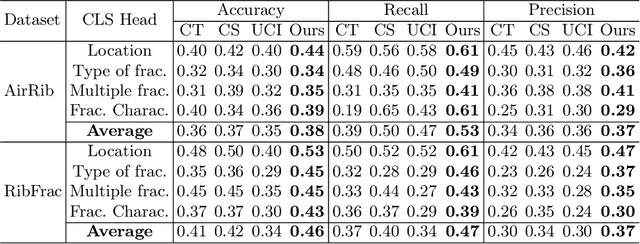
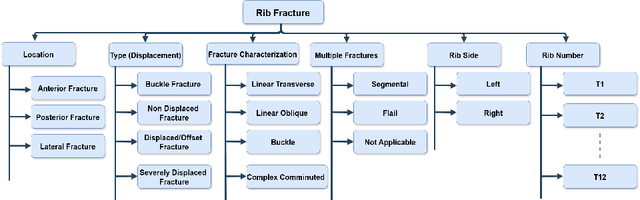
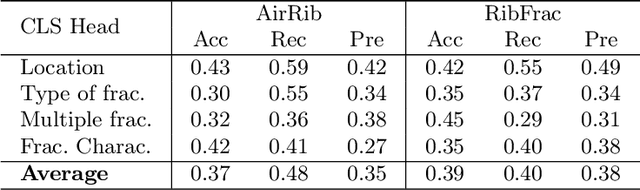
Accurate rib fracture identification and classification are essential for treatment planning. However, existing datasets often lack fine-grained annotations, particularly regarding rib fracture characterization, type, and precise anatomical location on individual ribs. To address this, we introduce a novel rib fracture annotation protocol tailored for fracture classification. Further, we enhance fracture classification by leveraging cross-modal embeddings that bridge radiological images and clinical descriptions. Our approach employs hyperbolic embeddings to capture the hierarchical nature of fracture, mapping visual features and textual descriptions into a shared non-Euclidean manifold. This framework enables more nuanced similarity computations between imaging characteristics and clinical descriptions, accounting for the inherent hierarchical relationships in fracture taxonomy. Experimental results demonstrate that our approach outperforms existing methods across multiple classification tasks, with average recall improvements of 6% on the AirRib dataset and 17.5% on the public RibFrac dataset.