 Add to Chrome
 Add to Firefox
 Add to Edge
STARK: Spatio-Temporal Attention for Representation of Keypoints for Continuous Sign Language Recognition
Mar 17, 2026
Continuous Sign Language Recognition (CSLR) is a crucial task for understanding the languages of deaf communities. Contemporary keypoint-based approaches typically rely on spatio-temporal encoding, where spatial interactions among keypoints are modeled using Graph Convolutional Networks or attention mechanisms, while temporal dynamics are captured using 1D convolutional networks. However, such designs often introduce a large number of parameters in both the encoder and the decoder. This paper introduces a unified spatio-temporal attention network that computes attention scores both spatially (across keypoints) and temporally (within local windows), and aggregates features to produce a local context-aware spatio-temporal representation. The proposed encoder contains approximately $70-80\%$ fewer parameters than existing state-of-the-art models while achieving comparable performance to keypoint-based methods on the Phoenix-14T dataset.

Hierarchical Windowed Graph Attention Network and a Large Scale Dataset for Isolated Indian Sign Language Recognition
Jul 19, 2024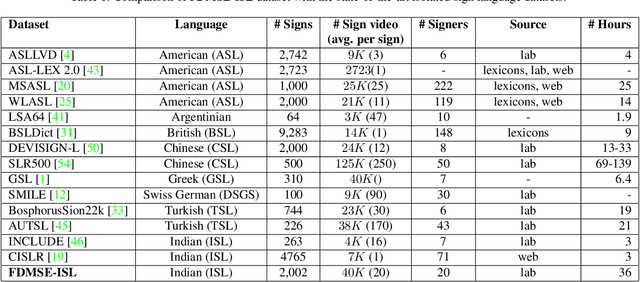
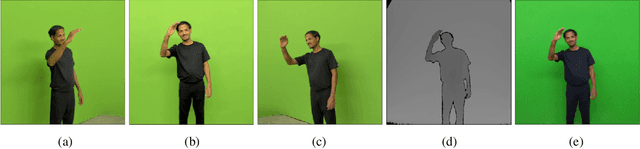
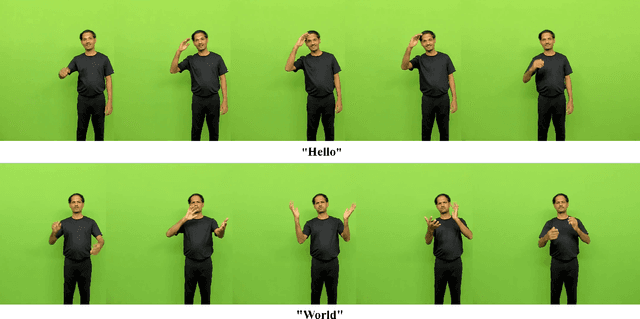
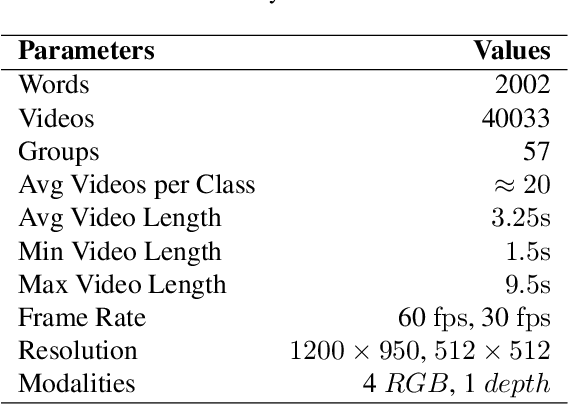
Automatic Sign Language (SL) recognition is an important task in the computer vision community. To build a robust SL recognition system, we need a considerable amount of data which is lacking particularly in Indian sign language (ISL). In this paper, we propose a large-scale isolated ISL dataset and a novel SL recognition model based on skeleton graph structure. The dataset covers 2,002 daily used common words in the deaf community recorded by 20 (10 male and 10 female) deaf adult signers (contains 40033 videos). We propose a SL recognition model namely Hierarchical Windowed Graph Attention Network (HWGAT) by utilizing the human upper body skeleton graph structure. The HWGAT tries to capture distinctive motions by giving attention to different body parts induced by the human skeleton graph structure. The utility of the proposed dataset and the usefulness of our model are evaluated through extensive experiments. We pre-trained the proposed model on the proposed dataset and fine-tuned it across different sign language datasets further boosting the performance of 1.10, 0.46, 0.78, and 6.84 percentage points on INCLUDE, LSA64, AUTSL and WLASL respectively compared to the existing state-of-the-art skeleton-based models.