 Add to Chrome
 Add to Firefox
 Add to Edge
Deep Distance Measurement Method for Unsupervised Multivariate Time Series Similarity Retrieval
Mar 13, 2026
We propose the Deep Distance Measurement Method (DDMM) to improve retrieval accuracy in unsupervised multivariate time series similarity retrieval. DDMM enables learning of minute differences within states in the entire time series and thereby recognition of minute differences between states, which are of interest to users in industrial plants. To achieve this, DDMM uses a learning algorithm that assigns a weight to each pair of an anchor and a positive sample, arbitrarily sampled from the entire time series, based on the Euclidean distance within the pair and learns the differences within the pairs weighted by the weights. This algorithm allows both learning minute differences within states and sampling pairs from the entire time series. Our empirical studies showed that DDMM significantly outperformed state-of-the-art time series representation learning methods on the Pulp-and-paper mill dataset and demonstrated the effectiveness of DDMM in industrial plants. Furthermore, we showed that accuracy can be further improved by linking DDMM with existing feature extraction methods through experiments with the combined model.
* Workshop of Artificial Intelligence for Time Series Analysis (AI4TS): Theory, Algorithms, and Applications at 2025 IEEE International Conference on Data Mining (ICDM), 2025

Anomaly Detection for Multivariate Time Series on Large-scale Fluid Handling Plant Using Two-stage Autoencoder
May 20, 2022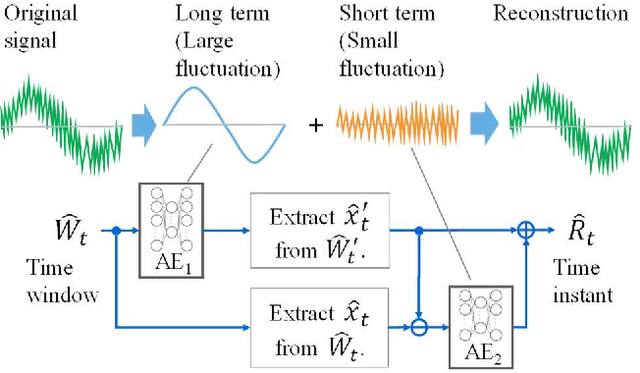

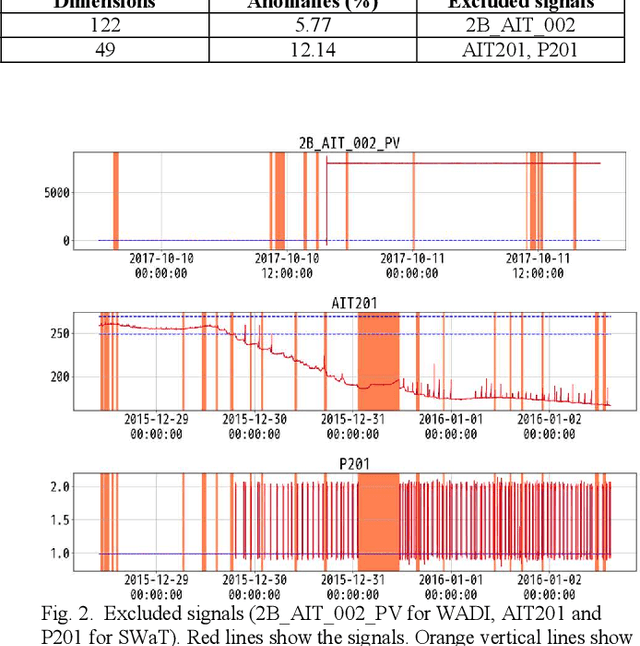
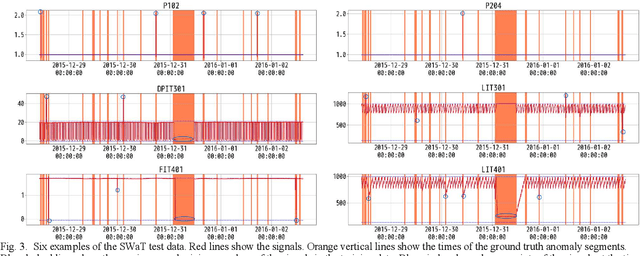
This paper focuses on anomaly detection for multivariate time series data in large-scale fluid handling plants with dynamic components, such as power generation, water treatment, and chemical plants, where signals from various physical phenomena are observed simultaneously. In these plants, the need for anomaly detection techniques is increasing in order to reduce the cost of operation and maintenance, in view of a decline in the number of skilled engineers and a shortage of manpower. However, considering the complex behavior of high-dimensional signals and the demand for interpretability, the techniques constitute a major challenge. We introduce a Two-Stage AutoEncoder (TSAE) as an anomaly detection method suitable for such plants. This is a simple autoencoder architecture that makes anomaly detection more interpretable and more accurate, in which based on the premise that plant signals can be separated into two behaviors that have almost no correlation with each other, the signals are separated into long-term and short-term components in a stepwise manner, and the two components are trained independently to improve the inference capability for normal signals. Through experiments on two publicly available datasets of water treatment systems, we have confirmed the high detection performance, the validity of the premise, and that the model behavior was as intended, i.e., the technical effectiveness of TSAE.
* The 2nd Workshop on Large-scale Industrial Time Series Analysis at the 21st IEEE International Conference on Data Mining (ICDM), 2021