 Add to Chrome
 Add to Firefox
 Add to Edge
Joint Channel Estimation and Beamforming for Reconfigurable Intelligent Surface Aided MIMO Systems: Sparsity-Based Approach
Mar 04, 2026
Continuous efforts have been devoted to integrate millimeter wave (mmWave) and terahertz (THz) bands into future communication standards in order to overcome the bandwidth shortage problem and achieve high data rates, primarily through developing accompanying technologies that can overcome the severe propagation loss and blockage associated with increased carrier frequency. One of the most notable accompanying technologies is reconfigurable intelligent surface (RIS), which uses a large number of low-cost passive reflecting elements to reconfigure the propagation environments for improved communication performance and coverage. Despite its numerous benefits, RIS can make channel estimation more difficult due to its lack of radio frequency (RF) chains that can perform baseband signal processing. In addition, the cascaded channel structure of RIS-aided communication systems, which differs from that in conventional systems, brings about significant challenges in both channel estimation and beamforming. In this paper, we propose the joint channel estimation and beamforming optimization algorithm for RIS-aided multiple-input multipleoutput (MIMO) communication systems. By carefully exploiting the angular sparsity of mmWave/THz channels, our proposed algorithm successfully designs the RIS matrices that not only facilitate the channel estimation process but also achieve the passive beamforming gain through increased channel capacity. Simulation results demonstrate that our proposed algorithm provides the systems of interest with significant improvement in spectral efficiency.

Hybrid Beamforming for Intelligent Reflecting Surface Aided Millimeter Wave MIMO Systems
May 28, 2021
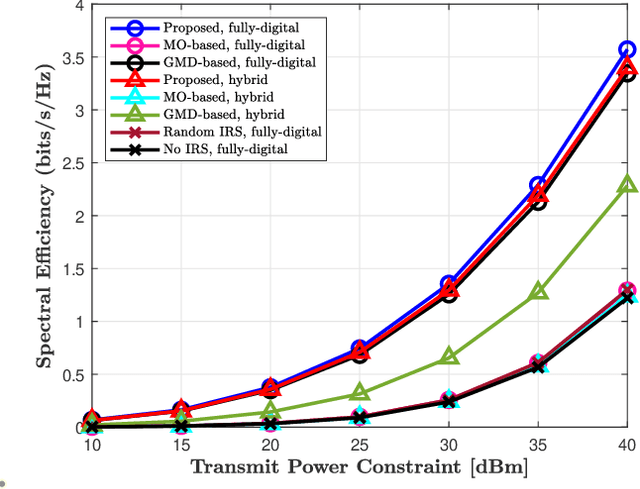
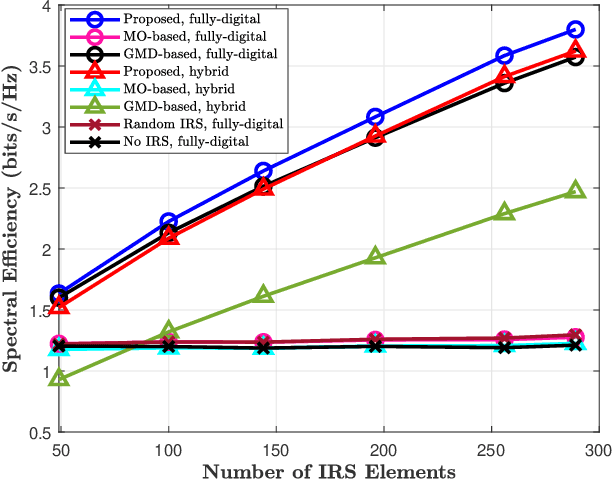
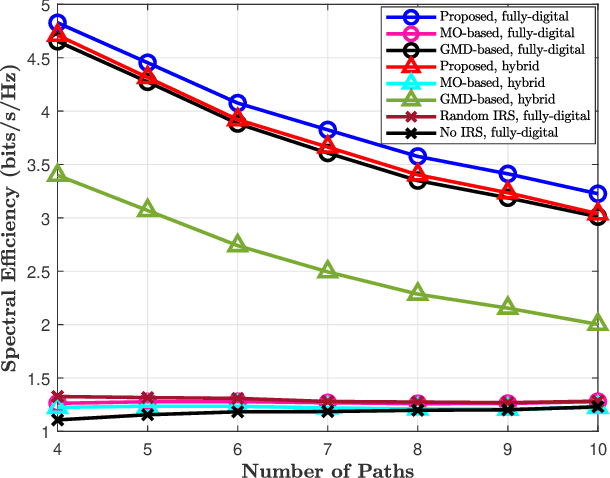
While communication systems that employ millimeter wave (mmWave) frequency bands can support extremely high data rates, they must use large antenna arrays in order to overcome the severe propagation loss of mmWave signals. As the cost of traditional fully-digital beamforming at baseband increases rapidly with the number of antennas, hybrid beamforming that requires only a small number of radio frequency (RF) chains has been considered as a key enabling technology for mmWave communications. Intelligent reflecting surface (IRS) is another innovative technology that has been proposed as an integral element of future communication systems, establishing the favorable propagation environment in a timely manner through the use of low-cost passive reflecting elements. In this paper, we study IRS-aided mmWave multiple-input multiple-output (MIMO) systems with hybrid beamforming architectures. We first propose the joint design of IRS reflection pattern and hybrid beamformer for narrowband MIMO systems. Then, by exploiting the sparsity of frequency-selective mmWave channels in the angular domain, we generalize the proposed joint design to broadband MIMO systems with orthogonal frequency division multiplexing (OFDM) modulation. Simulation results demonstrate that the proposed joint designs can significantly enhance the spectral efficiency of the systems of interest and achieve superior performance over the existing designs.