 Add to Chrome
 Add to Firefox
 Add to Edge
CRIT: Graph-Based Automatic Data Synthesis to Enhance Cross-Modal Multi-Hop Reasoning
Apr 02, 2026
Real-world reasoning often requires combining information across modalities, connecting textual context with visual cues in a multi-hop process. Yet, most multimodal benchmarks fail to capture this ability: they typically rely on single images or set of images, where answers can be inferred from a single modality alone. This limitation is mirrored in the training data, where interleaved image-text content rarely enforces complementary, multi-hop reasoning. As a result, Vision-Language Models (VLMs) frequently hallucinate and produce reasoning traces poorly grounded in visual evidence. To address this gap, we introduce CRIT, a new dataset and benchmark built with a graph-based automatic pipeline for generating complex cross-modal reasoning tasks. CRIT consists of diverse domains ranging from natural images, videos, and text-rich sources, and includes a manually verified test set for reliable evaluation. Experiments on this benchmark reveal that even state-of-the-art models struggle on such reasoning tasks. Models trained on CRIT show significant gains in cross-modal multi-hop reasoning, including strong improvements on SPIQA and other standard multimodal benchmarks.

LCIRC: A Recurrent Compression Approach for Efficient Long-form Context and Query Dependent Modeling in LLMs
Feb 10, 2025
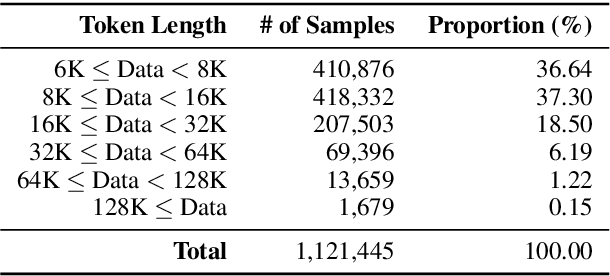


While large language models (LLMs) excel in generating coherent and contextually rich outputs, their capacity to efficiently handle long-form contexts is limited by fixed-length position embeddings. Additionally, the computational cost of processing long sequences increases quadratically, making it challenging to extend context length. To address these challenges, we propose Long-form Context Injection with Recurrent Compression (LCIRC), a method that enables the efficient processing long-form sequences beyond the model's length limit through recurrent compression without retraining the entire model. We further introduce query dependent context modeling, which selectively compresses query-relevant information, ensuring that the model retains the most pertinent content. Our empirical results demonstrate that Query Dependent LCIRC (QD-LCIRC) significantly improves LLM's ability to manage extended contexts, making it well-suited for tasks that require both comprehensive context understanding and query relevance.