 Add to Chrome
 Add to Firefox
 Add to Edge
FUSE: Feature-Wise Unified Specialization with Cross-Column Exchange for Mixed-Type Tabular Flow Matching
Aug 07, 2026
Generating mixed-type tabular data requires jointly modeling diverse feature distributions and their complex cross-column dependencies. Variational flow matching handles distinct endpoints via factorized distributions, yet leaves feature-specific processing and cross-column interactions implicit within a shared backbone. We introduce Feature-wise Unified Specialization with cross-column Exchange (FUSE) to explicitly separate these roles. FUSE applies separate adaptive mixture modules to numerical and categorical features, allowing each feature to combine shared specialized subnetworks, while joint attention preserves information exchange across all columns. We also characterize the excess population risk from restricted conditioning contexts and bound the continuous Wasserstein generation error by endpoint-prediction risk. Comprehensive experiments on eight tabular datasets demonstrate that FUSE achieves strong and consistent performance across distributional fidelity and downstream utility metrics.

General Frameworks for Conditional Two-Sample Testing
Oct 22, 2024


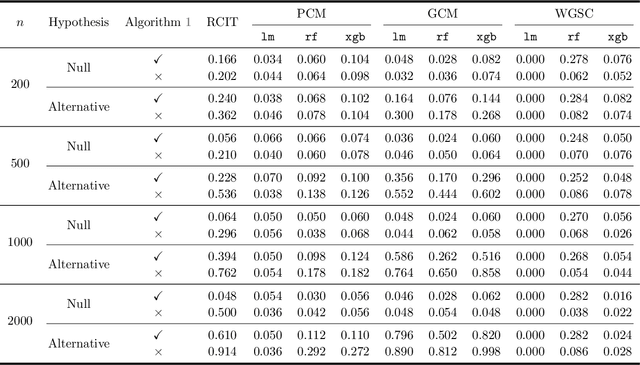
We study the problem of conditional two-sample testing, which aims to determine whether two populations have the same distribution after accounting for confounding factors. This problem commonly arises in various applications, such as domain adaptation and algorithmic fairness, where comparing two groups is essential while controlling for confounding variables. We begin by establishing a hardness result for conditional two-sample testing, demonstrating that no valid test can have significant power against any single alternative without proper assumptions. We then introduce two general frameworks that implicitly or explicitly target specific classes of distributions for their validity and power. Our first framework allows us to convert any conditional independence test into a conditional two-sample test in a black-box manner, while preserving the asymptotic properties of the original conditional independence test. The second framework transforms the problem into comparing marginal distributions with estimated density ratios, which allows us to leverage existing methods for marginal two-sample testing. We demonstrate this idea in a concrete manner with classification and kernel-based methods. Finally, simulation studies are conducted to illustrate the proposed frameworks in finite-sample scenarios.