 Add to Chrome
 Add to Firefox
 Add to Edge
Real-Time Whole-Body Teleoperation of a Humanoid Robot Using IMU-Based Motion Capture with Sim2Sim and Sim2Real Validation
May 12, 2026
Stable, low-latency whole-body teleoperation of humanoid robots is an open research challenge, complicated by kinematic mismatches between human and robot morphologies, accumulated inertial sensor noise, non-trivial control latency, and persistent sim-to-real transfer gaps. This paper presents a complete real-time whole-body teleoperation system that maps human motion, recorded with a Virdyn IMU-based full-body motion capture suit, directly onto a Unitree G1 humanoid robot. We introduce a custom motion-processing, kinematic retargeting, and control pipeline engineered for continuous, low-latency operation without any offline buffering or learning-based components. The system is first validated in simulation using the MuJoCo physics model of the Unitree G1 (sim2sim), and then deployed without modification on the physical platform (sim2real). Experimental results demonstrate stable, synchronized reproduction of a broad motion repertoire, including walking, standing, sitting, turning, bowing, and coordinated expressive full-body gestures. This work establishes a practical, scalable framework for whole-body humanoid teleoperation using commodity wearable motion capture hardware.

Deep Learning Frameworks for Cognitive Radio Networks: Review and Open Research Challenges
Oct 31, 2024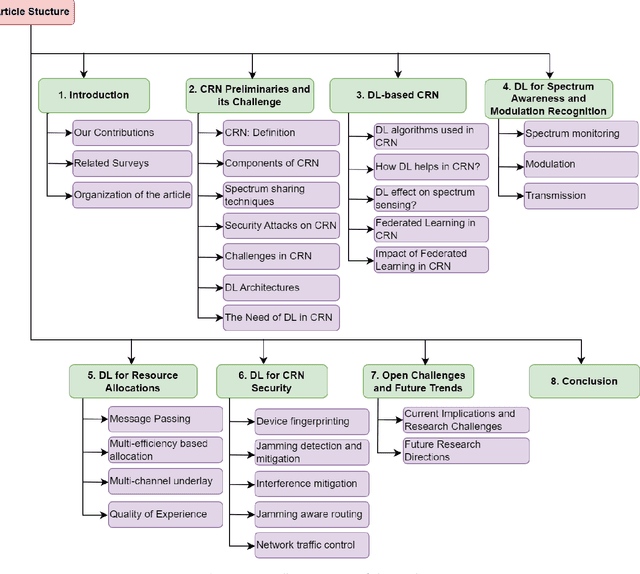
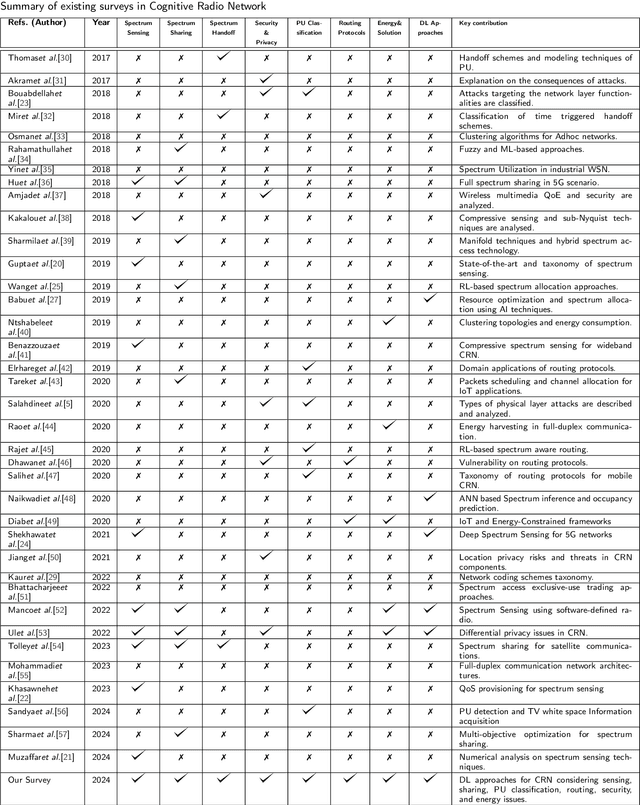
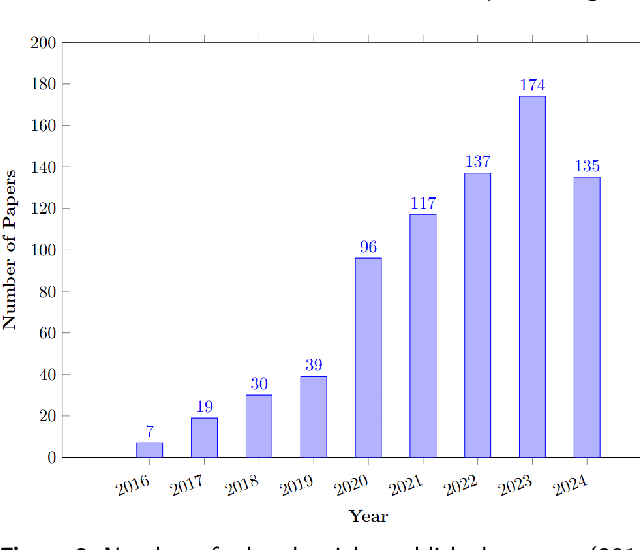
Deep learning has been proven to be a powerful tool for addressing the most significant issues in cognitive radio networks, such as spectrum sensing, spectrum sharing, resource allocation, and security attacks. The utilization of deep learning techniques in cognitive radio networks can significantly enhance the network's capability to adapt to changing environments and improve the overall system's efficiency and reliability. As the demand for higher data rates and connectivity increases, B5G/6G wireless networks are expected to enable new services and applications significantly. Therefore, the significance of deep learning in addressing cognitive radio network challenges cannot be overstated. This review article provides valuable insights into potential solutions that can serve as a foundation for the development of future B5G/6G services. By leveraging the power of deep learning, cognitive radio networks can pave the way for the next generation of wireless networks capable of meeting the ever-increasing demands for higher data rates, improved reliability, and security.