 Add to Chrome
 Add to Firefox
 Add to Edge
Understanding Representation Gaps Across Scales in Tropical Tree Species Classification from Drone Imagery
Apr 24, 2026
Accurate classification of tropical tree species from unoccupied aerial vehicle (UAV) imagery remains challenging due to high species diversity and strong visual similarity among species at typical image resolutions (centimeters per pixel). In contrast, models trained on close-up citizen science photographs captured with smartphones achieve strong plant species classification performance. Recent advances in UAV data acquisition now enable the collection of close-up images that are spatially registered with top-view aerial imagery and approach the level of visual detail found in smartphone photographs, with the trade-off that such high-resolution photos cannot be acquired for many trees. In this work, we evaluate the performance of existing methods using paired top-view and close-up UAV imagery collected in a species-rich tropical forest. Through fine-tuning experiments, we quantify the performance gap between vision foundation models and in-domain generalist plant recognition models across both image types (high-resolution close-up versus coarser-resolution top-view imagery). We show that classification performance is consistently higher on close-up images than on top-view aerial imagery, and that this performance gap widens for rare species. Finally, we propose that self-supervised representation alignment across these two spatial scales offers a promising approach for integrating fine-grained visual information into canopy-level species classification models based on top-view UAV imagery. Leveraging high-resolution close-up UAV imagery to enhance canopy-level species classification could substantially improve large-scale monitoring of tropical forest biodiversity.

Machine Learning and Multi-source Remote Sensing in Forest Carbon Stock Estimation: A Review
Nov 26, 2024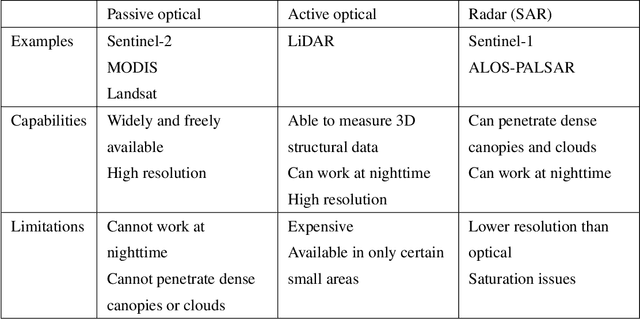
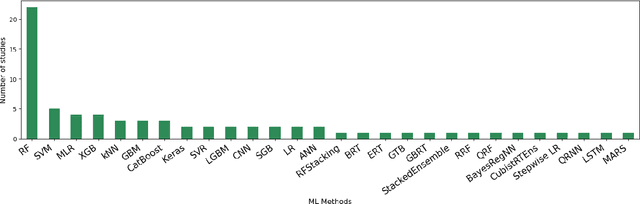
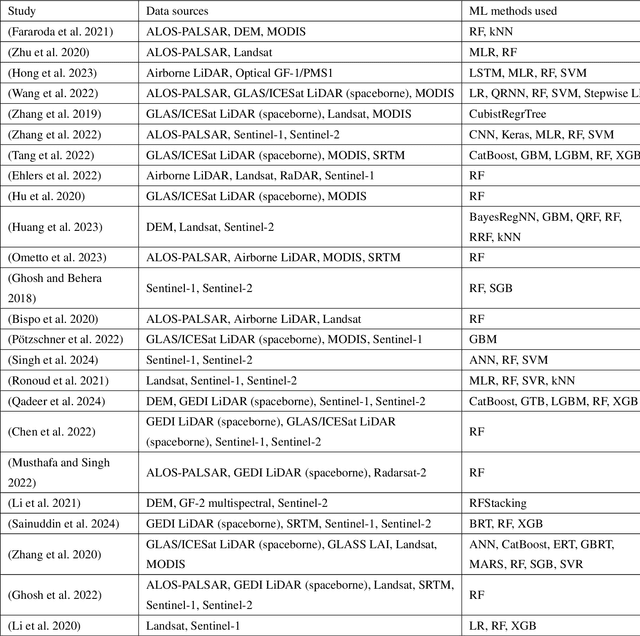
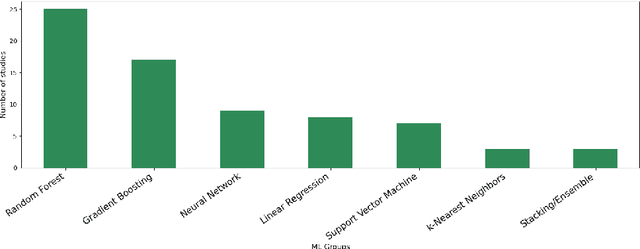
Quantifying forest carbon is crucial for informing decisions and policies that will protect the planet. Machine learning (ML) and remote sensing (RS) techniques have been used to do this task more effectively, yet there lacks a systematic review on the most recent ML methods and RS combinations, especially with the consideration of forest characteristics. This study systematically analyzed 25 papers meeting strict inclusion criteria from over 80 related studies, identifying 28 ML methods and key combinations of RS data. Random Forest had the most frequent appearance (88\% of studies), while Extreme Gradient Boosting showed superior performance in 75\% of the studies in which it was compared with other methods. Sentinel-1 emerged as the most utilized remote sensing source, with multi-sensor approaches (e.g., Sentinel-1, Sentinel-2, and LiDAR) proving especially effective. Our findings provide grounds for recommending best practices in integrating machine learning and remote sensing for accurate and scalable forest carbon stock estimation.