 Add to Chrome
 Add to Firefox
 Add to Edge
Freq-DP Net: A Dual-Branch Network for Fence Removal using Dual-Pixel and Fourier Priors
Feb 15, 2026
Removing fence occlusions from single images is a challenging task that degrades visual quality and limits downstream computer vision applications. Existing methods often fail on static scenes or require motion cues from multiple frames. To overcome these limitations, we introduce the first framework to leverage dual-pixel (DP) sensors for this problem. We propose Freq-DP Net, a novel dual-branch network that fuses two complementary priors: a geometric prior from defocus disparity, modeled using an explicit cost volume, and a structural prior of the fence's global pattern, learned via Fast Fourier Convolution (FFC). An attention mechanism intelligently merges these cues for highly accurate fence segmentation. To validate our approach, we build and release a diverse benchmark with different fence varieties. Experiments demonstrate that our method significantly outperforms strong general-purpose baselines, establishing a new state-of-the-art for single-image, DP-based fence removal.

Spatio-Temporal Video Representation Learning for AI Based Video Playback Style Prediction
Oct 03, 2021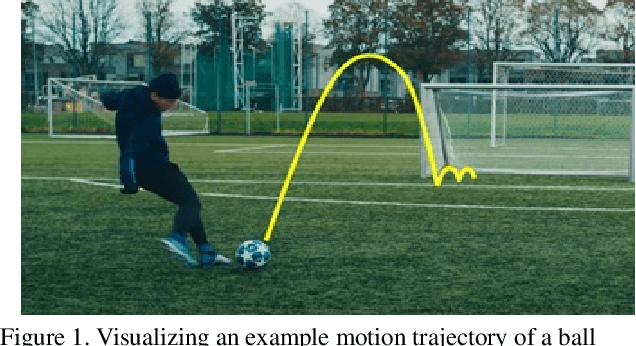
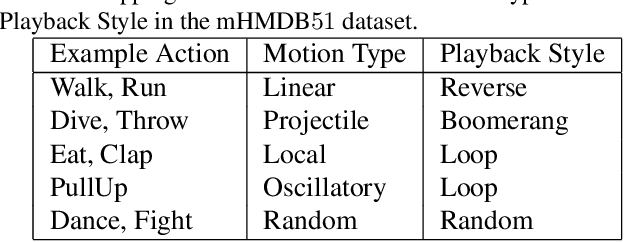
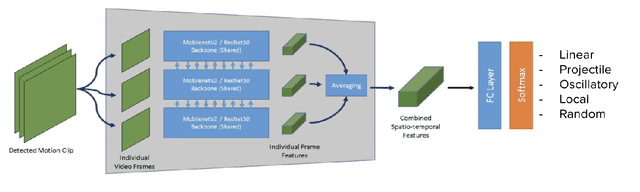
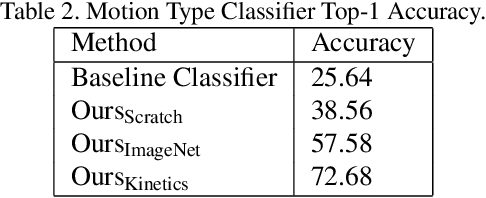
Ever-increasing smartphone-generated video content demands intelligent techniques to edit and enhance videos on power-constrained devices. Most of the best performing algorithms for video understanding tasks like action recognition, localization, etc., rely heavily on rich spatio-temporal representations to make accurate predictions. For effective learning of the spatio-temporal representation, it is crucial to understand the underlying object motion patterns present in the video. In this paper, we propose a novel approach for understanding object motions via motion type classification. The proposed motion type classifier predicts a motion type for the video based on the trajectories of the objects present. Our classifier assigns a motion type for the given video from the following five primitive motion classes: linear, projectile, oscillatory, local and random. We demonstrate that the representations learned from the motion type classification generalizes well for the challenging downstream task of video retrieval. Further, we proposed a recommendation system for video playback style based on the motion type classifier predictions.