 Add to Chrome
 Add to Firefox
 Add to Edge
Physics-informed neural operators for the in situ characterization of locally reacting sound absorbers
Apr 08, 2026
Accurate knowledge of acoustic surface admittance or impedance is essential for reliable wave-based simulations, yet its in situ estimation remains challenging due to noise, model inaccuracies, and restrictive assumptions of conventional methods. This work presents a physics-informed neural operator approach for estimating frequency-dependent surface admittance directly from near-field measurements of sound pressure and particle velocity. A deep operator network is employed to learn the mapping from measurement data, spatial coordinates, and frequency to acoustic field quantities, while simultaneously inferring a globally consistent surface admittance spectrum without requiring an explicit forward model. The governing acoustic relations, including the Helmholtz equation, the linearized momentum equation, and Robin boundary conditions, are embedded into the training process as physics-based regularization, enabling physically consistent and noise-robust predictions while avoiding frequency-wise inversion. The method is validated using synthetically generated data from a simulation model for two planar porous absorbers under semi free-field conditions across a broad frequency range. Results demonstrate accurate reconstruction of both real and imaginary admittance components and reliable prediction of acoustic field quantities. Parameter studies confirm improved robustness to noise and sparse sampling compared to purely data-driven approaches, highlighting the potential of physics-informed neural operators for in situ acoustic material characterization.

A data-driven two-microphone method for in-situ sound absorption measurements
Feb 06, 2025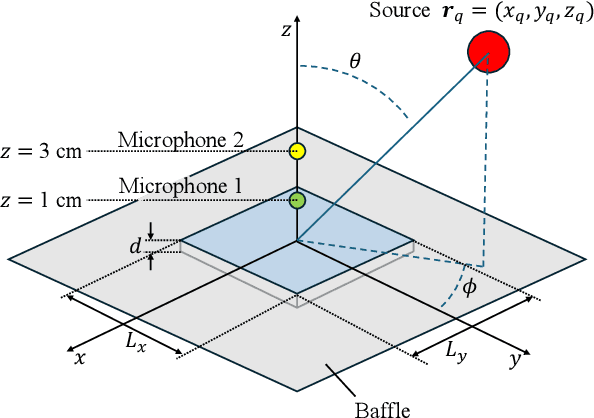
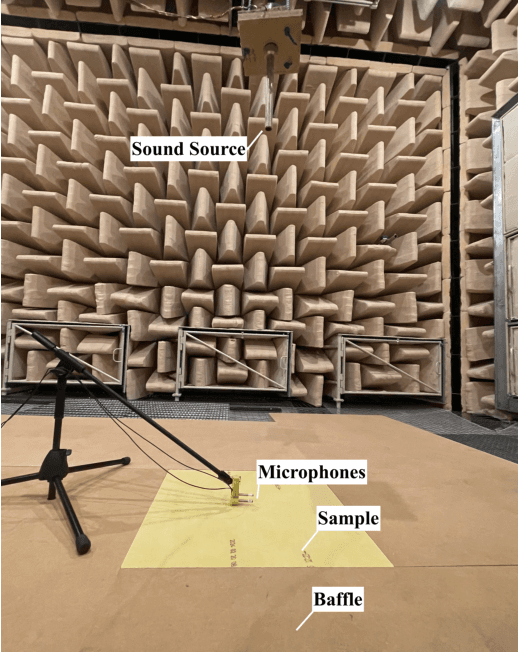
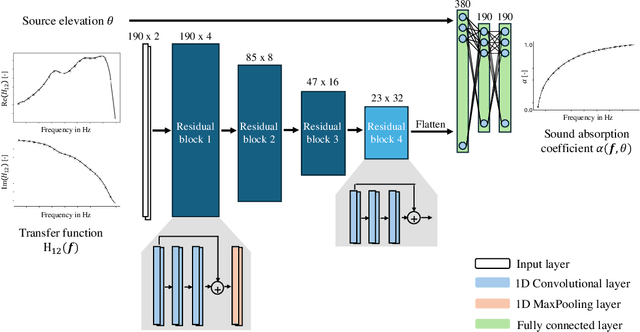
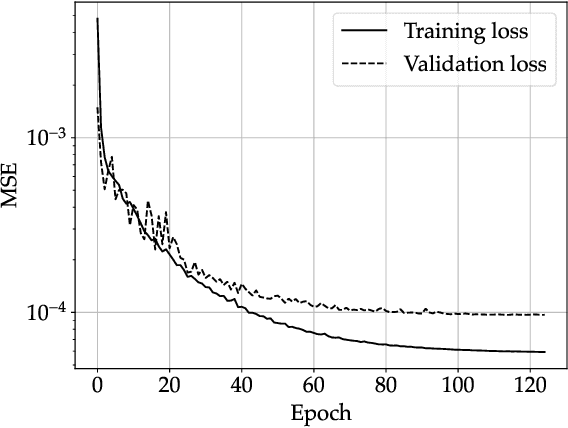
This work presents a data-driven approach to estimating the sound absorption coefficient of an infinite porous slab using a neural network and a two-microphone measurement on a finite porous sample. A 1D-convolutional network predicts the sound absorption coefficient from the complex-valued transfer function between the sound pressure measured at the two microphone positions. The network is trained and validated with numerical data generated by a boundary element model using the Delany-Bazley-Miki model, demonstrating accurate predictions for various numerical samples. The method is experimentally validated with baffled rectangular samples of a fibrous material, where sample size and source height are varied. The results show that the neural network offers the possibility to reliably predict the in-situ sound absorption of a porous material using the traditional two-microphone method as if the sample were infinite. The normal-incidence sound absorption coefficient obtained by the network compares well with that obtained theoretically and in an impedance tube. The proposed method has promising perspectives for estimating the sound absorption coefficient of acoustic materials after installation and in realistic operational conditions.