 Add to Chrome
 Add to Firefox
 Add to Edge
StormNet: Improving storm surge predictions with a GNN-based spatio-temporal offset forecasting model
Apr 23, 2026
Storm surge forecasting remains a critical challenge in mitigating the impacts of tropical cyclones on coastal regions, particularly given recent trends of rapid intensification and increasing nearshore storm activity. Traditional high fidelity numerical models such as ADCIRC, while robust, are often hindered by inevitable uncertainties arising from various sources. To address these challenges, this study introduces StormNet, a spatio-temporal graph neural network (GNN) designed for bias correction of storm surge forecasts. StormNet integrates graph convolutional (GCN) and graph attention (GAT) mechanisms with long short-term memory (LSTM) components to capture complex spatial and temporal dependencies among water-level gauge stations. The model was trained using historical hurricane data from the U.S. Gulf Coast and evaluated on Hurricane Idalia (2023). Results demonstrate that StormNet can effectively reduce the root mean square error (RMSE) in water-level predictions by more than 70\% for 48-hour forecasts and above 50\% for 72-hour forecasts, as well as outperform a sequential LSTM baseline, particularly for longer prediction horizons. The model also exhibits low training time, enhancing its applicability in real-time operational forecasting systems. Overall, StormNet provides a computationally efficient and physically meaningful framework for improving storm surge prediction accuracy and reliability during extreme weather events.

Storm Surge Modeling, Bias Correction, Graph Neural Networks, Graph Convolution Networks
Apr 22, 2026Storm surge forecasting remains a critical challenge in mitigating the impacts of tropical cyclones on coastal regions, particularly given recent trends of rapid intensification and increasing nearshore storm activity. Traditional high fidelity numerical models such as ADCIRC, while robust, are often hindered by inevitable uncertainties arising from various sources. To address these challenges, this study introduces StormNet, a spatio-temporal graph neural network (GNN) designed for bias correction of storm surge forecasts. StormNet integrates graph convolutional (GCN) and graph attention (GAT) mechanisms with long short-term memory (LSTM) components to capture complex spatial and temporal dependencies among water-level gauge stations. The model was trained using historical hurricane data from the U.S. Gulf Coast and evaluated on Hurricane Idalia (2023). Results demonstrate that StormNet can effectively reduce the root mean square error (RMSE) in water-level predictions by more than 70\% for 48-hour forecasts and above 50\% for 72-hour forecasts, as well as outperform a sequential LSTM baseline, particularly for longer prediction horizons. The model also exhibits low training time, enhancing its applicability in real-time operational forecasting systems. Overall, StormNet provides a computationally efficient and physically meaningful framework for improving storm surge prediction accuracy and reliability during extreme weather events.
Storm Surge Modeling in the AI ERA: Using LSTM-based Machine Learning for Enhancing Forecasting Accuracy
Mar 07, 2024

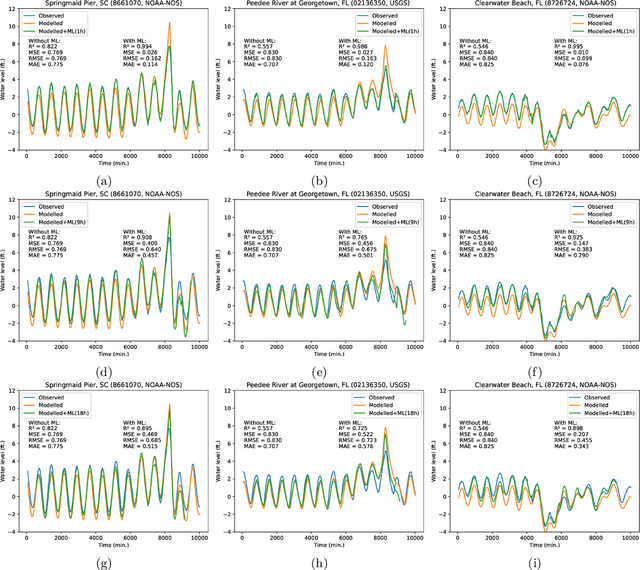

Physics simulation results of natural processes usually do not fully capture the real world. This is caused for instance by limits in what physical processes are simulated and to what accuracy. In this work we propose and analyze the use of an LSTM-based deep learning network machine learning (ML) architecture for capturing and predicting the behavior of the systemic error for storm surge forecast models with respect to real-world water height observations from gauge stations during hurricane events. The overall goal of this work is to predict the systemic error of the physics model and use it to improve the accuracy of the simulation results post factum. We trained our proposed ML model on a dataset of 61 historical storms in the coastal regions of the U.S. and we tested its performance in bias correcting modeled water level data predictions from hurricane Ian (2022). We show that our model can consistently improve the forecasting accuracy for hurricane Ian -- unknown to the ML model -- at all gauge station coordinates used for the initial data. Moreover, by examining the impact of using different subsets of the initial training dataset, containing a number of relatively similar or different hurricanes in terms of hurricane track, we found that we can obtain similar quality of bias correction by only using a subset of six hurricanes. This is an important result that implies the possibility to apply a pre-trained ML model to real-time hurricane forecasting results with the goal of bias correcting and improving the produced simulation accuracy. The presented work is an important first step in creating a bias correction system for real-time storm surge forecasting applicable to the full simulation area. It also presents a highly transferable and operationally applicable methodology for improving the accuracy in a wide range of physics simulation scenarios beyond storm surge forecasting.