 Add to Chrome
 Add to Firefox
 Add to Edge
Dual-Solver: A Generalized ODE Solver for Diffusion Models with Dual Prediction
Mar 04, 2026
Diffusion models achieve state-of-the-art image quality. However, sampling is costly at inference time because it requires a large number of function evaluations (NFEs). To reduce NFEs, classical ODE numerical methods have been adopted. Yet, the choice of prediction type and integration domain leads to different sampling behaviors. To address these issues, we introduce Dual-Solver, which generalizes multistep samplers through learnable parameters that continuously (i) interpolate among prediction types, (ii) select the integration domain, and (iii) adjust the residual terms. It retains the standard predictor-corrector structure while preserving second-order local accuracy. These parameters are learned via a classification-based objective using a frozen pretrained classifier (e.g., MobileNet or CLIP). For ImageNet class-conditional generation (DiT, GM-DiT) and text-to-image generation (SANA, PixArt-$α$), Dual-Solver improves FID and CLIP scores in the low-NFE regime ($3 \le$ NFE $\le 9$) across backbones.
* Published as a conference paper at ICLR 2026. 36 pages, 18 figures

HCLAS-X: Hierarchical and Cascaded Lyrics Alignment System Using Multimodal Cross-Correlation
Jul 10, 2023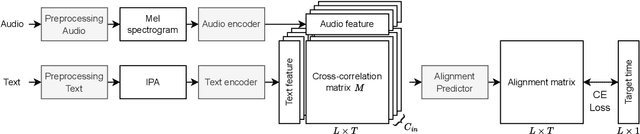


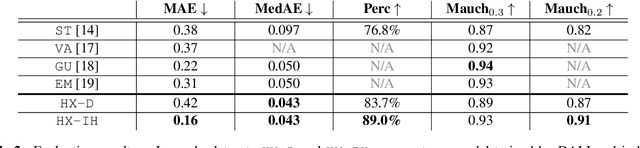
In this work, we address the challenge of lyrics alignment, which involves aligning the lyrics and vocal components of songs. This problem requires the alignment of two distinct modalities, namely text and audio. To overcome this challenge, we propose a model that is trained in a supervised manner, utilizing the cross-correlation matrix of latent representations between vocals and lyrics. Our system is designed in a hierarchical and cascaded manner. It predicts synced time first on a sentence-level and subsequently on a word-level. This design enables the system to process long sequences, as the cross-correlation uses quadratic memory with respect to sequence length. In our experiments, we demonstrate that our proposed system achieves a significant improvement in mean average error, showcasing its robustness in comparison to the previous state-of-the-art model. Additionally, we conduct a qualitative analysis of the system after successfully deploying it in several music streaming services.