 Add to Chrome
 Add to Firefox
 Add to Edge
PaperFlow: Profiling, Recommending, and Adapting Across Daily Paper Streams
Jun 05, 2026
Scientific paper recommendation is typically evaluated as static ranking over a fixed candidate set, yet real scientific reading unfolds as a daily, longitudinal process in which interests shift and feedback accumulates. We introduce PaperFlow, a framework that organizes it into three coupled stages: Profiling, which constructs and maintains a structured, inspectable scholarly profile from heterogeneous cold-start evidence; Recommending, which ranks each date-specific paper stream through multi-signal aggregation under a fixed display budget; and Adapting, which updates user state from semantically distinct feedback signals and models interest drift across days. We further define a longitudinal user-day benchmark that fixes users, dates, candidate pools, visible inputs, and hidden simulated relevance labels under a shared temporal information boundary. The benchmark contains 24 simulated research users, 50 daily paper streams, 1,200 user-day episodes, 20,727 unique papers, and 497,448 episode-paper records. We additionally specify a blind human-evaluation protocol to validate alignment between automatic metrics and expert judgments. Experiments against five scientific recommendation baselines show that PaperFlow achieves the strongest oracle-based ranking, the highest behavioral alignment with simulated reading selections, and the best blind human-evaluation score.

Probing Coronal Activity Using Radio Signals Based on the 2021 superior conjunction of Mars: the Downlink Data from Tianwen-1
Apr 15, 2026During the first superior conjunction of the Tianwen-1 Mars probe in October 2021, its downlink signal received by the Wuqing 70-m radio telescope passed within 4.53 solar radii of the Sun. The signal was significantly perturbed by the solar wind, providing a mechanism to probe coronal activity. We analyze the Doppler frequency scintillation spectrum of the solar wind within 10 solar radii to derive a characteristic frequency scintillation parameter. Statistical analysis indicates this parameter increases as the signal path approaches the Sun, with notable anomalies observed on October 5, 13, and 15. Comparisons with SOHO and SDO data reveal strong spatio-temporal correlations between these scintillation anomalies and coronal activity. We demonstrate that this parameter effectively identifies solar phenomena, including coronal streamers, high-speed solar wind, and coronal mass ejections (CMEs). Quantitative analysis confirms a distinct temporal correlation and delay between frequency scintillation and solar wind speed changes, validating the feasibility of spatially localizing solar activity.
A concise method for feature selection via normalized frequencies
Jun 10, 2021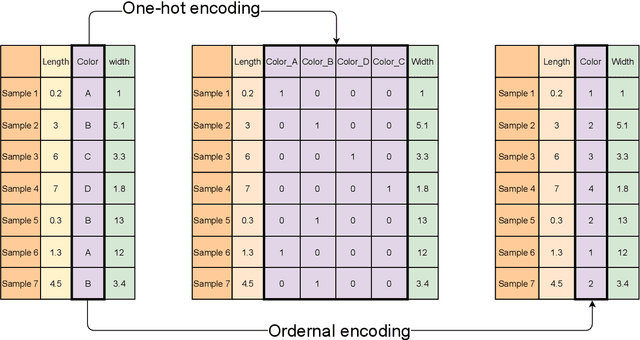

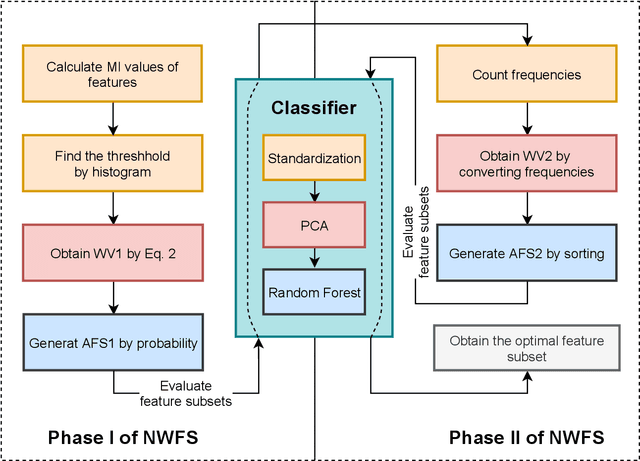

Feature selection is an important part of building a machine learning model. By eliminating redundant or misleading features from data, the machine learning model can achieve better performance while reducing the demand on com-puting resources. Metaheuristic algorithms are mostly used to implement feature selection such as swarm intelligence algorithms and evolutionary algorithms. However, they suffer from the disadvantage of relative complexity and slowness. In this paper, a concise method is proposed for universal feature selection. The proposed method uses a fusion of the filter method and the wrapper method, rather than a combination of them. In the method, one-hoting encoding is used to preprocess the dataset, and random forest is utilized as the classifier. The proposed method uses normalized frequencies to assign a value to each feature, which will be used to find the optimal feature subset. Furthermore, we propose a novel approach to exploit the outputs of mutual information, which allows for a better starting point for the experiments. Two real-world dataset in the field of intrusion detection were used to evaluate the proposed method. The evaluation results show that the proposed method outperformed several state-of-the-art related works in terms of accuracy, precision, recall, F-score and AUC.