 Add to Chrome
 Add to Firefox
 Add to Edge
INDOTABVQA: A Benchmark for Cross-Lingual Table Understanding in Bahasa Indonesia Documents
Apr 13, 2026
We introduce INDOTABVQA, a benchmark for evaluating cross-lingual Table Visual Question Answering (VQA) on real-world document images in Bahasa Indonesia. The dataset comprises 1,593 document images across three visual styles (bordered, borderless, and colorful) with one or more than one tables, and 1,593 question-answer sets in four languages: Bahasa Indonesia, English, Hindi, and Arabic. This enables evaluation of Vision-Language Models (VLMs) in both monolingual (Bahasa documents with Bahasa questions) and cross-lingual settings (Bahasa documents with questions in other languages). We benchmark leading open-source VLMs (Qwen2.5-VL, Gemma-3, LLaMA-3.2) and GPT-4o and reveal substantial performance gaps, particularly on structurally complex tables and in low-resource languages. Fine-tuning a compact 3B and LoRA-finetuned 7B model on our dataset yields 11.6% and 17.8% improvements in accuracy. Providing explicit table region coordinates as additional input further improves performance by 4-7%, demonstrating the value of Spatial priors for table-based reasoning. Our findings underscore the importance of language-diverse, domain-specific datasets and demonstrate that targeted fine-tuning can significantly enhance VLM performance on specialized document understanding tasks. INDOTABVQA provides a valuable resource for advancing research in cross-lingual, structure-aware document understanding, especially in underrepresented regions of the world. Full dataset can be accessed in huggingface at: https://huggingface.co/datasets/NusaBharat/INDOTABVQA}

Mind the (Language) Gap: Towards Probing Numerical and Cross-Lingual Limits of LVLMs
Aug 24, 2025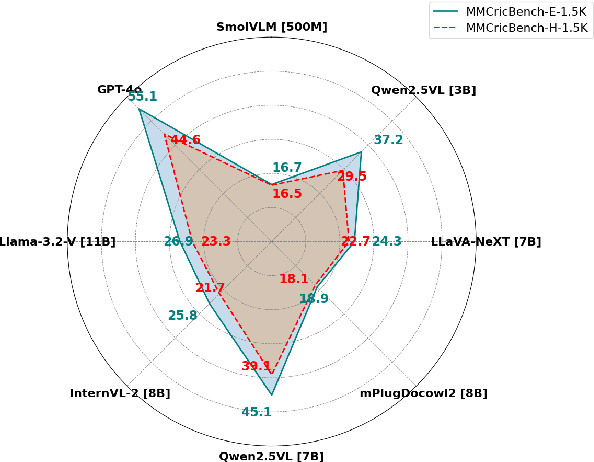
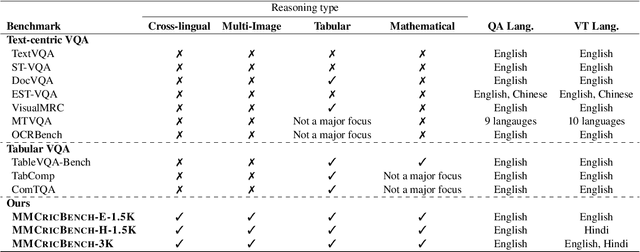
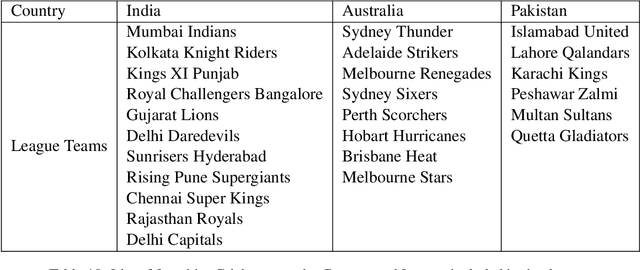
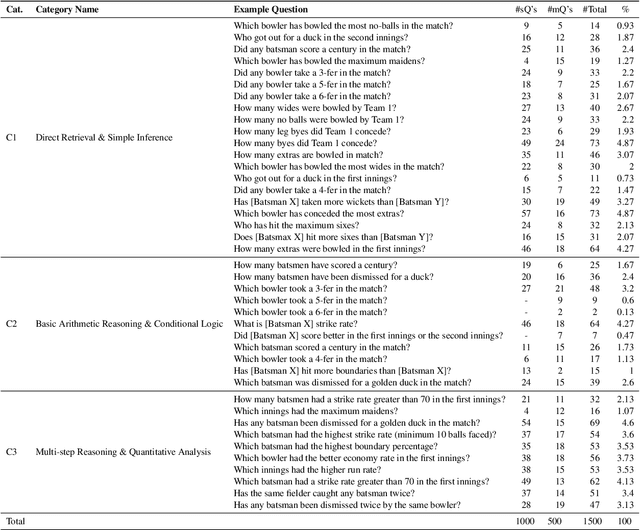
We introduce MMCRICBENCH-3K, a benchmark for Visual Question Answering (VQA) on cricket scorecards, designed to evaluate large vision-language models (LVLMs) on complex numerical and cross-lingual reasoning over semi-structured tabular images. MMCRICBENCH-3K comprises 1,463 synthetically generated scorecard images from ODI, T20, and Test formats, accompanied by 1,500 English QA pairs. It includes two subsets: MMCRICBENCH-E-1.5K, featuring English scorecards, and MMCRICBENCH-H-1.5K, containing visually similar Hindi scorecards, with all questions and answers kept in English to enable controlled cross-script evaluation. The task demands reasoning over structured numerical data, multi-image context, and implicit domain knowledge. Empirical results show that even state-of-the-art LVLMs, such as GPT-4o and Qwen2.5VL, struggle on the English subset despite it being their primary training language and exhibit a further drop in performance on the Hindi subset. This reveals key limitations in structure-aware visual text understanding, numerical reasoning, and cross-lingual generalization. The dataset is publicly available via Hugging Face at https://huggingface.co/datasets/DIALab/MMCricBench, to promote LVLM research in this direction.