 Add to Chrome
 Add to Firefox
 Add to Edge
LoCA: Spatially-Aware Low-Rank Convolutional Adaptation of Vision Foundation Models
Jul 08, 2026
Pre-trained Vision Foundation Models (VFMs) provide strong visual representations for diverse downstream tasks. The key challenge of VFM adaptation stems from the prohibitive costs of full fine-tuning and catastrophic forgetting. To address this, Low-Rank Adaptation (LoRA) has emerged as the prevailing paradigm for Parameter-Efficient Fine-Tuning (PEFT). However, LoRA is typically designed for transformer self-attention layers parameterized by 2D matrices. Since convolutional kernels inherently couple spatial and channel information within a 4D tensor, forcing them into a monolithic 2D matrix disrupts the inherent spatial topology. In this paper, we propose Low-Rank Convolutional Adaptation (LoCA), a convolution-aware PEFT framework that addresses spatial-channel entanglement by decoupling channel and spatial adaptation. LoCA introduces a low-rank channel adaptation for dense cross-channel mixing and refines spatial bases extracted from pre-trained kernels via Singular Value Decomposition (SVD). Experimental results show that LoCA preserves pre-trained spatial priors and achieves competitive or state-of-the-art performance across fine-grained classification, domain-generalized semantic segmentation, and generative benchmarks.

KSAFE-MM: A Multimodal Safety Benchmark via Localized Contextualization for Korean Cultural Risks
May 27, 2026Multimodal Large Language Models (MLLMs) exacerbate safety risks by introducing vulnerabilities across multiple modalities, such as language and vision. Current MLLM safety evaluation tools, however, suffer from major limitations: 1) English-centric dataset construction, and 2) a focus on generic risks that are not tied to local cultural contexts. This paper introduces KSAFE-MM, a benchmark for Korean multimodal safety evaluation that covers both general safety risks and culture-specific vulnerabilities. KSAFE-MM consists of two parts, KSAFE-MM-G and KSAFE-MM-C. KSAFE-MM-G evaluates globally shared risks in Korean contexts through linguistic contextualization, which transforms generic safety queries into contextually grounded multimodal samples. KSAFE-MM-C targets culture-dependent MLLM safety vulnerabilities using localized visual queries derived from real-world contexts. It pairs these visual queries with jailbreak-style textual queries to cover multimodal safety risks involving cultural visual cues and malicious textual intent. Together, these components provide a general-to-local construction pipeline for evaluating both globally shared safety risks and culture-specific vulnerabilities. We evaluate 12 state-of-the-art MLLMs on KSAFE-MM and reveal that models exhibit greater vulnerability to culturally grounded attacks than to generic ones. Notably, jailbreaking strategies substantially amplify attack success rates, with ProgramExecution yielding up to 74.2% ASR compared to 13.4% for standard queries. Furthermore, we identify a systematic trade-off between safety and over-refusal, where models achieving low ASR tend to exhibit excessive refusal behavior on benign queries. These findings highlight the urgent need for culturally grounded safety evaluation beyond English-centric benchmarks.
Self-Supervised Learning with Probabilistic Density Labeling for Rainfall Probability Estimation
Dec 08, 2024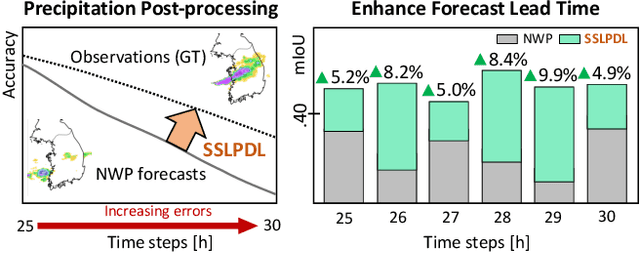
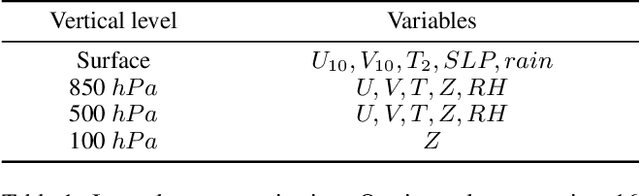
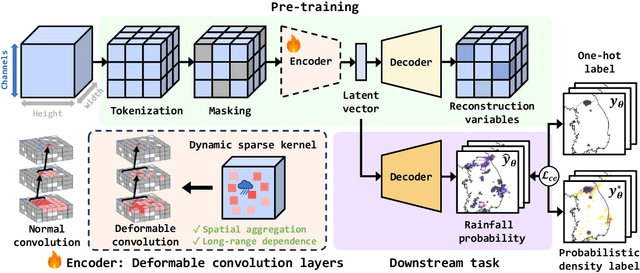
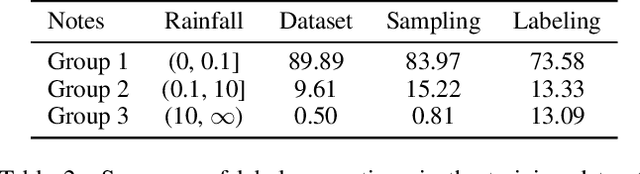
Numerical weather prediction (NWP) models are fundamental in meteorology for simulating and forecasting the behavior of various atmospheric variables. The accuracy of precipitation forecasts and the acquisition of sufficient lead time are crucial for preventing hazardous weather events. However, the performance of NWP models is limited by the nonlinear and unpredictable patterns of extreme weather phenomena driven by temporal dynamics. In this regard, we propose a \textbf{S}elf-\textbf{S}upervised \textbf{L}earning with \textbf{P}robabilistic \textbf{D}ensity \textbf{L}abeling (SSLPDL) for estimating rainfall probability by post-processing NWP forecasts. Our post-processing method uses self-supervised learning (SSL) with masked modeling for reconstructing atmospheric physics variables, enabling the model to learn the dependency between variables. The pre-trained encoder is then utilized in transfer learning to a precipitation segmentation task. Furthermore, we introduce a straightforward labeling approach based on probability density to address the class imbalance in extreme weather phenomena like heavy rain events. Experimental results show that SSLPDL surpasses other precipitation forecasting models in regional precipitation post-processing and demonstrates competitive performance in extending forecast lead times. Our code is available at https://github.com/joonha425/SSLPDL
Self-supervised Pre-training for Precipitation Post-processor
Oct 31, 2023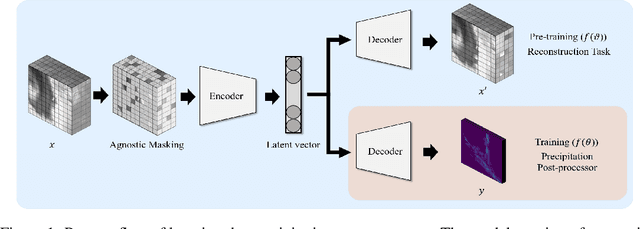
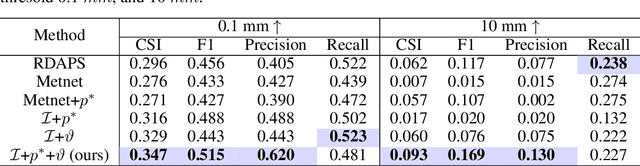
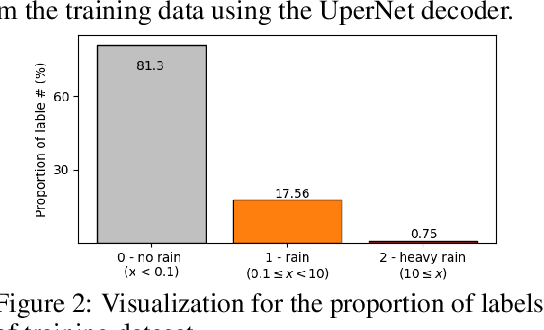
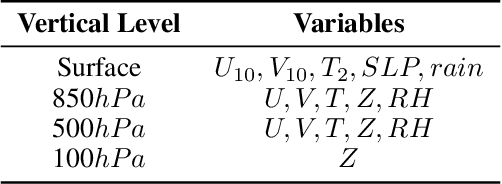
Securing sufficient forecast lead time for local precipitation is essential for preventing hazardous weather events. Nonetheless, global warming-induced climate change is adding to the challenge of accurately predicting severe precipitation events, such as heavy rainfall. In this work, we propose a deep learning-based precipitation post-processor approach to numerical weather prediction (NWP) models. The precipitation post-processor consists of (i) self-supervised pre-training, where parameters of encoder are pre-trained on the reconstruction of masked variables of the atmospheric physics domain, and (ii) transfer learning on precipitation segmentation tasks (target domain) from the pre-trained encoder. We also introduce a heuristic labeling approach for effectively training class-imbalanced datasets. Our experiment results in precipitation correction for regional NWP show that the proposed method outperforms other approaches.