 Add to Chrome
 Add to Firefox
 Add to Edge
EngiAI: A Multi-Agent Framework and Benchmark Suite for LLM-Driven Engineering Design
May 19, 2026
Large Language Model (LLM) agents are increasingly applied to engineering design tasks, yet existing evaluation frameworks do not adequately address multi-agent systems that combine simulation, retrieval, and manufacturing preparation. We introduce a benchmark suite with three evaluation dimensions: (1) a workflow benchmark with seven prompt styles targeting distinct cognitive demands-including direct tool use, semantic disambiguation, conditional branching, and working-memory tasks; (2) a Retrieval-Augmented Generation (RAG) benchmark with gated scoring isolating retrieval contributions to parameter selection; and (3) an High Performance Computing (HPC) benchmark evaluating end-to-end ML training orchestration on a SLURM cluster. Alongside the benchmark we present EngiAI, a Multi-Agent System (MAS) reference implementation built on LangGraph that operationalizes the benchmark by coordinating seven specialized agents through a supervisor architecture, unifying topology optimization, document retrieval, HPC job orchestration, and 3D printer control. Across four LLM backends and two EngiBench problems, proprietary models achieve 96-97% average task completion on Beams2D, while open-source 4B-parameter models reach 55-78%, with clear generational improvement. Conditional branching proves most challenging, with task completion dropping to 20-53% for the conditional style on Photonics2D. RAG gating confirms near-perfect retrieval-augmented scores ($\approx 1.0$) versus near-zero without retrieval, validating the evaluation design. On HPC orchestration, one model completes all pipeline steps in 100% of runs while another drops to 50%, revealing that multi-step instruction following degrades over long-running workflows.

Beyond Inference-Time Search: Reinforcement Learning Synthesizes Reusable Solvers
May 18, 2026Large language models (LLMs) typically approach combinatorial optimization as an inference-time procedure, solving each instance separately through sampling, search, or repeated prompting. We ask whether reinforcement learning can instead shift part of this reasoning cost into the weights of a code LLM, so that the model synthesizes a reusable solver for an entire problem family. We study this question on Synergistic Dependency Selection (SDS), a controlled variant of constrained Quadratic Knapsack designed to expose a specific failure mode: local signals and strict feasibility constraints make greedy heuristics attractive but unreliable. Under identical scaffolding, Best-of-64 base-model sampling saturates at an approximately 28.7% gap to the global Virtual Best Solver (VBS); code audits show that the base model often retrieves Simulated Annealing templates but misimplements the Metropolis acceptance rule. We fine-tune Qwen2.5-Coder-14B-Instruct with Group Relative Policy Optimization (GRPO) using a feasibility-gated reward and light structural scaffolding. The resulting policy converges to a constraint-aware Simulated Annealing template in 99.8% of feasible SDS outputs, achieves a 5.0% gap to that VBS, and is 91 times cheaper in post-generation execution/search cost than cumulative Best-of-64 evaluation. A compile-once check shows that one best frozen solver per seed remains highly competitive when reused unchanged across the SDS test set, while an additional-domain evaluation on Job Shop Scheduling provides narrower but positive evidence that the scaffold transfers beyond SDS. Negative ablations reveal the limits of this recipe: standard stabilizers degrade performance, a soft feasibility gate fails, and results remain sensitive to reward normalization and domain-specific design choices.
GLUE: Generative Latent Unification of Expertise-Informed Engineering Models
Dec 22, 2025Engineering complex systems (aircraft, buildings, vehicles) requires accounting for geometric and performance couplings across subsystems. As generative models proliferate for specialized domains (wings, structures, engines), a key research gap is how to coordinate frozen, pre-trained submodels to generate full-system designs that are feasible, diverse, and high-performing. We introduce Generative Latent Unification of Expertise-Informed Engineering Models (GLUE), which orchestrates pre-trained, frozen subsystem generators while enforcing system-level feasibility, optimality, and diversity. We propose and benchmark (i) data-driven GLUE models trained on pre-generated system-level designs and (ii) a data-free GLUE model trained online on a differentiable geometry layer. On a UAV design problem with five coupling constraints, we find that data-driven approaches yield diverse, high-performing designs but require large datasets to satisfy constraints reliably. The data-free approach is competitive with Bayesian optimization and gradient-based optimization in performance and feasibility while training a full generative model in only 10 min on a RTX 4090 GPU, requiring more than two orders of magnitude fewer geometry evaluations and FLOPs than the data-driven method. Ablations focused on data-free training show that subsystem output continuity affects coordination, and equality constraints can trigger mode collapse unless mitigated. By integrating unmodified, domain-informed submodels into a modular generative workflow, this work provides a viable path for scaling generative design to complex, real-world engineering systems.
ARRID: ANN-based Rotordynamics for Robust and Integrated Design
Aug 25, 2022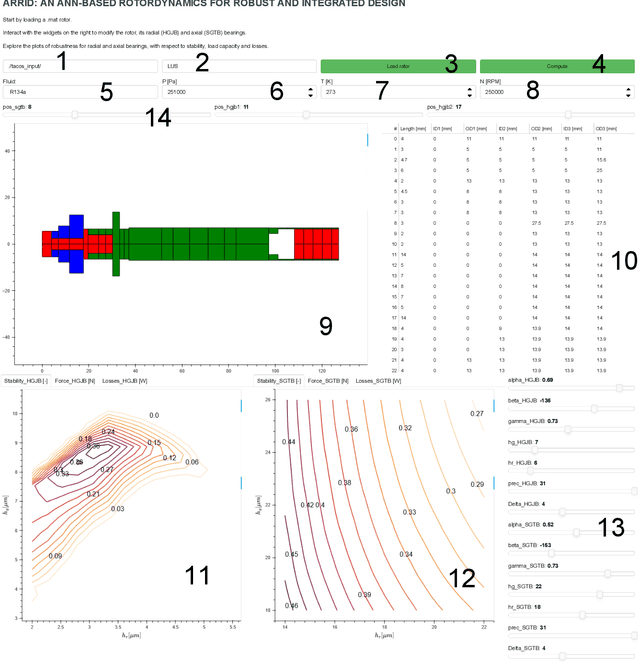
The purpose of this study is to introduce ANN-based software for the fast evaluation of rotordynamics in the context of robust and integrated design. It is based on a surrogate model made of ensembles of artificial neural networks running in a Bokeh web application. The use of a surrogate model has sped up the computation by three orders of magnitude compared to the current models. ARRID offers fast performance information, including the effect of manufacturing deviations. As such, it helps the designer to make optimal design choices early in the design process. The designer can manipulate the parameters of the design and the operating conditions to obtain performance information in a matter of seconds.