 Add to Chrome
 Add to Firefox
 Add to Edge
From Collapse to Improvement: Statistical Perspectives on the Evolutionary Dynamics of Iterative Training on Contaminated Sources
Feb 11, 2026
The problem of model collapse has presented new challenges in iterative training of generative models, where such training with synthetic data leads to an overall degradation of performance. This paper looks at the problem from a statistical viewpoint, illustrating that one can actually hope for improvement when models are trained on data contaminated with synthetic samples, as long as there is some amount of fresh information from the true target distribution. In particular, we consider iterative training on samples sourced from a mixture of the true target and synthetic distributions. We analyze the entire iterative evolution in a next-token prediction language model, capturing how the interplay between the mixture weights and the sample size controls the overall long-term performance. With non-trivial mixture weight of the true distribution, even if it decays over time, simply training the model in a contamination-agnostic manner with appropriate sample sizes can avoid collapse and even recover the true target distribution under certain conditions. Simulation studies support our findings and also show that such behavior is more general for other classes of models.

Selective Inference for Time-Varying Effect Moderation
Nov 24, 2024Causal effect moderation investigates how the effect of interventions (or treatments) on outcome variables changes based on observed characteristics of individuals, known as potential effect moderators. With advances in data collection, datasets containing many observed features as potential moderators have become increasingly common. High-dimensional analyses often lack interpretability, with important moderators masked by noise, while low-dimensional, marginal analyses yield many false positives due to strong correlations with true moderators. In this paper, we propose a two-step method for selective inference on time-varying causal effect moderation that addresses the limitations of both high-dimensional and marginal analyses. Our method first selects a relatively smaller, more interpretable model to estimate a linear causal effect moderation using a Gaussian randomization approach. We then condition on the selection event to construct a pivot, enabling uniformly asymptotic semi-parametric inference in the selected model. Through simulations and real data analyses, we show that our method consistently achieves valid coverage rates, even when existing conditional methods and common sample splitting techniques fail. Moreover, our method yields shorter, bounded intervals, unlike existing methods that may produce infinitely long intervals.
Bayes classifier cannot be learned from noisy responses with unknown noise rates
Apr 13, 2023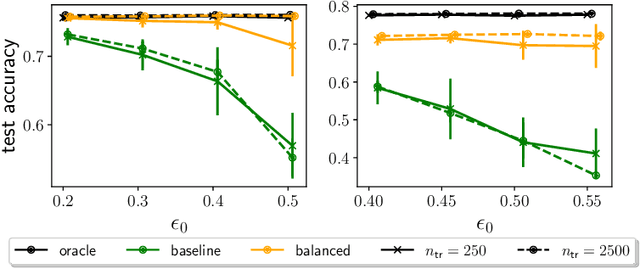
Training a classifier with noisy labels typically requires the learner to specify the distribution of label noise, which is often unknown in practice. Although there have been some recent attempts to relax that requirement, we show that the Bayes decision rule is unidentified in most classification problems with noisy labels. This suggests it is generally not possible to bypass/relax the requirement. In the special cases in which the Bayes decision rule is identified, we develop a simple algorithm to learn the Bayes decision rule, that does not require knowledge of the noise distribution.