 Add to Chrome
 Add to Firefox
 Add to Edge
Towards a Phonology-Informed Evaluation of Multilingual TTS
Jul 02, 2026
Neural TTS systems can sound natural across languages, but naturalness does not guarantee the preservation of sound contrasts that distinguish words from their grammatical forms. Standard metrics like MOS do not test for this. We propose a classifier-based framework that audits TTS output against language-specific phonological patterns using human speech as a benchmark. Testing Assamese advanced tongue root (ATR) vowel harmony with Meta's MMS TTS, we show that a classifier trained on human speech transfers to synthesized speech with minimal loss. The faithfulness audit reveals that [+ATR] mid vowels are realized as [-ATR] in 1/3 tokens despite an underlying [+ATR] specification, a bias absent in human speech. At the word level, predicted ATR labels classify harmony more accurately than transcription labels, indicating a gap between intended and produced phonology. The framework offers task-specific diagnostics and generalizes to other phonological contrasts with measurable acoustic cues.

Deciphering Assamese Vowel Harmony with Featural InfoWaveGAN
Jul 09, 2024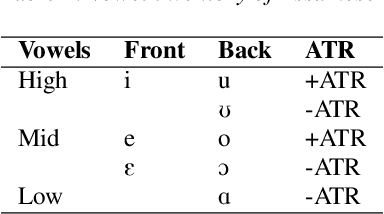
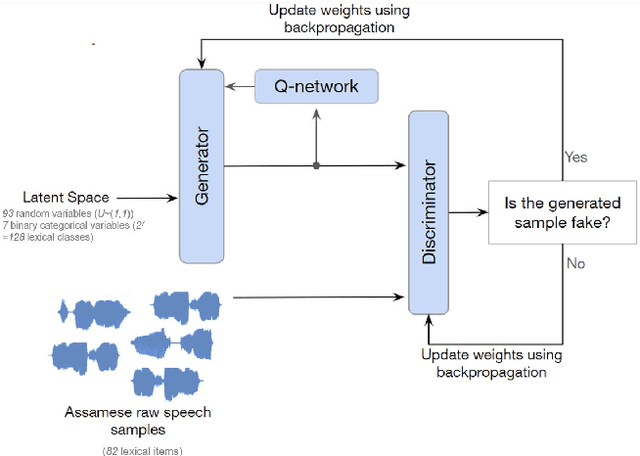
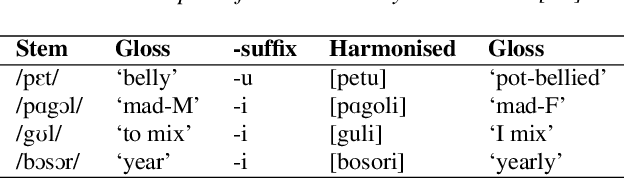
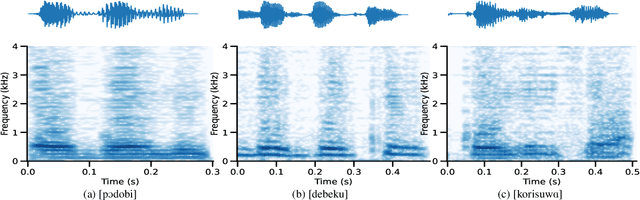
Traditional approaches for understanding phonological learning have predominantly relied on curated text data. Although insightful, such approaches limit the knowledge captured in textual representations of the spoken language. To overcome this limitation, we investigate the potential of the Featural InfoWaveGAN model to learn iterative long-distance vowel harmony using raw speech data. We focus on Assamese, a language known for its phonologically regressive and word-bound vowel harmony. We demonstrate that the model is adept at grasping the intricacies of Assamese phonotactics, particularly iterative long-distance harmony with regressive directionality. It also produced non-iterative illicit forms resembling speech errors during human language acquisition. Our statistical analysis reveals a preference for a specific [+high,+ATR] vowel as a trigger across novel items, indicative of feature learning. More data and control could improve model proficiency, contrasting the universality of learning.