 Add to Chrome
 Add to Firefox
 Add to Edge
Impact of Preprocessing on Neural Network-Based RSS/AoA Positioning
Feb 18, 2026
Hybrid received signal strength (RSS)-angle of arrival (AoA)-based positioning offers low-cost distance estimation and high-resolution angular measurements. Still, it comes at a cost of inherent nonlinearities, geometry-dependent noise, and suboptimal weighting in conventional linear estimators that might limit accuracy. In this paper, we propose a neural network-based approach using a multilayer perceptron (MLP) to directly map RSS-AoA measurements to 3D positions, capturing nonlinear relationships that are difficult to model with traditional methods. We evaluate the impact of input representation by comparing networks trained on raw measurements versus preprocessed features derived from a linearization method. Simulation results show that the learning-based approach consistently outperforms existing linear methods under RSS noise across all noise levels, and matches or surpasses state-of-the-art performance under increasing AoA noise. Furthermore, preprocessing measurements using the linearization method provides a clear advantage over raw data, demonstrating the benefit of geometry-aware feature extraction.

Reinforcing Localization Credibility Through Convex Optimization
Mar 31, 2025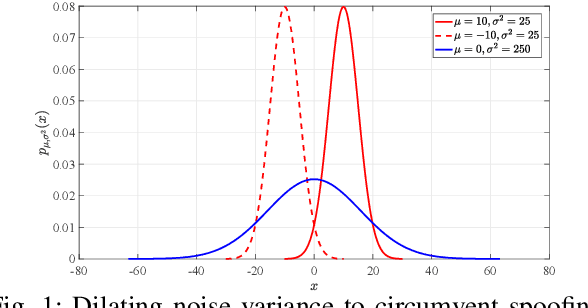
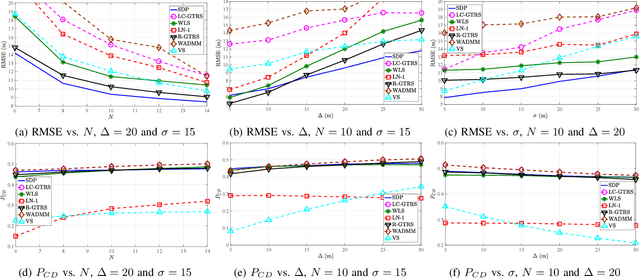
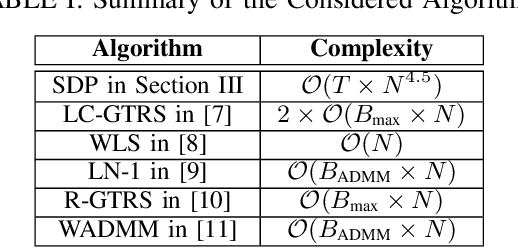
This work proposes a novel approach to reinforce localization security in wireless networks in the presence of malicious nodes that are able to manipulate (spoof) radio measurements. It substitutes the original measurement model by another one containing an auxiliary variance dilation parameter that disguises corrupted radio links into ones with large noise variances. This allows for relaxing the non-convex maximum likelihood estimator (MLE) into a semidefinite programming (SDP) problem by applying convex-concave programming (CCP) procedure. The proposed SDP solution simultaneously outputs target location and attacker detection estimates, eliminating the need for further application of sophisticated detectors. Numerical results corroborate excellent performance of the proposed method in terms of localization accuracy and show that its detection rates are highly competitive with the state of the art.
Voting Scheme to Strengthen Localization Security in Randomly Deployed Wireless Sensor Networks
Feb 27, 2025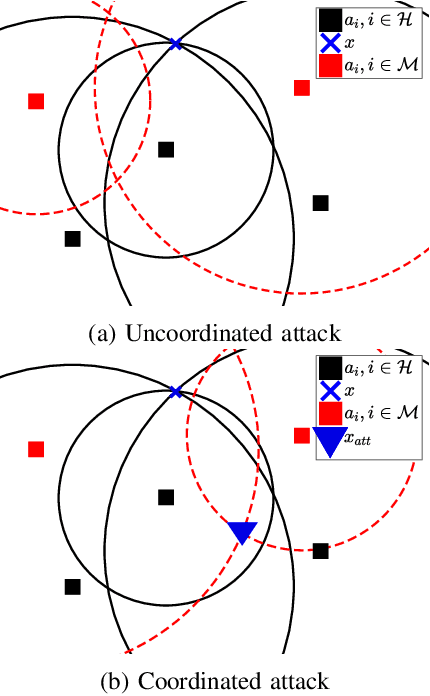
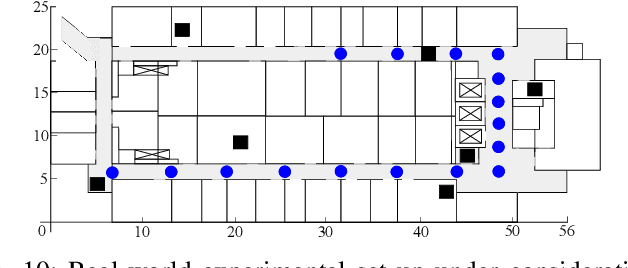
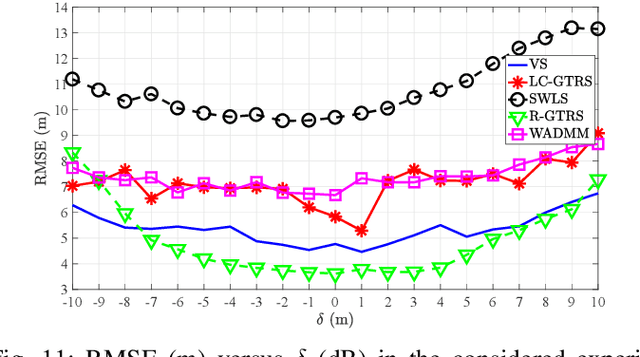
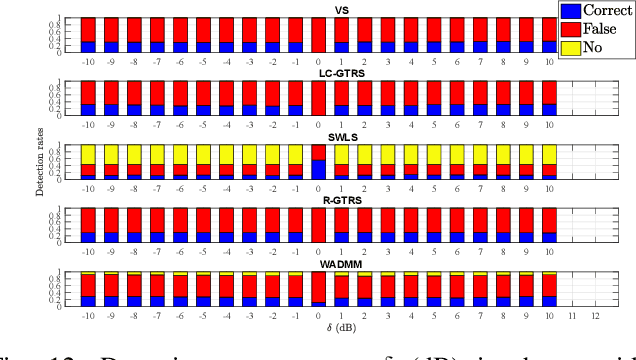
This work aspires to provide a trustworthy solution for target localization in adverse environments, where malicious nodes, capable of manipulating distance measurements (i.e., performing spoofing attacks), are present, thus hindering accurate localization. Besides localization, its other goal is to identify (detect) which of the nodes participating in the process are malicious. This problem becomes extremely important with the forthcoming expansion of IoT and smart cities applications, that depend on accurate localization, and the presence of malicious attackers can represent serious security threats if not taken into consideration. This is the case with most existing localization systems which makes them highly vulnerable to spoofing attacks. In addition, existing methods that are intended for adversarial settings consider very specific settings or require additional knowledge about the system model, making them only partially secure. Therefore, this work proposes a novel voting scheme based on clustering and weighted central mass to securely solve the localization problem and detect attackers. The proposed solution has two main phases: 1) Choosing a cluster of suitable points of interest by taking advantage of the problem geometry to assigning votes in order to localize the target, and 2) Attacker detection by exploiting the location estimate and basic statistics. The proposed method is assessed in terms of localization accuracy, success in attacker detection, and computational complexity in different settings. Computer simulations and real-world experiments corroborate the effectiveness of the proposed scheme compared to state-of-the-art methods, showing that it can accomplish an error reduction of $30~\%$ and is capable of achieving almost perfect attacker detection rate when the ratio between attacker intensity and noise standard deviation is significant.
A Closed-form Solution for Weight Optimization in Fully-connected Feed-forward Neural Networks
Jan 12, 2024This work addresses weight optimization problem for fully-connected feed-forward neural networks. Unlike existing approaches that are based on back-propagation (BP) and chain rule gradient-based optimization (which implies iterative execution, potentially burdensome and time-consuming in some cases), the proposed approach offers the solution for weight optimization in closed-form by means of least squares (LS) methodology. In the case where the input-to-output mapping is injective, the new approach optimizes the weights in a back-propagating fashion in a single iteration by jointly optimizing a set of weights in each layer for each neuron. In the case where the input-to-output mapping is not injective (e.g., in classification problems), the proposed solution is easily adapted to obtain its final solution in a few iterations. An important advantage over the existing solutions is that these computations (for all neurons in a layer) are independent from each other; thus, they can be carried out in parallel to optimize all weights in a given layer simultaneously. Furthermore, its running time is deterministic in the sense that one can obtain the exact number of computations necessary to optimize the weights in all network layers (per iteration, in the case of non-injective mapping). Our simulation and empirical results show that the proposed scheme, BPLS, works well and is competitive with existing ones in terms of accuracy, but significantly surpasses them in terms of running time. To summarize, the new method is straightforward to implement, is competitive and computationally more efficient than the existing ones, and is well-tailored for parallel implementation.