 Add to Chrome
 Add to Firefox
 Add to Edge
OmniEdit: A Training-free framework for Lip Synchronization and Audio-Visual Editing
Mar 10, 2026
Lip synchronization and audio-visual editing have emerged as fundamental challenges in multimodal learning, underpinning a wide range of applications, including film production, virtual avatars, and telepresence. Despite recent progress, most existing methods for lip synchronization and audio-visual editing depend on supervised fine-tuning of pre-trained models, leading to considerable computational overhead and data requirements. In this paper, we present OmniEdit, a training-free framework designed for both lip synchronization and audio-visual editing. Our approach reformulates the editing paradigm by substituting the edit sequence in FlowEdit with the target sequence, yielding an unbiased estimation of the desired output. Moreover, by removing stochastic elements from the generation process, we establish a smooth and stable editing trajectory. Extensive experimental results validate the effectiveness and robustness of the proposed framework. Code is available at https://github.com/l1346792580123/OmniEdit.

Breaking the Cycle of Recurring Failures: Applying Generative AI to Root Cause Analysis in Legacy Banking Systems
Nov 20, 2024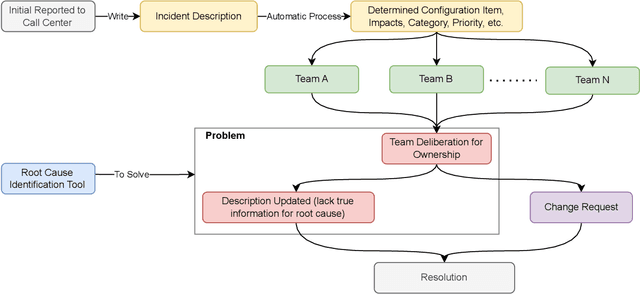

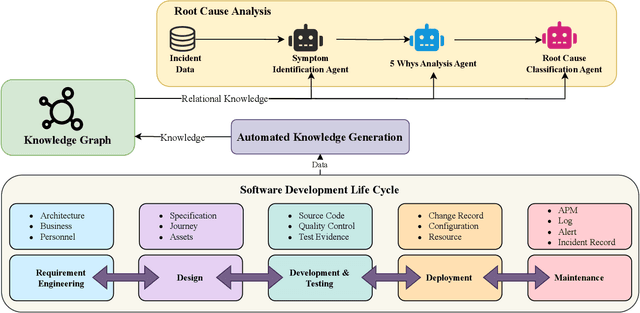
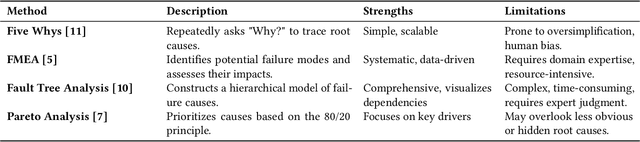
Traditional banks face significant challenges in digital transformation, primarily due to legacy system constraints and fragmented ownership. Recent incidents show that such fragmentation often results in superficial incident resolutions, leaving root causes unaddressed and causing recurring failures. We introduce a novel approach to post-incident analysis, integrating knowledge-based GenAI agents with the "Five Whys" technique to examine problem descriptions and change request data. This method uncovered that approximately 70% of the incidents previously attributed to management or vendor failures were due to underlying internal code issues. We present a case study to show the impact of our method. By scanning over 5,000 projects, we identified over 400 files with a similar root cause. Overall, we leverage the knowledge-based agents to automate and elevate root cause analysis, transforming it into a more proactive process. These agents can be applied across other phases of the software development lifecycle, further improving development processes.