 Add to Chrome
 Add to Firefox
 Add to Edge
Evaluating Modern Large Language Models on Low-Resource and Morphologically Rich Languages:A Cross-Lingual Benchmark Across Cantonese, Japanese, and Turkish
Nov 05, 2025
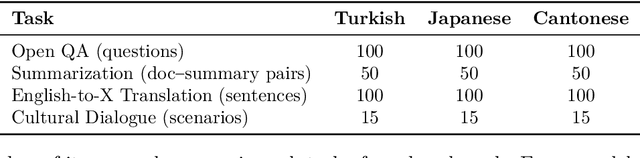
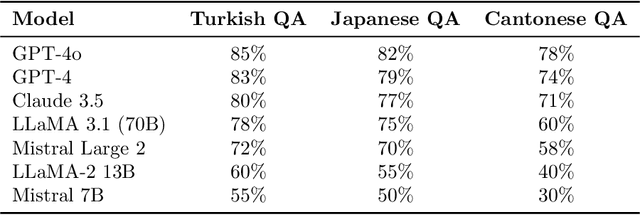
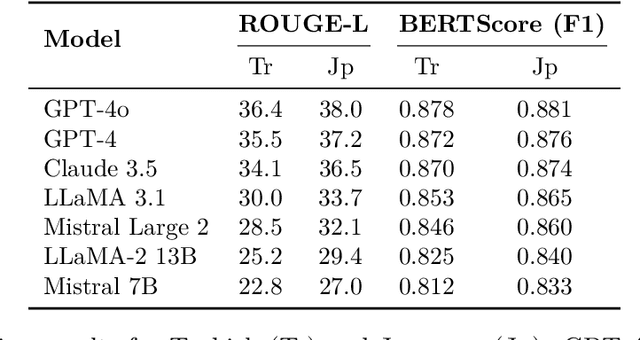
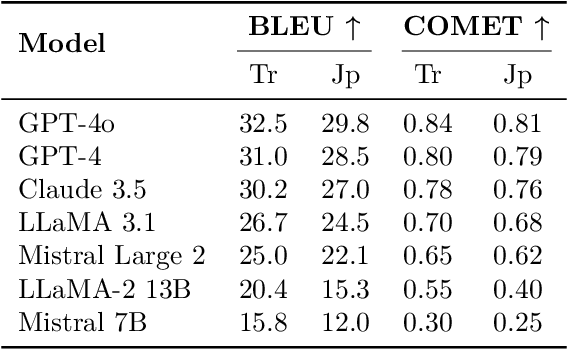
Large language models (LLMs) have achieved impressive results in high-resource languages like English, yet their effectiveness in low-resource and morphologically rich languages remains underexplored. In this paper, we present a comprehensive evaluation of seven cutting-edge LLMs -- including GPT-4o, GPT-4, Claude~3.5~Sonnet, LLaMA~3.1, Mistral~Large~2, LLaMA-2~Chat~13B, and Mistral~7B~Instruct -- on a new cross-lingual benchmark covering \textbf{Cantonese, Japanese, and Turkish}. Our benchmark spans four diverse tasks: open-domain question answering, document summarization, English-to-X translation, and culturally grounded dialogue. We combine \textbf{human evaluations} (rating fluency, factual accuracy, and cultural appropriateness) with automated metrics (e.g., BLEU, ROUGE) to assess model performance. Our results reveal that while the largest proprietary models (GPT-4o, GPT-4, Claude~3.5) generally lead across languages and tasks, significant gaps persist in culturally nuanced understanding and morphological generalization. Notably, GPT-4o demonstrates robust multilingual performance even on cross-lingual tasks, and Claude~3.5~Sonnet achieves competitive accuracy on knowledge and reasoning benchmarks. However, all models struggle to some extent with the unique linguistic challenges of each language, such as Turkish agglutinative morphology and Cantonese colloquialisms. Smaller open-source models (LLaMA-2~13B, Mistral~7B) lag substantially in fluency and accuracy, highlighting the resource disparity. We provide detailed quantitative results, qualitative error analysis, and discuss implications for developing more culturally aware and linguistically generalizable LLMs. Our benchmark and evaluation data are released to foster reproducibility and further research.

Parallelism Meets Adaptiveness: Scalable Documents Understanding in Multi-Agent LLM Systems
Jul 22, 2025Large language model (LLM) agents have shown increasing promise for collaborative task completion. However, existing multi-agent frameworks often rely on static workflows, fixed roles, and limited inter-agent communication, reducing their effectiveness in open-ended, high-complexity domains. This paper proposes a coordination framework that enables adaptiveness through three core mechanisms: dynamic task routing, bidirectional feedback, and parallel agent evaluation. The framework allows agents to reallocate tasks based on confidence and workload, exchange structured critiques to iteratively improve outputs, and crucially compete on high-ambiguity subtasks with evaluator-driven selection of the most suitable result. We instantiate these principles in a modular architecture and demonstrate substantial improvements in factual coverage, coherence, and efficiency over static and partially adaptive baselines. Our findings highlight the benefits of incorporating both adaptiveness and structured competition in multi-agent LLM systems.