 Add to Chrome
 Add to Firefox
 Add to Edge
Wall Shear Stress Reconstruction from Concentration: Differentiable Physics and Physics-Informed Neural Networks
Jun 04, 2026
Wall shear stress (WSS) governs near-wall transport dynamics and is a key hemodynamic indicator in cardiovascular flows, yet remains difficult to infer accurately due to the need for precise computation of near-wall velocity gradients. Passive scalar fields, such as concentration or temperature, are advected by the same underlying velocity field and have the potential to uncover hidden flow physics metrics such as WSS. In this work, we demonstrate such reconstruction from spatially limited passive scalar observations using two fundamentally different inverse frameworks: a differentiable physics framework based on discrete adjoint, PDE-constrained optimization, which enforces the governing equations as hard constraints, and physics-informed neural networks (PINNs), which treat them as soft constraints. Benchmark problems include a 2D canonical backward-facing step (2D-BFS) and a 3D patient-specific stenotic coronary artery. For the 2D-BFS case, evaluated under three measurement scenarios (near-wall, far-field, and combined), PINN achieves high accuracy when near-wall data are available but fails when restricted to far-field measurements, whereas the differentiable physics approach recovers accurate WSS across all scenarios. In the 3D patient-specific case, the differentiable physics framework outperforms PINNs, yielding accurate WSS reconstruction. These results establish that measurement location and inverse formulation jointly determine reconstruction fidelity in scalar-based near-wall flow inference. The proposed framework opens a path toward estimation of near-wall hemodynamics from scalar transport data, with broader applicability to fluid flow problems where passive scalars can be observed.

ADAM-SINDy: An Efficient Optimization Framework for Parameterized Nonlinear Dynamical System Identification
Oct 21, 2024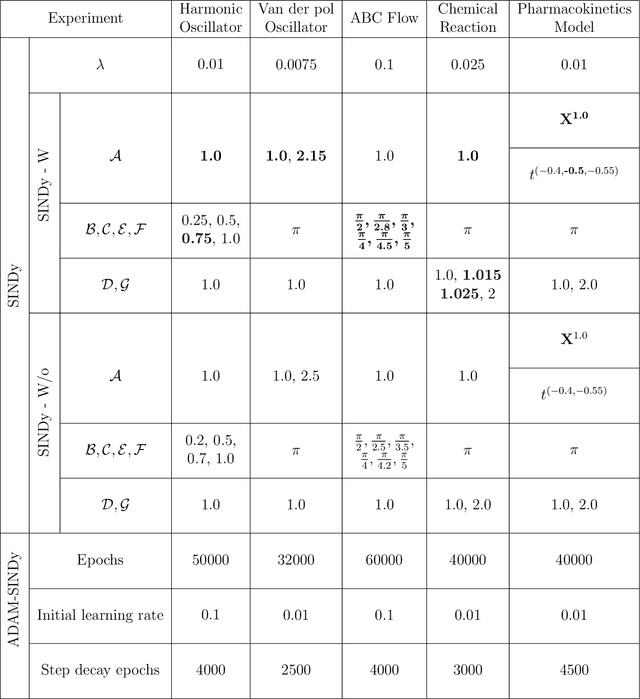
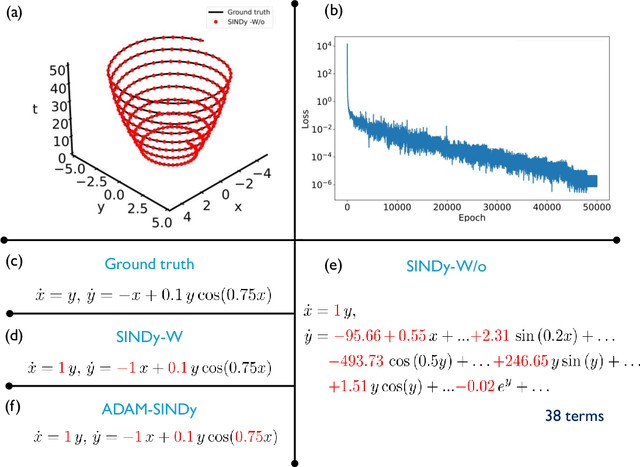
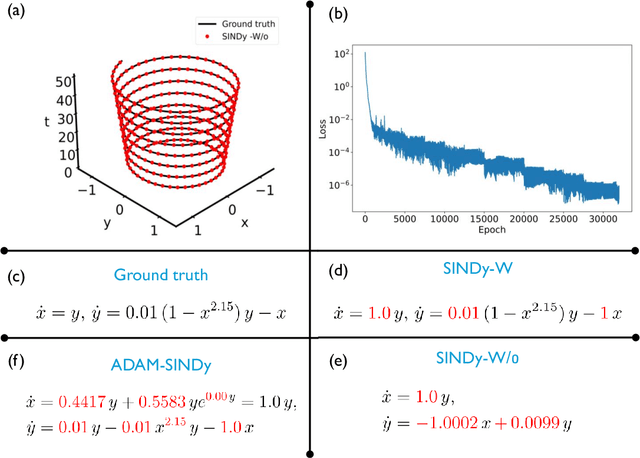
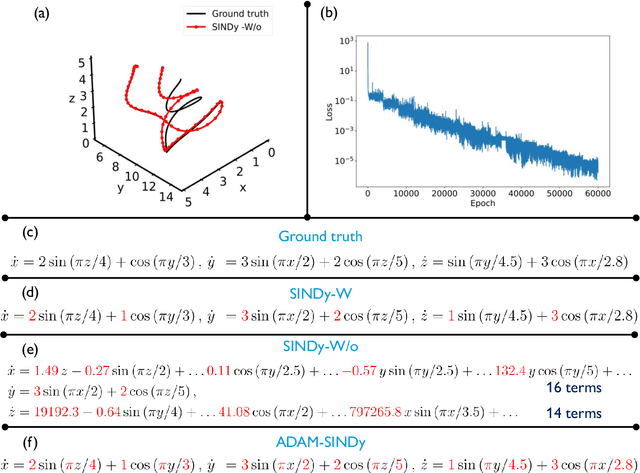
Identifying dynamical systems characterized by nonlinear parameters presents significant challenges in deriving mathematical models that enhance understanding of physics. Traditional methods, such as Sparse Identification of Nonlinear Dynamics (SINDy) and symbolic regression, can extract governing equations from observational data; however, they also come with distinct advantages and disadvantages. This paper introduces a novel method within the SINDy framework, termed ADAM-SINDy, which synthesizes the strengths of established approaches by employing the ADAM optimization algorithm. This facilitates the simultaneous optimization of nonlinear parameters and coefficients associated with nonlinear candidate functions, enabling precise parameter estimation without requiring prior knowledge of nonlinear characteristics such as trigonometric frequencies, exponential bandwidths, or polynomial exponents, thereby addressing a key limitation of SINDy. Through an integrated global optimization, ADAM-SINDy dynamically adjusts all unknown variables in response to data, resulting in an adaptive identification procedure that reduces the sensitivity to the library of candidate functions. The performance of the ADAM-SINDy methodology is demonstrated across a spectrum of dynamical systems, including benchmark coupled nonlinear ordinary differential equations such as oscillators, chaotic fluid flows, reaction kinetics, pharmacokinetics, as well as nonlinear partial differential equations (wildfire transport). The results demonstrate significant improvements in identifying parameterized dynamical systems and underscore the importance of concurrently optimizing all parameters, particularly those characterized by nonlinear parameters. These findings highlight the potential of ADAM-SINDy to extend the applicability of the SINDy framework in addressing more complex challenges in dynamical system identification.